Let's Be Honest: Your Children's Section Looks Like a Tornado Hit a Rainbow
You know the scene. A parent, armed with a Frappuccino and the weary resignation of someone who hasn't slept in three years, is frantically digging through a pile of tiny t-shirts. They need a 3T. They are surrounded by a sea of 2Ts and 4Ts, mocking them with their incorrectness. Their child, meanwhile, has decided that the neatly folded stack of sweaters is actually a mountain that must be conquered. Welcome to the children's section. It’s a special kind of retail purgatory.
Merchandising a children's clothing store is, to put it mildly, a unique challenge. You're not just organizing clothes; you're trying to create a calm, navigable oasis for some of the most stressed-out, time-crunched customers on the planet. Get it wrong, and you get frustrated parents, abandoned shopping carts, and a sales floor that requires a search party to navigate. Get it right, however, and you create a loyal customer base that will happily return every time their child has another growth spurt (so, every six weeks).
So, let's talk about how to turn that colorful chaos into a well-oiled, sales-generating machine. Forget what you think you know; we’re diving into the art and science of organizing tiny clothes for maximum sanity and profit.
Decoding the Parent Brain: Merchandising for Maximum Sanity (and Sales)
To effectively sell to parents, you first need to understand their frazzled, multitasking mindset. They aren't browsing; they are on a mission. Your store's layout should be their trusty sidekick, not the final boss battle.
Step 1: The Golden Rule - Group by Age, Then by Size
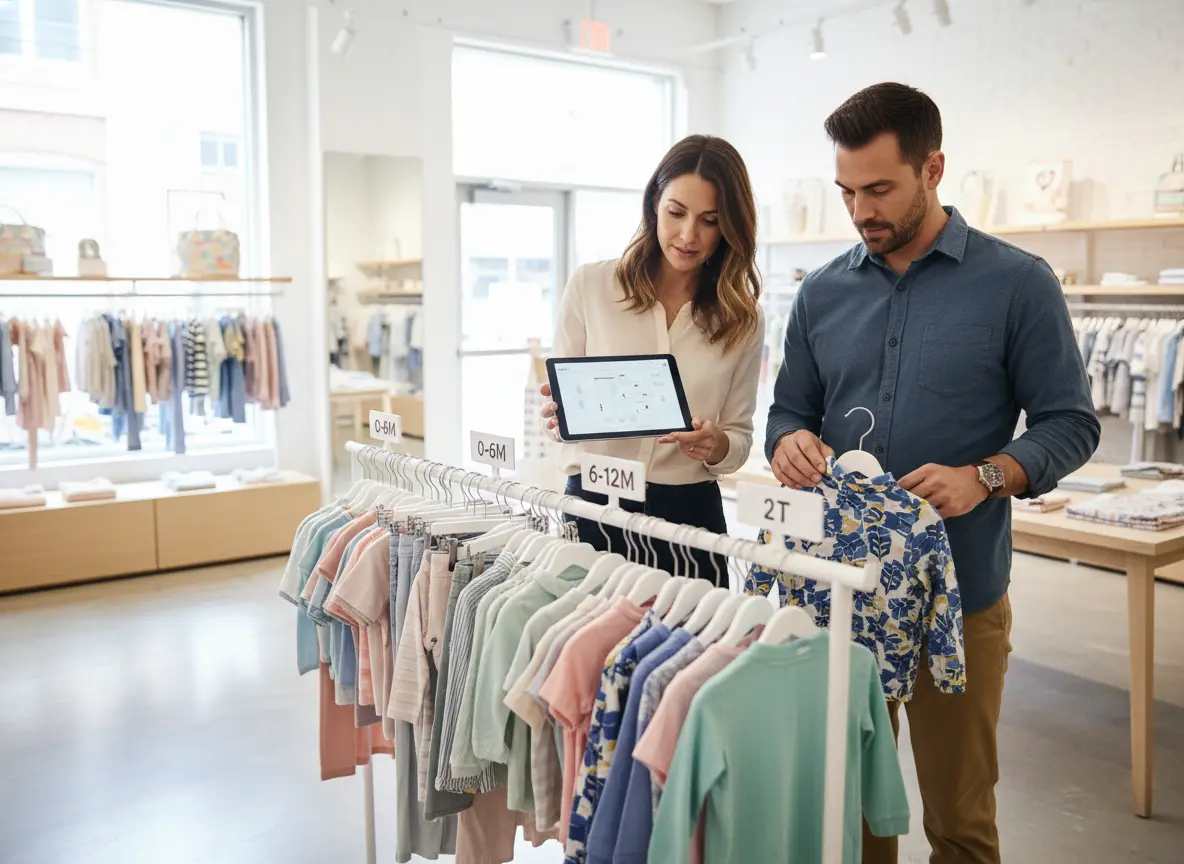
This is the absolute, non-negotiable foundation of children's merchandising. Parents shop for an age range first. The mom of a newborn has zero interest in your 5T section, and the dad of a first-grader will glaze over if he has to walk past racks of onesies. Create clearly defined "zones" in your store:
- Baby / Infant (0-24 Months): This is often a gift-heavy section. Make it beautiful, accessible, and easy to navigate for grandparents and friends.
- Toddler (2T-5T): The wild years. Parents here are looking for durability and ease. Think reinforced knees and clothes that can survive a spaghetti incident.
- Kids (Sizes 6+): This is where opinions start. Kids are now "helping" choose, so make this section feel a bit more "grown-up" and trend-focused.
Your signage for these zones should be visible from space. We're talking large, bold, and ridiculously clear. A tired parent should be able to spot the "Toddler" section from the front door. Within each of these age zones, you can then break it down by specific sizes. Use rack dividers, drawer labels, and table signs. Over-communicate. There is no such thing as too much signage when it comes to sizes.
Step 2: The "Shop by Outfit" vs. "Shop by Item" Conundrum
Should you group all the 4T shirts in one place, or should you create adorable, pre-styled outfits? The correct answer is, of course, yes. A hybrid approach is your best bet for catering to different shopping styles.
The "Shop by Item" approach (all pants here, all tops there) is for the parent on a mission. Their child just blew out the knees on all their jeans, and they need replacements. Fast. This layout is efficient and practical.
The "Shop by Outfit" approach is for the parent looking for inspiration. By displaying a cute top with matching leggings, a coordinating jacket, and maybe even a little hat, you're not just selling items—you're selling a look. This is how you increase your average transaction value. A parent came in for a shirt and left with an entire outfit because you made it easy and irresistible. Use mannequins, curated wall displays, and "inspiration tables" to show off these collections.
Step 3: Engineer a Path of Least Resistance
The flow of your store should be intuitive. A common and effective layout guides the customer along a path that mirrors a child's growth. Start with newborns and infants near the entrance, flow into the toddler section, and then move to the older kids' area. This creates a logical journey through the store.
And for the love of all that is profitable, use your checkout area strategically. This is prime real estate for impulse buys. Think socks, hair clips, fun shoelaces, and small, parent-approved toys. Just be warned: placing candy here is a rookie mistake unless you enjoy refereeing a public meltdown.
Putting Your Store on Autopilot
Even with the most brilliant merchandising strategy, you and your staff can't be everywhere at once. Shoppers will still have questions, and a perfectly placed promotion can still be missed. This is where you can leverage technology to be your eyes, ears, and voice on the floor.
Let a Robot Do the Talking
Imagine a customer walks in, looking overwhelmed. Before they can even begin their frantic search, they're greeted by a friendly presence. That's where an in-store assistant like Stella can be a game-changer. She's more than just a greeter; she's an active part of your merchandising strategy.
You can program Stella to highlight exactly what you want customers to see. For example, she can say, "Welcome in! If you're looking for toddler sizes, our entire 2T to 5T collection is organized for you on the left. And this week, all our graphic tees are buy one, get one 50% off!" She can direct traffic, answer common questions ("Where are the rain boots?"), and make sure no one misses the amazing deals you've set up. This frees up your human staff to handle more complex needs, like helping a parent find the perfect holiday outfit or managing the fitting rooms.
Beyond the Basics: Merchandising Like a Pro
Once you've nailed the fundamentals, you can start implementing some next-level tactics that separate the amateur retailers from the seasoned pros.
The Fine Art of the Cross-Sell
Cross-selling isn't just about putting a cute hat on a mannequin. It's about anticipating your customer's needs. Think thematically.
- Swimwear Section: Don't just display swimsuits. Surround them with sun hats, sunglasses, cover-ups, waterproof shoes, and even some fun beach toys. You're selling the entire "day at the beach" experience.
- Back-to-School: Create a dedicated "Back to School" zone in late summer. Feature first-day-of-school outfits alongside backpacks, lunchboxes, and fun school supplies. You're saving parents a trip to another store.
- Pajama Party: Group your pajamas with slippers, robes, and popular bedtime storybooks. It’s an easy upsell and a delightful shopping experience.
This "lifestyle" or "event-based" merchandising makes shopping easier and more inspiring for your customers.
Embrace—and Manage—the Inevitable Mess
Let's be realistic. Your store is going to get messy. Children touch everything. Parents, in a hurry, don't always refold things perfectly. Instead of fighting it, plan for it. Use fixtures that are forgiving. Bins and baskets are your best friends for small, loose items like socks, underwear, and accessories. A neatly folded stack of socks will be destroyed in five minutes; a well-labeled bin can be rummaged through and still look relatively contained.
Most importantly, build "recovery time" into your team's daily workflow. This isn't just a task for closing time. A quick 10-minute tidy-up of the toddler zone every two hours can make a world of difference. According to research from Envirosell, shoppers are subconsciously more hesitant to buy in a messy environment, associating clutter with lower quality. Keeping things neat isn't just about aesthetics; it's about psychology.
Use Your Data, Not Just Your "Gut"
Your Point of Sale (POS) system is a treasure trove of merchandising gold. Stop guessing what your customers want and start looking at the cold, hard facts.
- Identify Bestsellers: What sizes and styles fly off the shelves? Give them more space and a premium location in the store.
- Spot the Duds: What's been sitting on the rack for months? It's time to mark it down and move it to a clearance section to make room for new inventory.
- Analyze Shopping Carts: What items are frequently purchased together? Use that data to inform your cross-selling displays.
Data-driven merchandising ensures you're investing your floor space and inventory budget in the products that will actually make you money.
A Quick Reminder About Your New Favorite Employee
Mastering your merchandising is a huge step, but you can't greet every customer personally, especially during busy rushes. That's where an AI retail assistant comes in. Stella ensures every single shopper is welcomed, informed about promotions, and guided, all without you lifting a finger. She’s the most reliable, professional, and cheerful employee you'll ever have.
Go Forth and Conquer the Chaos
Organizing a children's clothing store may feel like an endless battle against entropy, but it doesn't have to be. By thinking like a parent, creating a logical flow, and using smart displays, you can transform your store from a source of stress into a helpful resource for your customers.
So, here’s your homework. This week, commit to doing these three things:
- Be the Parent: Walk through your store as if you were a stressed parent with a squirmy toddler. What's confusing? What's frustrating? What roadblocks do you hit? Fix them.
- Audit Your Signage: Is it big enough? Is it clear? Does it answer questions before they're even asked? If not, it's time for a redesign.
- Consult Your Data: Pull up a sales report for your best-selling category. Are you giving those items the prime real estate they deserve? If not, make a move.
By implementing these strategies, you'll not only create a better shopping experience but also a healthier bottom line. Now go on—it's time to turn that tornado-hit rainbow into a finely-tuned pot of gold.