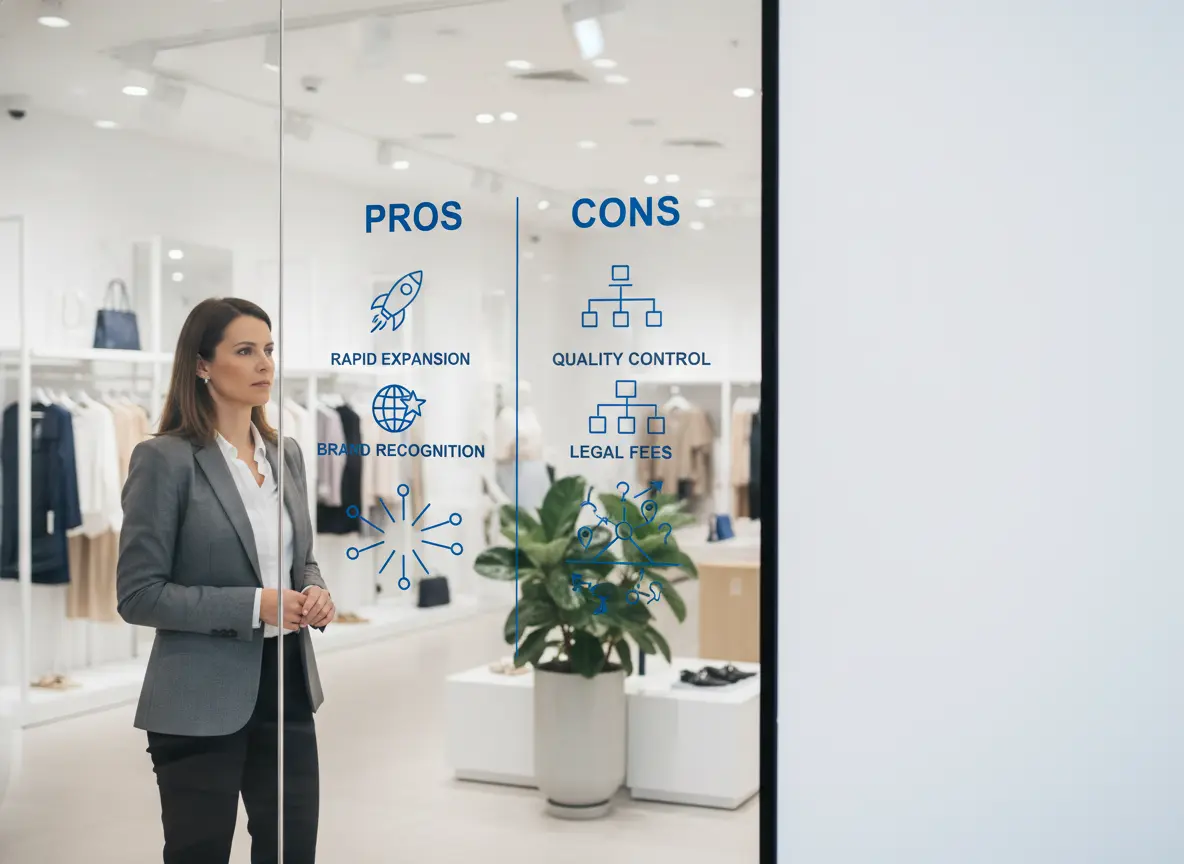
So, You've Built a Retail Masterpiece. Now What?
Your store is the talk of the town. You’ve got regulars who know your staff by name, a product mix that’s pure genius, and a brand voice that’s uniquely you. People don't just shop at your store; they have an experience. You’re not just a retailer; you’re a local legend. And now, the inevitable question has started to creep into your mind, probably late at night when you’re wrestling with inventory spreadsheets: "What’s next?"
That’s when you hear the seductive whisper of a single, powerful word: franchising. It sounds so glamorous, doesn't it? A kingdom of stores, all bearing your name, dotting the map like little beacons of your commercial brilliance. Franchisees clamoring to give you money for the privilege of running a carbon copy of your success. It’s the retail dream, right? Well, sort of. Franchising can be a golden ticket to massive expansion, but it can also be a one-way trip to a very special kind of headache-filled purgatory. Before you start printing "Founder" on your business cards, let's peel back the shiny wrapping and take a hard, honest look at the pros and cons of turning your beloved retail concept into a franchise.
The Glimmering Upside: Why Franchising Looks So Good on Paper
Let's be honest, the "pros" list for franchising is incredibly tempting. It preys on the deepest desires of every overworked, under-caffeinated store owner. More money, more recognition, and maybe—just maybe—a vacation that lasts longer than a three-day weekend.
The Magic of "More Money, Less You" (Theoretically)
The number one reason business owners consider franchising is the potential for rapid revenue growth without the soul-crushing capital investment of opening new corporate locations. Instead of you footing the bill for rent, build-out, and inventory, your franchisee does. Your revenue streams shift from direct product sales to a delightful cocktail of:
- Initial Franchise Fees: A lovely chunk of change you get upfront for handing over your playbook.
- Ongoing Royalties: A percentage of their gross sales, paid to you regularly. It's like getting a paycheck for someone else’s hard work. Glorious.
- Marketing Levies: Contributions to a shared fund to build the brand, theoretically benefiting everyone.
It’s like cloning yourself, but the clones pay you for the privilege of working 80-hour weeks. The dream of "passive income" suddenly feels a little less like a myth and a little more like a real possibility.
Brand Domination: Your Logo on Every Corner
Remember when you were thrilled to see your store's name in the local paper? Franchising is that feeling on steroids. It allows for market penetration at a speed you could never achieve on your own. While you might be able to scrounge up the cash and energy to open one new store every two years, a successful franchise system can open dozens in that same timeframe. This exponential growth translates directly into enhanced brand recognition. Suddenly, you're not just "that amazing boutique on Elm Street;" you're "that amazing boutique on every Elm Street." Your purchasing power with suppliers increases, your marketing becomes more efficient, and your high school rival who said you'd never amount to anything will see your logo every time they go out for milk. And isn't that the purest form of success?
Motivated Management: The Power of Skin in the Game
Finding a store manager who cares as much as you do is like finding a unicorn that’s also a certified public accountant. It’s nearly impossible. Salaried managers are employees; when the clock hits five, their motivation often walks out the door with them. A franchisee, however, is a different breed entirely. They've invested their own life savings, taken out loans, and put their financial future on the line. Their "skin in the game" is very, very real. They aren’t just managing a store; they are running their own business under your banner. This vested interest often translates into a level of dedication, passion, and operational excellence that’s incredibly difficult to replicate with even the best-paid employee.
Maintaining Your Secret Sauce Across Locations
The single biggest challenge—and fear—in franchising is losing control over the customer experience. Your first store is successful because of the unique magic you created. How do you bottle that lightning and ensure it strikes in every new location, run by people who aren't you? Consistency is king, and in franchising, it’s the entire kingdom.
The Consistency Conundrum
One franchisee who cuts corners, provides lackluster service, or lets their store look shabby can tarnish the reputation of the entire brand. Your meticulously built empire could be damaged by one bad apple. This is where systemization and technology become your best friends. You need rock-solid operating manuals, rigorous training programs, and tools that ensure a baseline of quality. For example, a core part of your brand might be the warm, personal greeting every customer receives. How do you guarantee that happens every time? You could hire mystery shoppers, or you could implement a solution that never fails. For many forward-thinking retailers, an in-store assistant like Stella provides that unwavering consistency right at the front door. She greets every single customer, communicates the current promotions with perfect accuracy, and embodies the professional, helpful tone of your brand, 24/7. Deploying tools like Stella across your franchise network gives you a powerful lever for quality control, ensuring that the most critical first impression is always flawless, no matter who is managing the store that day.
The Not-So-Glittering Downside: The Franchisee Factor
Okay, we’ve had our fun dreaming of royalty checks and brand domination. Now it’s time for a cold, hard dose of reality. Franchising isn’t just about collecting fees; it’s about managing relationships, navigating legal minefields, and giving up a significant amount of control.
Letting Go of the Reins (And Your Sanity)
Are you a control freak? Be honest. If you’re the type of owner who needs to personally approve the font on every new price tag, franchising will be your personal hell. You are no longer the one making every decision. You have to trust your franchisees to run their locations according to your system, but you can’t be there to micromanage every detail. You’ve poured your blood, sweat, and tears into this business, and now you have to hand your "baby" over to someone else. It's like giving the keys to your pristine vintage sports car to a teenager who just got their license. Sure, they passed the test, but you’re still going to be holding your breath around every corner.
The Legal Labyrinth and Financial Funhouse
Becoming a franchisor is not a weekend project. It involves a mountain of complex legal work. You'll become intimately familiar with an acronym that will haunt your dreams: the FDD (Franchise Disclosure Document). This is a comprehensive legal document, often hundreds of pages long, that you must provide to prospective franchisees. It details everything from your company's financial health to the full obligations of the franchisee. Creating one requires specialized franchise attorneys, and they are not cheap. The initial investment in legal fees, operations manual creation, and state registration can easily run into the tens, or even hundreds, of thousands of dollars before you ever sign your first franchisee. Hope you love paperwork, because you’re about to be buried in it.
The Relationship Rollercoaster: They're Partners, Not Employees
This is the most critical point to understand: franchisees are not your employees. They are independent business owners. You can’t just fire a franchisee who is underperforming or being difficult. Your relationship is governed by a legally binding contract that can last for 10 or 20 years. Disagreements over royalty payments, marketing strategies, or required store updates are common. A sour franchisee relationship can lead to negative buzz within your system, poor performance, and even costly litigation. You're not just a boss anymore; you’re a partner, a mentor, a coach, and sometimes, a reluctant therapist. It's less of a business arrangement and more of a high-stakes, legally-binding marriage—for better or for worse.
A Quick Reminder About Stella
Whether you’re a single-store powerhouse or exploring a multi-location empire, maintaining a perfect and consistent customer welcome is non-negotiable. An AI retail assistant like Stella ensures every shopper feels seen and informed, driving sales and standardizing your brand experience without the HR headaches that come with scaling.
Conclusion: To Franchise or Not to Franchise?
Franchising is a powerful growth engine, but it's not the right vehicle for every business or every owner. It offers a tantalizing path to expansion and financial reward, but it comes at the cost of control, simplicity, and a whole lot of upfront legal work. The decision hinges on a clear-eyed assessment of your business, your finances, and, most importantly, your own personality.
Before you take the plunge, here are your next steps:
- Solidify Your Systems. Your flagship store must be a flawlessly well-oiled machine. Document every single process, from how you greet customers to how you restock the shelves. Your business must be "franchise-ready," meaning it can be replicated successfully by someone else.
- Consult the Experts. Talk to a reputable franchise lawyer and a franchise consultant. Do not—I repeat, do not—try to do this on your own to save a few bucks. It will cost you dearly in the long run.
- Talk to People in the Trenches. Reach out to other franchisors (in non-competing industries, of course). Ask them about their biggest wins and their most painful regrets. Their real-world wisdom is worth its weight in gold.
Franchising can be the rocket ship that takes your brand to the moon, or it can be the one that blows up on the launchpad, taking your life savings with it. Do your homework, be brutally honest with yourself, and choose wisely. Your retail empire depends on it.