Let's Be Honest: Your Boutique is "Cozy"
So, you run a boutique. A charming, intimate, thoughtfully curated... and, let's face it, tiny boutique. "Cozy" is the word you use on your website, but sometimes, standing by the cash wrap, you feel it’s more like a well-organized walk-in closet. You have incredible products, but they’re currently playing a high-stakes game of Jenga on your shelves. You dream of sprawling aisles, but your reality is a space where two customers with large tote bags can cause a traffic jam.
The fear is real. Will shoppers feel claustrophobic? Will your best items get lost in the visual noise? Will someone knock over that precarious tower of artisanal candles?
Deep breaths. Your small footprint isn't a retail death sentence; it's a creative opportunity. With a bit of visual merchandising wizardry, you can make your little shop feel spacious, luxurious, and completely captivating. It’s not about demolition, it’s about deception—in the best possible way. Let's turn that "cozy" corner into a customer magnet.
The Art of Illusion: Tricks to Create Space
Your main goal is to trick the human eye. You want to create an illusion of depth, height, and openness where little exists. Luckily, you don't need a degree in theoretical physics, just a few tried-and-true retail magic tricks.
Let There Be Light (And Mirrors)
Dark corners are the enemy of small spaces. They literally make your walls feel like they're closing in. Your first mission is to banish shadows. A single, sad fluorescent panel in the ceiling won’t cut it. Think in layers:
- Ambient Lighting: This is your overall illumination. It should be bright and welcoming.
- Task Lighting: Focused light for key areas, like your checkout counter and fitting rooms. -
- Accent Lighting:
- This is your secret weapon. Use spotlights or track lighting to highlight your best products, a beautiful display, or a textured wall. Drawing attention to specific points creates depth and interest.
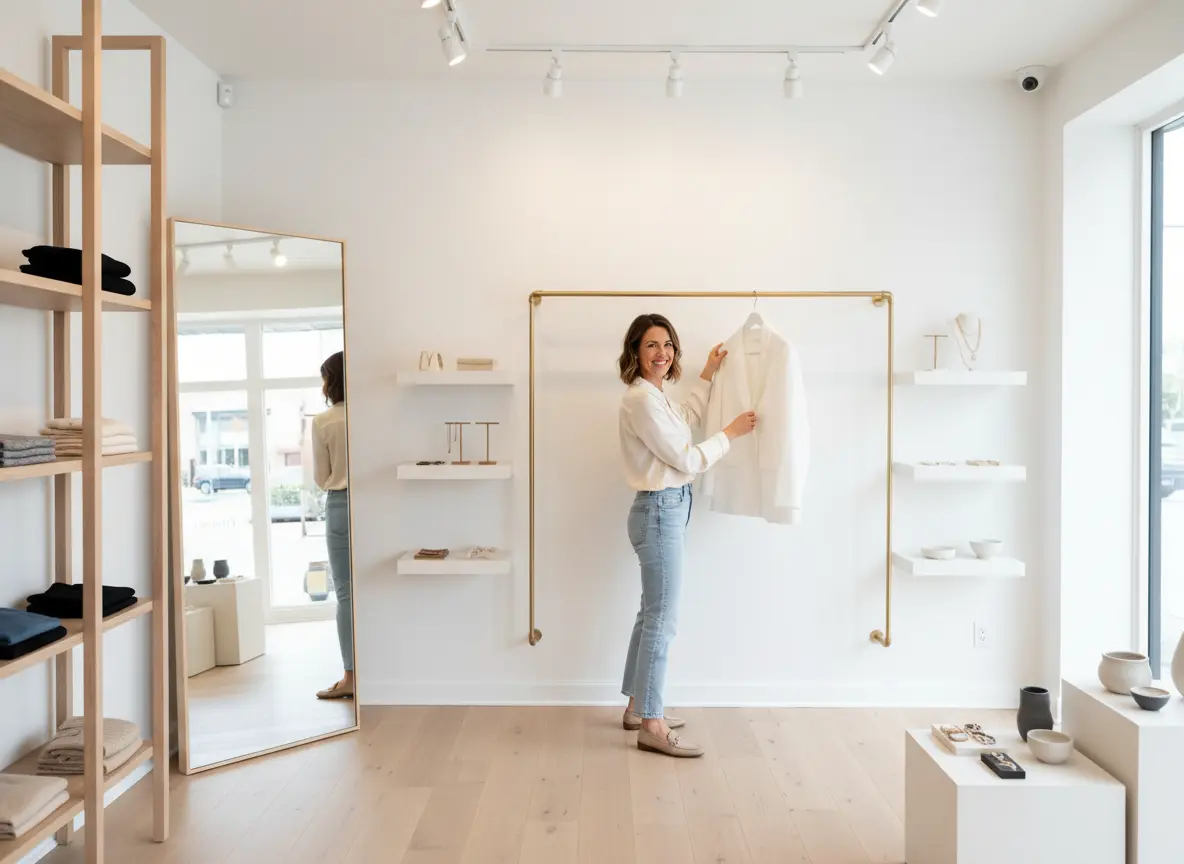
Once your store is beautifully lit, bring in the classic accomplice: the mirror. A large, strategically placed mirror doesn't just give customers a place to admire their potential purchases; it doubles the perceived size of your space. Place one on a long wall to create the illusion of a wider room. But please, use this power wisely. One or two large, elegant mirrors work wonders. An entire wall of them, and your boutique suddenly feels less like a chic shop and more like a funhouse. Unless that's your brand, in which case, carry on.
The Vertical Horizon
When you can't build out, you build up. Your floor space is precious, non-negotiable real estate. Your walls, however, are a wide-open opportunity. Stop thinking in terms of bulky floor fixtures that eat up square footage and create visual roadblocks. It’s time to look up.
Embrace verticality with things like:
- Floating shelves that seem to hover on the wall.
- Tall, slender étagères or ladder-style shelving units.
- Wall-mounted systems like slatwall or pegboards for ultimate flexibility.
- Hanging displays from the ceiling for lightweight items like scarves or accessories.
By drawing the customer's eye upward, you create a sense of height and airiness. It makes the entire room feel grander and prevents that cramped, cluttered feeling at eye level. Your products get the spotlight, and your customers get room to breathe.
Aisle Be Back: Mastering the Flow
Have you ever heard of the "butt-brush effect"? It’s a real term, coined by retail anthropologist Paco Underhill. He found that shoppers, particularly women, will abandon a product or even an entire aisle if they are brushed from behind. In a small store, an accidental butt-brush is almost guaranteed if your layout is poor, and it’s a silent sales killer.
Your layout must provide a clear, intuitive path. A simple loop is often best. It guides customers from the entrance, around your key displays, and naturally to the cash wrap. Grab a tape measure: your main pathway should be at least 36 inches wide. Yes, really. It might feel like you’re sacrificing product space, but you’re actually creating buying space. A customer who feels comfortable and unhurried is a customer who spends more time—and more money—in your store.
Your Silent Sales Assistant: More Than Just a Pretty Face
Every square inch of your store matters, but none more so than the checkout counter. It's your last chance to make an impression and a final point of sale. Unfortunately, in a small shop, it often becomes a chaotic dumping ground for signs, flyers, impulse-buy items, and policy notices. It’s functional, sure, but it’s also a cluttered mess that detracts from a smooth checkout experience.
Declutter Your Counter, Not Your Customer Service
Imagine your counter with nothing on it but your POS system, a stylish bag holder, and maybe a small, beautiful plant. Clean. Serene. Professional. So where did all those promotional signs and FAQ sheets go? They’ve been upgraded. Instead of relying on a forest of cardboard to announce your "20% Off" sale or answer questions about your return policy, you can have a single, elegant assistant handle it all. This is where Stella comes in. Stationed near your entrance, she can greet every single customer, enthusiastically promote your daily deals, and answer common questions before they even reach the counter. She frees up your precious counter space from visual clutter and frees up your staff from repeating the same information all day, allowing them to focus on genuine, value-added conversations with your customers.
Curate Like a Pro: Less is More (Profit)
The biggest mistake small retailers make is trying to act big. You can't carry every product in every color. Trying to do so will turn your charming boutique into a jumble sale. The key to success in a small space is ruthless curation and strategic presentation.
The Power of Negative Space
Repeat after me: empty space is not wasted space. It’s called negative space, and it’s one of the most powerful tools in your visual merchandising arsenal. When you cram every surface with merchandise, nothing stands out. The customer's eye doesn't know where to look, and the brain registers it all as "clutter." By leaving breathing room around a product or a small group of products, you send a powerful subconscious message: "This is special. This is worth looking at." A cluttered shelf screams "discount." A well-spaced display whispers "luxury." Don't be afraid to put half of your inventory in the stockroom. Rotate it frequently to keep your displays fresh and exciting.
Color Theory for the Cramped
A riot of clashing colors can make a small space feel chaotic and even smaller. You want to create a cohesive, calming visual experience. Start with your walls—light, neutral colors like white, cream, or a very pale grey work best to reflect light and create a sense of openness. Then, apply that same logic to your products. Instead of scattering colors randomly, group items by color story. A table dedicated to soft blues and whites or a rack organized in a gradient from light to dark is incredibly pleasing to the eye. It makes your merchandise look intentional, high-end, and easy to shop.
Tell a Story, Don't Just Stack a Pile
People don’t just buy things; they buy the life they imagine having with those things. Instead of grouping all your mugs on one shelf and all your books on another, create a story. This is called a vignette. Set up a small side table to look like a cozy reading nook: place one perfect mug next to a bestselling novel, a small reading lamp, and a beautifully folded throw blanket. You’re not just selling four individual items; you’re selling the experience of a perfect, relaxing afternoon. This cross-selling technique is incredibly effective, showing customers how products can be used together and inspiring them to buy the whole "look." In a small store, these focused, story-driven displays have far more impact than a massive, uninspired pile of a single product type.
A Quick Reminder About Stella
As you're transforming your space into a visual masterpiece, don't forget about the customer experience. Your tireless robot assistant, Stella, can greet every shopper, highlight your curated collections, and answer questions, ensuring no one feels overlooked. She’s the perfect, space-saving addition to a team focused on providing impeccable service.
Conclusion: The Best Things Come in Small Packages
Your small store is your secret weapon. It offers an intimacy and a curated point of view that big-box retailers can only dream of. Stop seeing your square footage as a limitation and start viewing it as a canvas for focused, high-impact creativity. By mastering light, creating a seamless flow, and curating your products like a museum director, you can design an experience that feels expansive, exclusive, and extremely profitable.
Now, go on. Adjust that spotlight, hang that mirror, and declutter that shelf. It’s time to prove that size doesn’t matter when you’ve got style.