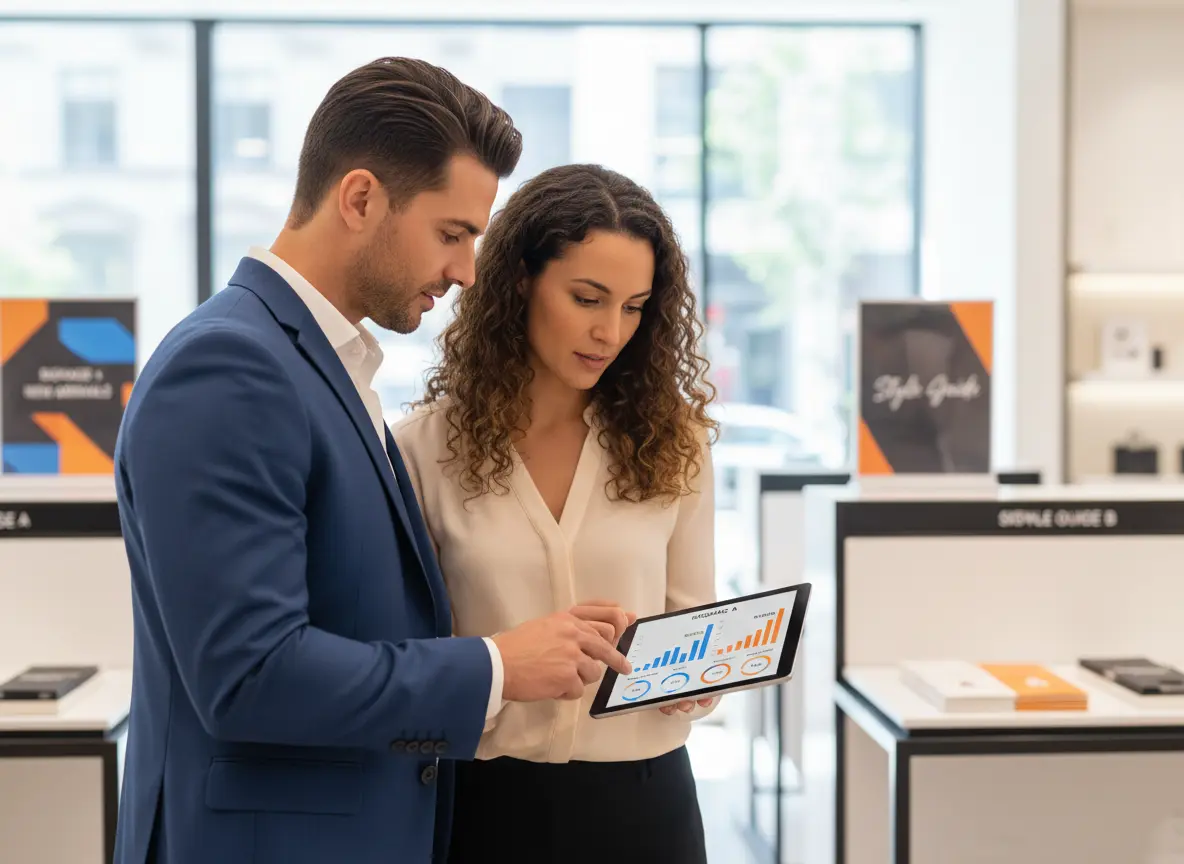
Welcome to the Signage Thunderdome: Two Signs Enter, One Sign Sells
You spent three hours on it. You debated between Helvetica and Comic Sans (a terrifying thought), agonized over the perfect shade of “sale red,” and used a thesaurus to turn “Discount” into “Unprecedented Savings Opportunity.” You printed it, laminated it, and placed it with the care of a museum curator. And then… crickets. Shoppers walk right by it, their eyes glazing over as if it were written in invisible ink.
Sound familiar? As retail store owners, we often rely on gut feelings and a “that looks about right” design philosophy for our in-store marketing. But in a world where every dollar counts, “gut feelings” are a notoriously unreliable business partner. Your online competitors are obsessively tracking clicks, conversions, and bounce rates. Why should you be left guessing what works inside your own four walls?
Enter A/B testing. Before you roll your eyes and mutter, “That’s for tech nerds,” hear us out. A/B testing, or split testing, is simply a method of comparing two versions of something to see which one performs better. And it’s one of the most powerful, data-driven tools you can bring from the digital world into your physical store. It’s time to stop wondering and start knowing. Because “I have a good feeling about this font” is not, in fact, a viable business strategy.
The "Why Bother?" Guide to A/B Testing Signage
Let's be honest, you have a million things to do. Inventory, scheduling, payroll, and that one leaky faucet in the breakroom aren't going to fix themselves. So why should you add “in-store science experiments” to your to-do list? Because well-designed, strategically tested signage doesn't just decorate your store—it actively sells for you. It’s a silent, 24/7 salesperson, and it’s time you gave it a proper performance review.
From Guesswork to Genius: The Core Idea
At its heart, A/B testing is beautifully simple. You create two versions of a sign (A and B) that are identical except for one single change. Maybe you change the headline. Maybe you change the color of the price. Maybe you change the image. You run Version A for a specific period, measure its performance, then swap it with Version B for the same period and measure again. Whichever sign leads to more sales, more inquiries, or more of whatever you’re measuring, wins. It’s a methodical way to let your customers vote with their wallets.
Consider the data: Studies have shown that in-store signage can influence up to 85% of purchase decisions. That's an enormous lever to pull. By testing, you’re not just making your signs prettier; you’re systematically improving their effectiveness and directly impacting your bottom line.
What You Can Actually Test (Spoiler: Almost Everything)
The beauty of A/B testing is its versatility. You can apply it to nearly any element of your signage to see what resonates with your specific clientele. Don’t know where to start? Here are a few ideas to get the gears turning:
- The Offer Itself: Does "25% Off" work better than "Buy One, Get One 50% Off"? Even if the math is similar, the psychological framing can have a huge impact.
- The Headline: Test a straightforward "Sale on All Denim" against a more benefit-driven "Find Your Perfect Fit for Less." -
- Color & Font:
- Is your bold, red "SALE" sign creating urgency or is it just visual noise? Test it against a cooler, more sophisticated blue or green. See if a clean, modern font outperforms a classic serif.
- Imagery: Does a picture of the product itself work better than a "lifestyle" photo of someone happily using it? Or perhaps no image at all, focusing purely on compelling text, is the winner.
- The Call to Action (CTA): Small words can make a big difference. Test "Limited Time Only" vs. "While Supplies Last" vs. "Get Yours Before They're Gone."
- Placement: This is a big one. Does that end-cap display generate more sales than the same sign placed mid-aisle? Is a hanging sign more visible than a floor stand?
The Hidden Costs of Not Testing
A sign that doesn’t work isn’t just a waste of paper and ink; it’s a black hole of lost opportunity. Every customer who walks past without noticing your promotion is a potential sale gone forever. This is the opportunity cost of sticking with what you’ve always done. Furthermore, customers can develop “sign blindness” if your marketing is stale. They learn to tune out the same old signs in the same old places. Testing forces you to keep things fresh and interesting, continually re-engaging your shoppers' attention.
You could be one simple headline change away from finally clearing out that slow-moving inventory of artisanal marmalade. Don't you want to find out what it is?
Your Secret Weapon for Data Collection
The biggest challenge of in-store A/B testing compared to its digital counterpart is data collection. You can't install cookies on your customers (please, don't try), and following them around with a clipboard is a great way to make everyone uncomfortable. This is where modern technology can give you a serious edge.
Gathering Feedback Without Being Creepy
Imagine you're testing two different signs for a new line of coffee beans. You can track sales, sure, but what about engagement? How many people noticed the sign but didn't buy? How do you measure interest? This is where an in-store assistant like Stella can be your data-gathering MVP. While your new sign is up, she can be programmed to greet customers and mention the promotion. For your test, you could have her use two different scripts.
For week one (Sign A), Stella might say, "Welcome! Just so you know, our new single-origin coffee beans are 20% off this week." For week two (Sign B), she might try, "Hi there! Have you tried our new single-origin coffee? We're hearing amazing things about it, and it's on a special introductory offer." Stella can then track how many customers ask a follow-up question to each prompt, giving you a powerful new layer of engagement data to pair with your sales numbers.
Adding a Voice to Your Visuals
A sign is a passive tool. It waits for someone to look at it. An AI retail assistant, on the other hand, is an active one. Stella can proactively draw attention to your A/B test. She can say, "If you're looking for a great gift, check out the new display of scented candles right behind me—we have a special promotion running that you can see on the sign." This synergy creates a powerful one-two punch, ensuring your beautifully crafted test sign gets the attention it deserves and providing you with cleaner, more reliable data.
The Not-So-Scary, Step-by-Step A/B Testing Plan
Ready to put on your lab coat? Don’t worry, it’s easier than it sounds. You don’t need a Ph.D. in statistics, just a bit of patience and a willingness to let the data be your guide. Follow these simple steps to run your first in-store experiment.
Step 1: Pick Your Poison (and Your Goal)
First, and this is non-negotiable, test only one thing at a time. If you change the headline, the color, and the location of a sign all at once, you’ll have no idea which change was responsible for the result. So, pick one variable. Next, define a single, clear goal. What result are you trying to drive?
- The Goal: Increase sales of Product X by 15%.
- The Metric: The number of units of Product X sold per day.
Or maybe...
- The Goal: Drive more foot traffic to the underperforming back-left corner of the store.
- The Metric: A simple manual count of how many people enter that zone per hour.
Having a specific goal and metric is crucial. It's the only way to know for sure if you've won.
Step 2: Run the Experiment (With Scientific-ish Rigor)
Now for the fun part. Create your two versions: Version A (the "control," which is your existing sign or the original idea) and Version B (the "challenger," with your one deliberate change). The key to a good test is consistency.
- Run Version A for a set period. A full week is a good baseline, as it covers both weekday and weekend shopping patterns. Meticulously track your chosen metric.
- Swap in Version B and run it for the exact same duration. That means running it the following week, from Tuesday to Monday, just like the first.
A word of caution from Captain Obvious: try not to run your "Summer Beach Towel Sale" test during an unexpected snowstorm. Keep the testing conditions as similar as you possibly can for both versions.
Step 3: Analyze the Results (and Don't Lie to Yourself)
The numbers are in. It's time to face the music. Compare the performance of Version A against Version B. Did your challenger outperform the control? If Version B resulted in a statistically significant lift in your metric, pop the champagne! You have a new winner. Version B now becomes your new "control" for the next test you run on that sign. You are a genius.
But what if Version B bombed? Or what if there was no difference? This is still a victory. You just saved yourself from rolling out a change that was ineffective or, worse, detrimental to sales. A "failed" test provides invaluable learning. You now know what doesn't work, which is just as important as knowing what does. The goal isn't to be right; the goal is to get it right. So, dust yourself off, form a new hypothesis, and go again.
A Quick Reminder About Stella
Remember, while you're optimizing your static signs, Stella can be your dynamic sales force multiplier. She’s the perfect partner for a data-driven retail strategy, greeting customers, answering questions, and actively promoting the very specials you’re testing to ensure they get maximum exposure.
Your First Experiment Awaits
The days of marketing by guesswork are over. A/B testing your in-store signage is a simple, low-cost, and incredibly effective way to make data-driven decisions that have a real, measurable impact on your sales. It transforms your store from a static space into a living laboratory where you are constantly learning, adapting, and improving.
So here is your homework. This week, pick one sign in your store. Just one. It could be your worst-performing sign or your most important one. Create a "Version B" with a single, simple change—a different headline, a different price color, anything. Run it for a week and see what happens. You have nothing to lose and a world of insight (and sales) to gain.
Go on, unleash your inner scientist. Your bottom line will thank you for it.