The Couch Looks Great Online, But Will It Fit Through the Door?
If you run a furniture store, you already know the single biggest obstacle between a customer and a sale: uncertainty. Will that sectional overpower the living room? Is that dining table too dark for the flooring? Does the armchair actually match the accent wall they painted three years ago and now deeply regret? These are the questions keeping your customers up at night — and keeping their wallets firmly closed.
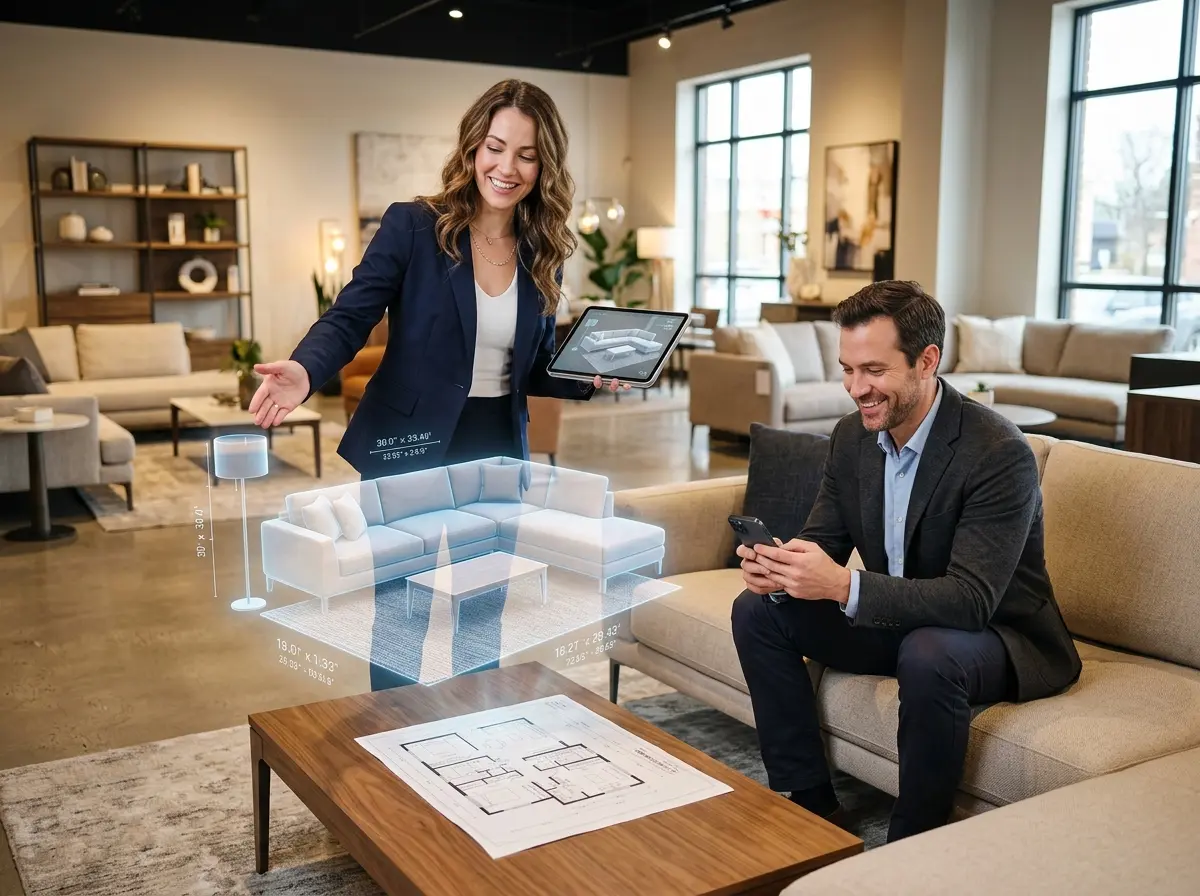
Enter augmented reality. AR technology allows shoppers to visualize furniture in their actual homes before buying, overlaying 3D product models onto a live camera feed of their space. The result? Fewer returns, more confident buyers, and a dramatic reduction in the dreaded "I need to think about it" response that furniture sales reps hear roughly ten thousand times a day.
According to Shopify, merchants who added AR to their product listings saw a 94% higher conversion rate compared to those without it. IKEA's Place app — one of the earliest major retail AR implementations — reportedly reduced returns significantly because customers could see exactly what they were getting. The data is in, and it's pointing at your showroom saying, "You could be doing so much better."
This guide will walk you through how to implement AR effectively in your furniture business, how to use it as a closing tool rather than just a novelty, and how to pair it with the right in-store experience to turn browsers into buyers.
Making AR Work on the Sales Floor
Choosing the Right AR Platform for Furniture Retail
Not all AR tools are created equal, and the difference between a polished AR experience and a glitchy disaster can make or break customer trust. For furniture retailers, you'll want a platform that supports high-resolution 3D models with accurate dimensions, realistic lighting and texture rendering, and a frictionless user experience — ideally one that works directly in a mobile browser without forcing customers to download yet another app they'll delete tomorrow.
Top platforms worth evaluating include Zakeke, Threekit, and Vertebrae for enterprise-level needs, while Shopify's built-in AR features offer a surprisingly capable entry point for smaller retailers already using that e-commerce platform. If you're running a mid-size showroom, look for solutions that integrate with your existing product catalog and can generate 3D models from your manufacturer's existing assets — recreating every item from scratch is expensive and unnecessary.
Key features to prioritize: accurate room-scale placement, shadow and reflection mapping (so the virtual sofa doesn't look like it's floating in midair), and the ability to swap colors and finishes in real time. That last one is a quiet powerhouse — letting a customer toggle between "charcoal linen" and "oat cream" on a sectional in their own living room is the digital equivalent of handing them the fabric swatch book and never taking it back.
Training Your Sales Team to Lead with AR
The technology is only as good as the humans deploying it. AR is most effective when it's introduced naturally in the sales conversation rather than awkwardly bolted on at the end. Train your team to ask early qualifying questions that set up the AR demo: "What does the room look like right now?" and "Do you have a photo of the space?" are low-pressure conversation starters that double as setup for the visual experience.
When the customer pulls out their phone to use the AR tool, your salesperson should be right there, guiding them through it — not standing three feet away pretending to rearrange pillows. Treat it like a test drive, not a self-service kiosk. The human element still matters enormously, and the salesperson's role shifts from "describe the product" to "help the customer see their future." That's a much more enjoyable job, and it closes faster.
Letting Technology Handle the Welcome Mat
How Stella Keeps the In-Store Experience Running Smoothly
Here's a scenario every furniture store owner recognizes: a customer walks in, glances around hopefully, and immediately gets ignored because your two sales reps are both deep in consultations with other shoppers. That customer waits about ninety seconds, decides this is awkward, and leaves. You just lost a potential $2,000 sectional sale because nobody said hello.
Stella, the AI robot employee and phone receptionist, solves that problem without adding to your payroll. As a friendly, human-sized kiosk stationed inside your showroom, Stella greets every customer who walks in, answers questions about products, current promotions, store policies, and available finishes — and can even introduce shoppers to your AR tools and explain how to use them while your human staff finishes up with other customers. She's consistent, knowledgeable, and never has an off day.
Stella also answers your phone calls 24/7, which matters more than most furniture retailers realize. A significant portion of purchase decisions begin with a quick call — "Do you carry outdoor dining sets?" or "What are your delivery lead times right now?" — and if those calls go to voicemail during a busy Saturday, you've handed that customer to your competitor. With Stella handling incoming calls, every inquiry gets a prompt, professional response around the clock, with call forwarding to staff when needed and AI-generated voicemail summaries pushed directly to your managers.
Turning the AR Experience into a Closed Sale
Creating a Clear Path from "I Love It" to "I'll Take It"
AR gets the customer emotionally committed — now you need a frictionless path to purchase. The worst thing you can do after a successful AR visualization is let the momentum die while you hunt down pricing sheets or check inventory availability. Before you roll out AR in your store, make sure your sales process is tightened up on the backend. Your team should have instant access to stock levels, delivery timelines, and financing options, because a customer who just watched their living room transform digitally is primed to say yes — and hesitation kills that momentum fast.
Consider building a simple digital follow-up process: when a customer uses your AR tool in-store, capture their email address and send them a saved image of their configured room. This serves as a personalized reminder that lives in their inbox, not on a showroom floor they've already left. Several AR platforms support this feature natively. A customer staring at a photo of their own living room containing your sofa is significantly more likely to come back and buy than one who just remembers "a nice gray couch somewhere."
Using AR to Justify Premium Price Points
One underappreciated superpower of augmented reality is its ability to neutralize price objections. When a customer is debating between a $799 sofa and a $1,400 sofa, the cheaper one almost always wins on paper. But when they can see the $1,400 sofa — in the right scale, in their actual room, in the finish that complements their existing furniture — the conversation changes entirely. The premium product is no longer an abstraction; it's a decision they can visualize themselves living with.
Train your sales team to use AR specifically when discussing higher-margin items. Position it as a confidence tool: "Let me show you what this would actually look like in your space before you decide." That framing removes the sales pressure and replaces it with something more powerful — clarity. Customers don't resist spending money; they resist spending money on something they're not sure about. AR eliminates the uncertainty, and uncertainty is the only thing standing between you and a bigger average ticket.
Capturing Post-Visit Intent and Following Up Effectively
Not every customer will buy on the first visit, and that's fine — furniture is a considered purchase. What matters is whether you have a system to stay in front of them afterward. Make sure every in-store AR interaction or showroom visit results in some form of contact capture: a name, a phone number, an email address, or ideally all three. This doesn't have to feel transactional — it can be framed as saving their custom room configuration or signing them up for notifications when a specific item goes on sale.
From there, a short follow-up sequence — a personalized email the next day, a check-in call within the week — can meaningfully increase your close rate on those "I need to think about it" situations. The customers who use your AR tool are already more engaged than average; they've invested time and imagination into the experience. That's warm lead territory, and it deserves more than radio silence.
A Quick Reminder About Stella
Stella is an AI robot employee and phone receptionist available for just $99/month with no upfront hardware costs — she works as a human-sized in-store kiosk that engages walk-in customers, promotes your current deals, and answers questions about your products and policies without pulling your staff away from active sales conversations. She also answers every phone call your business receives, 24/7, with the same knowledge she uses on the floor. For furniture retailers juggling busy showroom floors and a constant stream of product and logistics inquiries, Stella is the kind of reliable, always-on presence that pays for itself quickly.
The Bottom Line: AR Sells Furniture, But Experience Closes Deals
Augmented reality is not a gimmick — it's a genuine competitive advantage for furniture retailers willing to implement it thoughtfully. The technology addresses the single biggest friction point in your sales process (uncertainty about how something will look at home), and the data consistently shows it drives higher conversion rates and fewer returns. But the technology alone won't do the heavy lifting.
To make AR work as a true closing tool, here's what you should walk away ready to do:
- Evaluate and select an AR platform that integrates with your existing catalog and works smoothly on customer devices without requiring an app download.
- Train your sales team to introduce AR early in the conversation and position it as a confidence-building tool rather than a tech demo.
- Tighten up your sales process so that when a customer says "I love it," you can move to close without fumbling for information.
- Capture contact information from every in-store AR interaction and build a simple follow-up workflow for customers who don't buy on the first visit.
- Use AR strategically to support premium price points and reduce hesitation on higher-margin items.
The furniture retailers who thrive in the next few years will be the ones who understand that the showroom experience and the at-home experience are no longer separate things. Your customers are making decisions in their living rooms, on their phones, at ten o'clock at night — and your job is to be present in that moment. AR gets you into the room. A sharp sales process, a well-trained team, and the right support tools close the deal.
Now go sell some furniture.