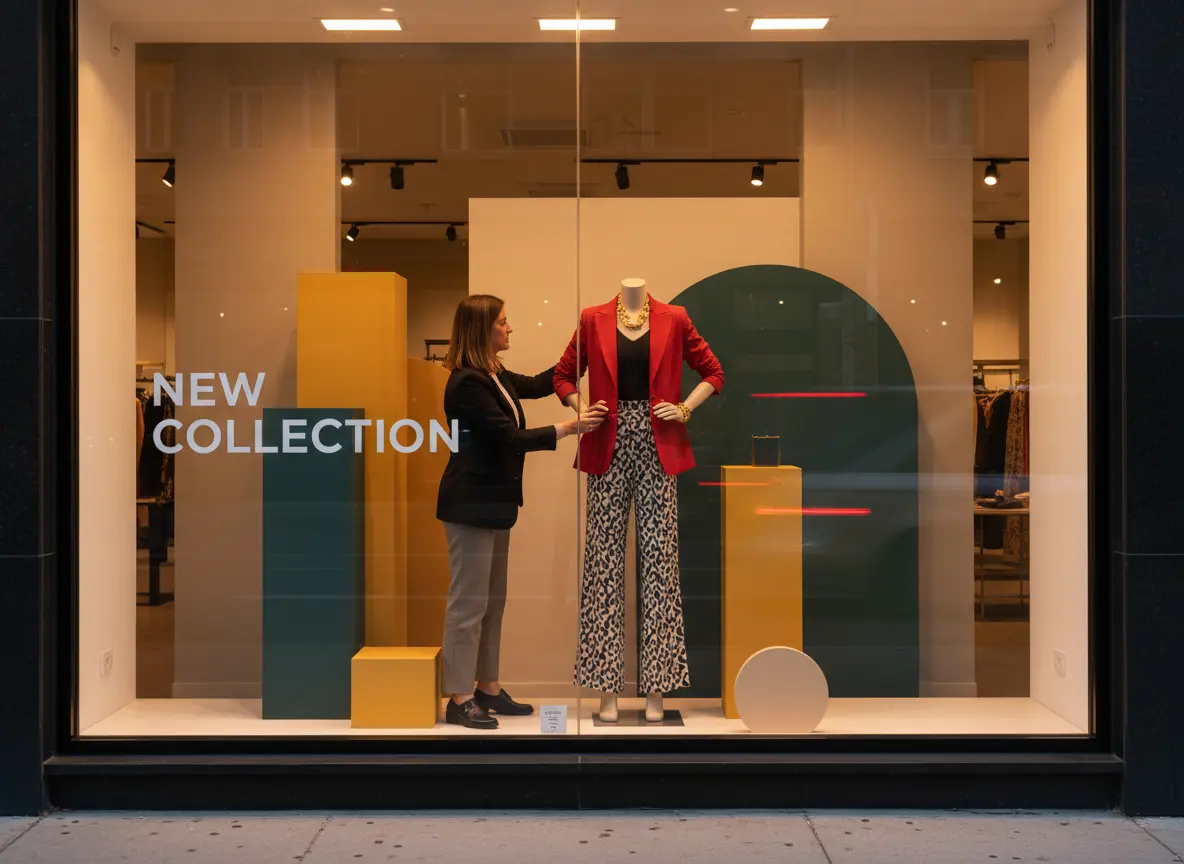
Your Window Display is Your Store's Pickup Line. Is It Any Good?
Let’s be honest. Your storefront window has about three seconds to convince a distracted driver, a hurried pedestrian, or a tourist trying to follow Google Maps to stop, turn their head, and think, "Huh. I should go in there." Three seconds. That’s less time than it takes to skip a YouTube ad.
For many retailers, the window display is treated like that one junk drawer everyone has. It’s a chaotic mix of last season’s leftovers, a dusty mannequin who has seen better days (we’ll call him Bartholomew), and a faded "50% OFF!" sign from two years ago. It’s not a magnet for customers; it’s a monument to missed opportunities.
Your window is your 24/7 billboard, your first handshake, and your most persistent salesperson. It should be working harder than your morning coffee. If it’s not turning passing cars into parked cars and walkers into talkers, it's time for an intervention. Let's transform that glass box from a forgotten space into a foot-traffic-generating machine.
The Art and Science of the 5-Second Sell
Merchandising for drive-by traffic is a different beast entirely. You're not designing for a leisurely stroll through a museum; you're designing for a glance at 35 miles per hour. This requires a shift in thinking from "detail" to "drama." It’s about creating a single, powerful impression that sticks.
Go Big or Go Home (Literally, They'll Just Go Home)
Tiny props, delicate signage, and intricate product arrangements are lovely for the customer who is already pressing their nose against the glass. For the person in the Honda Civic across the street, they’re just… a blur. When designing for distance and speed, scale is your best friend. Think less about individual products and more about the overall shape and impact.
- Oversized Graphics: Forget the 8.5x11 printed sign. Use a massive, floor-to-ceiling vinyl decal that communicates your message instantly. A giant, vibrant image of your signature product is more effective than a dozen small ones.
- Dramatic Props: Instead of a small vase of flowers, think about a six-foot-tall paper-mache cactus. Instead of a standard mannequin, create a scene with oversized, abstract shapes that draw the eye.
- Bold Typography: If you use text, make it huge and legible. A simple, one-to-three-word message like "Hello, Sunshine" or "The Perfect Gift" in a giant font is far more effective than a paragraph explaining your new arrivals.
The goal is to create a visual that can be understood and processed in a split second. Ask yourself: if I squint my eyes and look at my display from across the street, what do I see? If the answer is "a vague, cluttered shape," you need to go bigger.
The Power of a Single, Brilliant Idea
A cluttered window communicates a cluttered mind—and potentially a cluttered store. Drivers and pedestrians are already overloaded with visual information. Don’t add to the noise. The most powerful drive-by displays are built around a single, focused concept.
Resist the urge to showcase one of everything. It’s a window display, not Noah’s Ark. A singular theme creates an immediate, memorable story. For a kitchen supply store, instead of showing a pot, a pan, a mixer, and a set of knives, create a massive "waterfall" of pasta flowing out of a single, giant colander. For a clothing boutique, a monochromatic display—every single item in a vibrant, shocking pink—is far more arresting than a rainbow of disconnected outfits.
Your mantra should be: one theme, one focal point, one message. This clarity is what cuts through the noise and makes someone hit the brakes.
Light It Up Like You Mean It
A phenomenal display sitting in the dark is like telling a brilliant joke in an empty room. Lighting isn't an accessory; it's a core component of your design. It directs the eye, creates mood, and—most importantly—ensures your hard work is visible 24/7.
Proper lighting can make colors pop and create a sense of depth and drama. Use spotlights to highlight your main focal point, casting the less important areas in shadow. Backlighting can create striking silhouettes. Colored gels can instantly change the mood of the entire display, from a warm, inviting yellow to a cool, sophisticated blue. And remember, your window works for you even when you’re closed. Having it brilliantly lit at night turns your store into a landmark, attracting attention from evening traffic and diners. A well-lit business just feels more successful and trustworthy.
Turning a Glance Into an Entrance
Okay, you did it. Your window is a masterpiece. A car just pulled over. A group of friends just stopped to take a picture. Now what? The most stunning window in the world is useless if the in-store experience feels like a completely different, and far less interesting, company. The transition from the sidewalk to the sales floor must be seamless.
Your Window Makes a Promise; Your Store Keeps It
Your window display sets an expectation. If it’s bold, modern, and exciting, the customer expects to feel that same energy the moment they walk through the door. This is where the magic of a great first impression happens. That initial "hello" can make or break the sale you just worked so hard to attract.
Imagine your new customer, drawn in by your incredible display, walking in to be greeted by a friendly, helpful, and—dare we say—futuristic assistant. That's where Stella comes in. While you’re helping another customer or managing inventory, Stella ensures that no one who was captivated by your window walks in unnoticed. She can immediately reinforce the window's theme ("Welcome! If you loved the floral display outside, you have to see our new spring collection right over here.") and turn that initial curiosity into a genuine shopping experience.
Pro-Tips from the People Who Stare at Windows
Ready to level up? Once you've mastered the basics of scale, focus, and light, you can start playing with more advanced techniques that separate the good windows from the truly unforgettable ones.
Movement is Your Secret Weapon
The human eye is biologically programmed to notice movement. It’s an ancient survival instinct. While you probably don’t want your customers to feel like they’re being hunted by a saber-toothed tiger, you can use this instinct to your advantage. A little bit of motion can be disproportionately effective at capturing attention.
This doesn't have to be a flashy, seizure-inducing digital screen. Subtle is often better.
- A slow-moving turntable displaying a hero product.
- A small, hidden fan making a lightweight scarf or fabric billow elegantly.
- Projected, slow-moving patterns of light or color.
The key is to add a touch of life to an otherwise static scene. It creates intrigue and makes people look twice—and a second look is a massive win in the world of drive-by marketing.
Color Theory Isn't Just for Art Students
Color is emotion. It’s a shortcut to the brain that can communicate a feeling long before the logical mind has processed what it’s even looking at. Using color strategically can dramatically increase the visibility and impact of your display. High-contrast combinations like black and white, yellow and black, or red and white are classic for a reason: they are incredibly easy to see from a distance.
Consider a bold, limited color palette for your entire window. A monochromatic display, where everything is a single color, is visually arresting and sophisticated. An analogous color scheme (using colors next to each other on the color wheel, like blue and green) can create a harmonious, pleasing look. Whatever you choose, be intentional. Throwing every color of the rainbow at the window usually results in visual mud.
A Quick Reminder About Stella
While your stunning new window is busy pulling people in off the street, remember who’s waiting to greet them. Stella is the perfect partner for your newfound foot traffic, ensuring every single curious visitor gets a warm welcome and a helpful introduction to your store. She turns that "huh, interesting window" into a "wow, great service" experience from the second they step inside.
Conclusion: Your Window is Waiting
Your storefront window is not just a structural requirement; it's arguably the most valuable marketing real estate you own. It’s time to stop treating it like an afterthought and start treating it like the lead-generation powerhouse it can be. By focusing on a single big idea, using scale and light to create drama, and ensuring the in-store experience delivers on the window's promise, you can transform ignored glances into loyal customers.
So here's your homework: Sometime this week, go across the street. Get in your car and drive past your own store. Be brutally honest. Would you stop? If the answer is anything less than a resounding "YES!", you know what to do. Get planning, get creative, and get ready for the traffic jam.