Introduction: The Awkward Dance of the Upsell
Picture this: your dental hygienist has just spent 45 minutes scraping, polishing, and making small talk about someone's vacation plans, and now they're supposed to pivot to, "So… have you considered whitening?" It's a bit like a masseuse trying to sell you essential oils while you're still facedown on the table. Technically possible. Definitely awkward if done wrong.
Here's the truth that many dental practice owners already know but struggle to act on: whitening upgrades are among the highest-margin, highest-satisfaction services your practice offers. Patients who whiten are more likely to invest in their overall oral health, maintain their hygiene appointments, and refer friends. And yet, study after study shows that hygienists consistently underperform on presenting elective services — not because they don't believe in them, but because they genuinely don't want to feel like they're selling something.
The good news? There's a meaningful difference between pushy sales tactics and confident, patient-centered recommendations. Once your hygienists internalize that difference, presenting whitening upgrades becomes less of an awkward sales pitch and more of a natural extension of the care they're already providing. This post will show you exactly how to get there.
Building the Foundation: Mindset, Language, and Timing
Shift the Mindset from "Selling" to "Serving"
The single biggest barrier to your hygienists presenting whitening upgrades isn't skill — it's identity. Most hygienists became hygienists because they care about people's health, not because they dreamed of hitting a monthly sales quota. The moment they feel like they're "selling," their body language shifts, their voice changes, and patients can sense it immediately.
The reframe you need to embed in your team culture is simple: recommending whitening is an act of patient advocacy, not a sales tactic. If a hygienist notices surface staining from coffee, tea, or age, mentioning whitening is the same professional responsibility as recommending a specific flossing technique. They would never hesitate to say, "I'd suggest flossing more around your back molars." The whitening conversation should carry the same natural confidence.
Reinforce this in your team meetings. Celebrate stories where a patient lit up after whitening. Share before-and-after outcomes. When your hygienists genuinely believe in the value of the service — and they see the emotional impact it has on patients — the conversation stops feeling like a pitch and starts feeling like good patient care.
Use Language That Opens Doors Instead of Closing Them
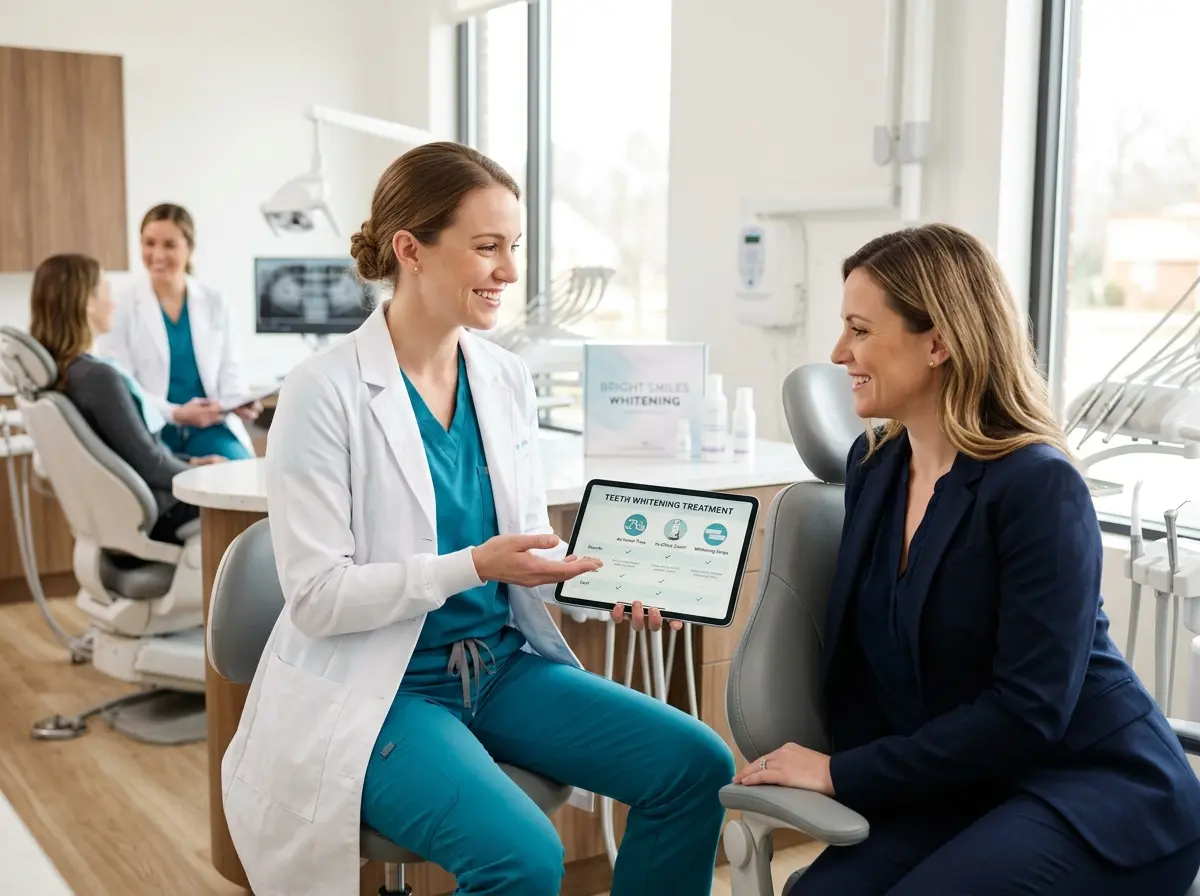
Word choice matters enormously in this context. There's a significant difference between "We're running a whitening special this month" (transactional, forgettable) and "I noticed some staining on your anterior teeth — have you ever thought about whitening? A lot of our patients have been really happy with the results." The second approach is observational, personal, and inviting — it doesn't pressure anyone; it opens a door.
Train your hygienists to use language that ties the recommendation to something specific they observed during the appointment. This makes it feel clinical and credible rather than promotional. Phrases like "based on what I'm seeing," "a lot of patients in your situation," and "it might be worth considering" keep the tone professional and low-pressure while still making the offer.
Nail the Timing — It's Everything
Timing a whitening conversation is genuinely an art form. Too early, and the patient is still nervous. Too late, and they're already mentally in the parking lot. The sweet spot is typically during or immediately after the polishing step, when the patient's teeth are already looking their best, they're relaxed, and you can point to the fresh, clean surface as a natural segue. Another effective moment is during the post-exam consultation when the dentist or hygienist is reviewing findings — it fits naturally into the "here's what I noticed, here's what we can do" flow.
A Little Help From Your Robot Friend
Let Technology Handle the Warm-Up
Your hygienists shouldn't have to do all the heavy lifting. One of the most effective ways to reduce the awkwardness of in-appointment upsells is to make sure patients already know about your whitening services before they even sit in the chair. That's where Stella — the AI robot employee and phone receptionist — can quietly do a lot of the groundwork for you.
In practices with a physical location, Stella stands in your waiting area as a friendly, human-sized kiosk that naturally engages patients as they arrive. She can mention current whitening promotions, answer common questions about the process, and get patients curious before the appointment even starts. By the time a patient gets into the hygienist's chair, they may already be halfway sold — which makes your hygienist's job dramatically easier. On the phone side, Stella handles incoming calls 24/7 and can promote your current offers to every caller, so patients who might never have known about your whitening services get a friendly nudge during their appointment confirmation call. Less awkward human selling. More seamless, consistent messaging. Everyone wins.
Training Techniques That Actually Stick
Role-Play Without Making It Miserable
Role-playing has a reputation problem. Mention it in a staff meeting and watch everyone suddenly find their shoes extremely interesting. But the reality is that role-playing whitening conversations is one of the fastest ways to build genuine confidence — as long as you don't make it feel like a corporate exercise from 2003.
Keep it brief, low-stakes, and specific. Pair hygienists up and give them a realistic scenario: a patient with visible coffee staining, a patient who has mentioned a wedding coming up, a patient who seems cost-conscious. Let them practice the observation-based language you've introduced, take turns being the patient, and debrief on what felt natural versus forced. Run these short sessions monthly, not annually. Repetition builds fluency, and fluency eliminates the awkwardness.
Create Simple Scripts as Guardrails, Not Crutches
Scripts get a bad reputation because people deliver them robotically, and patients can tell. But a well-designed script isn't something to read — it's a framework that gives hygienists a reliable starting point when they feel uncertain. Think of it as training wheels that eventually come off.
Develop two or three short, adaptable templates that your hygienists can personalize based on the patient in front of them. For example: "Your teeth are looking great after today's cleaning. I did notice some staining near the front — have you ever looked into whitening? We have a couple of options depending on what kind of results you're after." That's it. It's brief, it's observational, and it invites a conversation without demanding a decision. Practice until it sounds like them, not like a script.
Track, Celebrate, and Adjust
What gets measured gets improved, and what gets celebrated gets repeated. Start tracking whitening upgrade conversion rates by hygienist — not to create pressure, but to identify patterns. If one hygienist is converting at twice the rate of others, find out what they're saying and share it with the team. If conversions dip in certain months, investigate whether timing, language, or promotion visibility might be the issue.
Celebrate wins publicly and specifically. "Jamie presented whitening to six patients this week and three said yes" is far more motivating than a generic "great job this month." Recognition reinforces the behavior, and over time, it builds a culture where presenting elective services feels normal and expected — not exceptional.
Quick Reminder About Stella
Stella is an AI robot employee and phone receptionist that helps dental practices and other businesses greet patients, answer calls around the clock, promote services, and reduce the burden on front-desk and clinical staff — all for just $99 a month with no upfront hardware costs. Whether she's engaging patients in your waiting room or handling calls after hours, she keeps your practice looking professional and proactive without ever needing a coffee break.
Conclusion: Small Shifts, Big Results
Training your hygienists to present whitening upgrades confidently isn't about turning them into salespeople — it's about helping them communicate the full value of the care they're already providing. When the mindset shifts from "selling" to "serving," when the language becomes observational and personal, and when the timing aligns with natural moments in the appointment flow, the conversation stops being awkward and starts being genuinely helpful.
Here's your action plan to get started this week:
- Hold a brief team meeting to reframe whitening recommendations as patient advocacy, and share two or three real patient success stories.
- Develop or refine two short script templates that your hygienists can personalize based on clinical observations.
- Schedule a monthly 15-minute role-play session to build fluency without the corporate cringe.
- Start tracking whitening upgrade conversion rates by hygienist so you can spot what's working and celebrate it.
- Consider how your front-end touchpoints — including your waiting area and phone experience — can prime patients before they ever sit in the chair.
The whitening revenue your practice is leaving on the table isn't a reflection of your hygienists' talent or your patients' interest. It's a training gap — and training gaps are entirely fixable. Start small, stay consistent, and give your team the tools and confidence they need. The results will follow.