Are Your Customers Ignoring Your Best Products?
Let’s paint a picture. You’ve just stocked a fantastic new product. It’s innovative, it’s got great margins, and you know your customers will love it if they just give it a chance. So, you carefully place one—a single, solitary sample—on a shelf, perfectly centered, with a lovingly crafted little sign. You stand back, admire your work, and wait for it to fly off the shelf. And then… crickets. Shoppers walk right past it, their eyes glazing over in the vast sea of merchandise.
Sound familiar? If you’re nodding, you’ve fallen victim to the myth of the “lone wolf” product. In the chaotic, overstimulated world of retail, a single item rarely has the power to stop a customer in their tracks. It’s like whispering in a rock concert. To get noticed, you need to shout. Not with your voice, but with your visual strategy. This is where a principle so simple it almost feels like cheating comes into play: The Rule of Repetition.
Frankly, if you think one strategically placed bottle of artisanal, gluten-free, ethically-sourced hot sauce is going to change your life, you might be in for a long quarter. It’s time to stop hiding your best products and start making them impossible to ignore.
The Psychology Behind "Why More is More"
Repeating elements in your displays isn't about a lack of creativity; it's about leveraging basic human psychology. Our brains are wired to notice patterns and are comforted by familiarity. When you strategically repeat products, colors, or shapes, you're not just stocking shelves—you're speaking a primal visual language that your customers instinctively understand. It’s less “interior design” and more “neuroscience for retail.”
The Mere-Exposure Effect: Familiarity Breeds Content(ment)
Psychologists call it the "mere-exposure effect"—a fancy term for the fact that people develop a preference for things simply because they are familiar with them. The first time a customer sees a new brand of organic dog treats, their brain registers it as “unknown, potentially risky.” But when they see a powerful, stacked display at the entrance, then see it again in the pet aisle, and then see a small basket of it by the checkout, their brain’s narrative shifts. It’s no longer an unknown entity. It’s “Oh, that popular dog treat I keep seeing everywhere. It must be good.” You’ve manufactured familiarity and, with it, trust.
Cutting Through the Cognitive Clutter
The average supermarket has over 30,000 SKUs. Your customers are suffering from a chronic case of decision fatigue before they even walk through your door. A jumbled, chaotic display of one-of-everything just adds to their cognitive load. Repetition, however, is a visual oasis. A bold, uniform block of color or a massive pyramid of the same product is easy for the brain to process. It acts as a visual anchor, drawing the eye and making a powerful statement amidst the noise. Given that shoppers often make purchasing decisions in seconds, a display that can be understood at a glance is a display that sells.
Creating Perceived Value and Demand
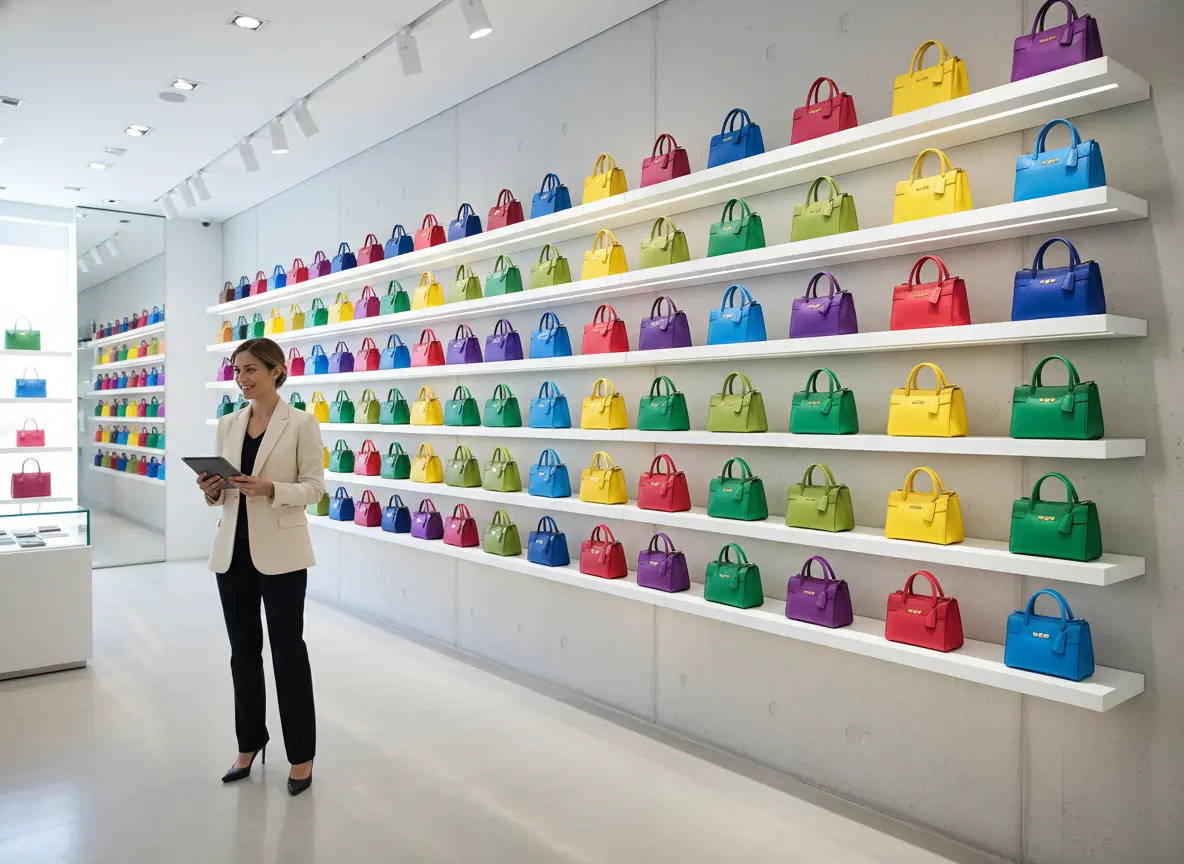
Perception is everything in retail. Which scenario feels more compelling? A single, lonely sweater hanging on a rack, or a table neatly stacked with dozens of the same sweater in a rainbow of colors? The mass display communicates abundance, popularity, and value. It sends a subconscious message: “This is a bestseller. Everyone wants one. You should, too.” It’s social proof in physical form. A large display implies you’ve invested heavily in this product because you believe in it—and that confidence is contagious.
Repetition Beyond the Product Stack
Effective repetition isn't just about piling products high. It's about creating a cohesive, multi-sensory story that guides your customer through the store. It’s about repeating a message—a promotion, a theme, a feeling—across different touchpoints to ensure it sinks in. This is where visual merchandising works hand-in-hand with in-store communication to create a truly immersive experience.
Unifying Your Message with Words and Visuals
Let's say you're running a "Harvest Festival" promotion. Your visual merchandising team creates beautiful endcaps with autumnal colors and displays of seasonal jams and pies. That's a great start. But what if that message was reinforced from the moment someone walked in? While your displays are creating visual repetition, your in-store assistant, Stella, can provide the auditory reinforcement. Imagine a shopper entering your store and being greeted by Stella, who cheerfully says, "Welcome! Be sure to check out our Harvest Festival specials—all baking supplies are 15% off this week!" Suddenly, the theme isn't just a pretty display; it's an active, store-wide event. This combination of seeing and hearing the same message creates a powerful one-two punch that is far more effective than either tactic alone.
Putting Repetition into Practice (Without Being a Bore)
Okay, so you’re sold on the concept. But how do you implement repetition without making your store look like a dreary, uniform warehouse? The goal is to create impact, not monotony. The key is to think like an artist, using pattern, rhythm, and strategic breaks to guide the eye and create visual delight.
Rhythm and Pattern: The Art of Repetition
Repetition doesn’t have to mean lining up identical items like soldiers. Introduce rhythm to your displays to make them dynamic. Consider these techniques:
- Alternating Patterns: If you're displaying books, alternate between showing the spine and the cover. For clothing, alternate folded stacks with a single item on a mannequin.
- Color Blocking: Create a powerful statement by grouping items by color. A wall of blue jeans organized from light wash to dark wash is visually striking and helps the customer navigate the options.
- Pyramids and Shapes: Stacking cans or boxes into a pyramid is a classic for a reason—it’s visually stable yet interesting. Don't be afraid to create waves, zig-zags, or other geometric shapes with your products.
The goal is to establish a clear pattern that is then pleasing for the brain to follow.
The "Break" in the Pattern: Your Secret Weapon
Once you’ve established a strong, repetitive pattern, you can use it to your advantage by strategically breaking it. This is a classic design trick to create a focal point. Imagine a wall display featuring 50 jars of strawberry jam, and right in the middle, one single jar of exotic dragon fruit jam. Where does your eye go immediately? To the outlier, of course. The repetition of the strawberry jam serves as the backdrop that makes the special item pop. Use this to highlight a new flavor, a premium version, or a product you particularly want to feature.
Avoiding the Repetition Rut
A word of caution: there can be too much of a good thing. If you try to apply the rule of repetition to every product in your store, you’ll just end up with a new kind of visual chaos. Be selective. Each week or month, choose 2-3 "hero" products or promotions. Give them the full repetition treatment—a power display at the front, a well-stocked home on the shelf, and a secondary placement elsewhere. For everything else, a standard, tidy display is perfectly fine. Focus your efforts where they'll have the most impact.
A Quick Reminder About Stella
Remember, your visual merchandising is just one piece of the puzzle. An in-store AI assistant like Stella ensures your beautifully merchandised promotions are verbally reinforced, greeting every customer and guaranteeing your message is both seen and heard for maximum impact.
Conclusion: Go Forth and Repeat Yourself
The Rule of Repetition is one of the most powerful, cost-effective tools in your visual merchandising arsenal. It’s a simple concept rooted in deep psychological principles that can transform overlooked products into bestsellers. It cuts through the noise, builds customer trust, and creates a perception of value and demand that is impossible to ignore.
So, here’s your homework. Don't just read this and go back to placing single items on a shelf.
- Pick a "Hero": Walk your store right now and choose one product that deserves more attention.
- Find Three Homes: Identify three different locations where you can feature that product using the power of repetition. Think entrance, main aisle, and checkout.
- Get Creative: Don’t just stack it—give it rhythm, pattern, and style. Make it a destination, not just a product.
Stop whispering and start shouting with your displays. In the world of retail, it’s perfectly acceptable to repeat yourself. In fact, your bottom line will thank you for it.