Let's Be Honest: You're Tired of Losing to the Big Guys
You see it every day. A potential customer slows down, peers into your beautifully curated window display, and then... gets sucked into the gravitational pull of the giant, beige big-box store down the street. It’s a tale as old as retail itself: David versus Goliath, except Goliath has a multi-billion-dollar marketing budget, a parking lot the size of a small country, and the ability to sell lawnmowers next to lactose-free milk.
Fighting back can feel like bringing a butter knife to a tank fight. You can’t out-spend them. You can’t out-stock them. But what if you could out-smart them? What if you had a secret weapon that let you digitally tap a customer on the shoulder right when they’re in your competitor's territory and whisper, “Psst... we’ve got what you need over here, and we’re way cooler.”
That, my friend, is the magic of geo-fencing. It’s your digital slingshot, and it’s time to start poaching some customers. Ethically, of course. Mostly.
The Art of the Digital Heist: Geo-Fencing 101
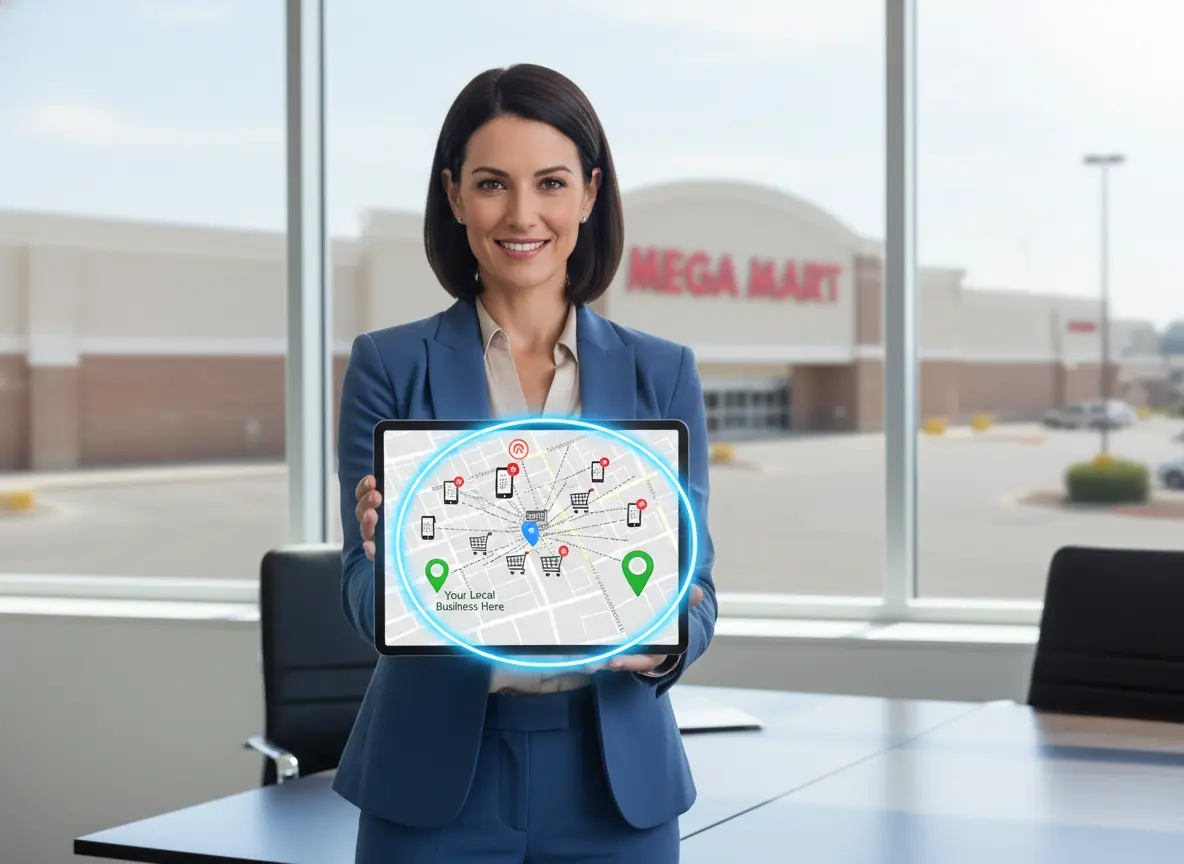
Before you start picturing yourself in a black turtleneck downloading customer data from a satellite, let’s clarify. Geo-fencing is less "Mission: Impossible" and more "Marketing: Incredibly Possible." It’s a location-based advertising tool that lets you create a virtual perimeter—a "fence"—around any real-world geographical area you choose. When someone with a smartphone enters or exits that fence, it triggers a pre-programmed action, like sending a targeted ad straight to their device.
So, What Exactly is This Voodoo? (Aka Geo-Fencing Explained)
Think of it like drawing an invisible circle on a map with a digital crayon. The moment a potential customer’s phone—with location services enabled, of course—crosses into that circle, your ad platform gets a notification. If that user fits your target demographic and is using an app that shows ads (which is, let's face it, pretty much all of them), your ad can pop up on their screen. It’s precise, it’s immediate, and it feels a little bit like you have superpowers.
For example, you could draw a fence around the entire property of the Home Depot a mile away. The instant a shopper pulls into their parking lot, they could see an ad on their phone for your local hardware store with an offer that’s too good to ignore. It’s not voodoo; it’s just brilliantly targeted data.
Setting the Trap: Choosing Your Conquest Zones
The power of geo-fencing lies in its precision. You aren't just blasting ads into the ether; you're targeting people based on a powerful indicator of intent: their physical location. Where should you build your digital fences?
- The Obvious Target: Your Competitors. This is Geo-Fencing 101. Fence their store, their parking lot, their entire shopping plaza. This is called "conquesting," and yes, it’s as fun as it sounds. Target shoppers who are literally at your competitor's location, giving them a compelling reason to leave and visit you instead.
- Complementary Businesses. Think symbiotically. If you own a boutique clothing store, why not fence the popular hair salon next door? Their clients are your ideal demographic. A gourmet kitchen supply store could fence the local farmers' market on a Saturday morning. Get creative and find where your customers hang out before they need you. -
- Local Events and Venues. Is there a big street festival, a concert, or a major sporting event happening nearby? Fence it. You can capture the attention of thousands of people in your area who are already out and about, often in a mood to shop or explore.
Crafting the Irresistible Bait (Your Ad Copy)
A perfectly placed fence is useless if the ad itself is a dud. Your message needs to be timely, relevant, and compelling enough to make someone change their plans. Generic ads won't cut it. Your offer needs to feel like a secret, personalized invitation.
Focus on what makes you better. Is it service? Price? A unique product? Your ad should scream it. Consider offers like:
- Urgency-Driven: "Shopping at Big Mart? Come see us next door in the next 30 minutes for 20% off your entire purchase. Show this ad at checkout!"
- Value-Driven: "Can't find an expert at the mega-store? Our friendly staff are here to help you find the perfect gift. Plus, free gift-wrapping!"
- Product-Specific: "Looking for organic pet food? Big-box brands can't compete with our selection. Get a free bag of treats with any purchase today."
Remember, you're interrupting their mission. Make it worth their while.
From Digital Nudge to In-Store "Wow"
Okay, so your brilliant geo-fenced ad worked. A customer has abandoned their quest at "MegaCorp" and walked through your front door. Success! But... now what? The digital promise has to translate into a real-world experience that confirms they made the right choice. If your ad promised amazing service and a friendly atmosphere, you'd better deliver it the moment they step inside.
The All-Important Handoff: Sealing the Deal
This is where the magic really happens. The transition from the phone screen to your sales floor must be seamless. A customer who was just lured away from a competitor is, by definition, a "hot lead." You can't afford to have them wander around unnoticed or be ignored by busy staff.
Imagine they walk in and are instantly greeted by a welcoming, helpful presence. For stores using our technology, this is where Stella shines. Imagine a customer who just saw an ad for "15% off all imported coffee" walks in and is immediately greeted by a friendly, life-sized robot who says, "Welcome! If you're here for the coffee special, our award-winning Ethiopian Yirgacheffe is right this way. It smells amazing, doesn't it?" This instantly validates their decision, creates a memorable "wow" moment, and makes your store feel light-years ahead of the soulless big-box experience they just left. The ad got them there; a great in-store experience keeps them there—and makes them come back.
Getting Your Hands Dirty: The Practical Stuff
Theory is great, but let's talk about execution. Setting up a geo-fencing campaign isn't rocket science, but it does require a little bit of know-how. The good news is that many of the platforms you might already be using have these capabilities built right in.
Choosing Your Weapon: Geo-Fencing Platforms
You don’t need a black-ops budget to get started. Many mainstream digital advertising platforms offer robust location-based targeting features.
- Google Ads: A powerhouse for targeting users near your location or who have shown interest in your area. You can target people "in" or "regularly in" your chosen locations with incredible precision.
- Facebook & Instagram Ads: Meta's ad platform is fantastic for targeting based on demographics and interests, layered with location. You can drop a pin on your competitor’s store and set a one-mile radius to target everyone within it.
- Specialized Platforms: Companies like GroundTruth or AdCobra are dedicated to location-based marketing and offer even more advanced features, like targeting based on past visitation patterns or brand affinities.
Our advice? Start with a platform you're already comfortable with. If you've run Facebook ads before, start there. The learning curve will be much gentler.
How Much Does This "Theft" Cost? (Aka Budgeting)
This is probably your biggest question, and the answer is: a lot less than you think. You can run a highly targeted local geo-fencing campaign for as little as $10-$20 a day. Unlike a newspaper ad that gets seen by everyone (including plenty of people who will never be your customer), every dollar you spend on a geo-fenced campaign is aimed at someone who is in the right place, at the right time. The ROI can be staggering. You're not just screaming into the void; you're whispering directly into the ear of a customer who is actively shopping for what you sell. The efficiency is unmatched.
Did It Work? Measuring Your Heist's Success
The beauty of digital marketing is that everything is trackable. You're not just hoping your campaign worked; you can prove it. Key metrics to watch include:
- Store Visit Conversions: This is the holy grail. Many platforms (like Google and Facebook) can actually track how many people saw your ad and then physically visited your store. This is powerful data that directly links your ad spend to real-world foot traffic.
- Click-Through Rate (CTR): This tells you how compelling your ad is. A high CTR means your message and offer are resonating with the people who see it.
- Coupon Code Redemption: The simplest way to track success. Use a unique discount code in your ad ("Show this ad for 15% off!") and simply count how many people use it.
Don't be afraid to experiment. Test different offers, different ad copy, and different fenced locations. The data will tell you what works.
A Quick Reminder About Stella
While you're mastering the art of the digital lure, remember that the in-store experience is what creates a loyal customer. An amazing first impression is crucial, and that's where Stella, our AI retail assistant, ensures every single customer you poach feels welcomed and expertly guided from the moment they walk in.
Conclusion: Level the Playing Field
The days of being steamrolled by the big-box behemoths are over. Geo-fencing is the great equalizer—a powerful, affordable, and surprisingly simple tool that lets you surgically target your competitor's customers and show them why local, independent retail is better.
Your mission, should you choose to accept it, is to start small. Pick one competitor. Set a modest budget for one week. Craft a single, irresistible offer. Launch your campaign and see what happens. You're no longer just competing on price or inventory; you're competing on speed, agility, and intelligence.
The big guys have the size, but you have the local charm, the superior service, and now, the digital savvy to fight back. Go on. It's time to steal some customers.