Your Products Are Great. Too Bad Nobody Can Tell.
You've sourced the products, stocked the shelves, and opened the doors. And yet... customers walk in, glance around, and leave without buying anything. What gives? The problem might not be your products at all — it might be how they're presented. Visual merchandising is the art of arranging your store (or display space) in a way that practically whispers, "Hey, buy this." When done well, it turns casual browsers into paying customers. When done poorly, it turns your store into a very organized warehouse that nobody's excited about.
The good news? You don't need a massive budget or a degree in interior design to make your products pop. With a few strategic tricks, some creative thinking, and maybe a willingness to rearrange things on a Tuesday afternoon, you can dramatically improve how customers experience your space — and your sales numbers will thank you for it. According to the Retail Design Institute, well-executed visual merchandising can increase sales by up to 30%. That's not pocket change.
Let's dig into the practical magic of visual merchandising — the low-cost kind that actually works.
The Fundamentals: Setting the Stage Without Breaking the Bank
The Power of the Rule of Three
If you've ever felt like your displays look "off" but couldn't figure out why, there's a good chance you're violating the Rule of Three. Designers, photographers, and visual merchandisers swear by this principle: odd numbers are more visually appealing than even ones. When you group products in threes (or fives, or sevens), the eye moves naturally across the display without landing awkwardly on a perfectly balanced — and perfectly boring — arrangement.
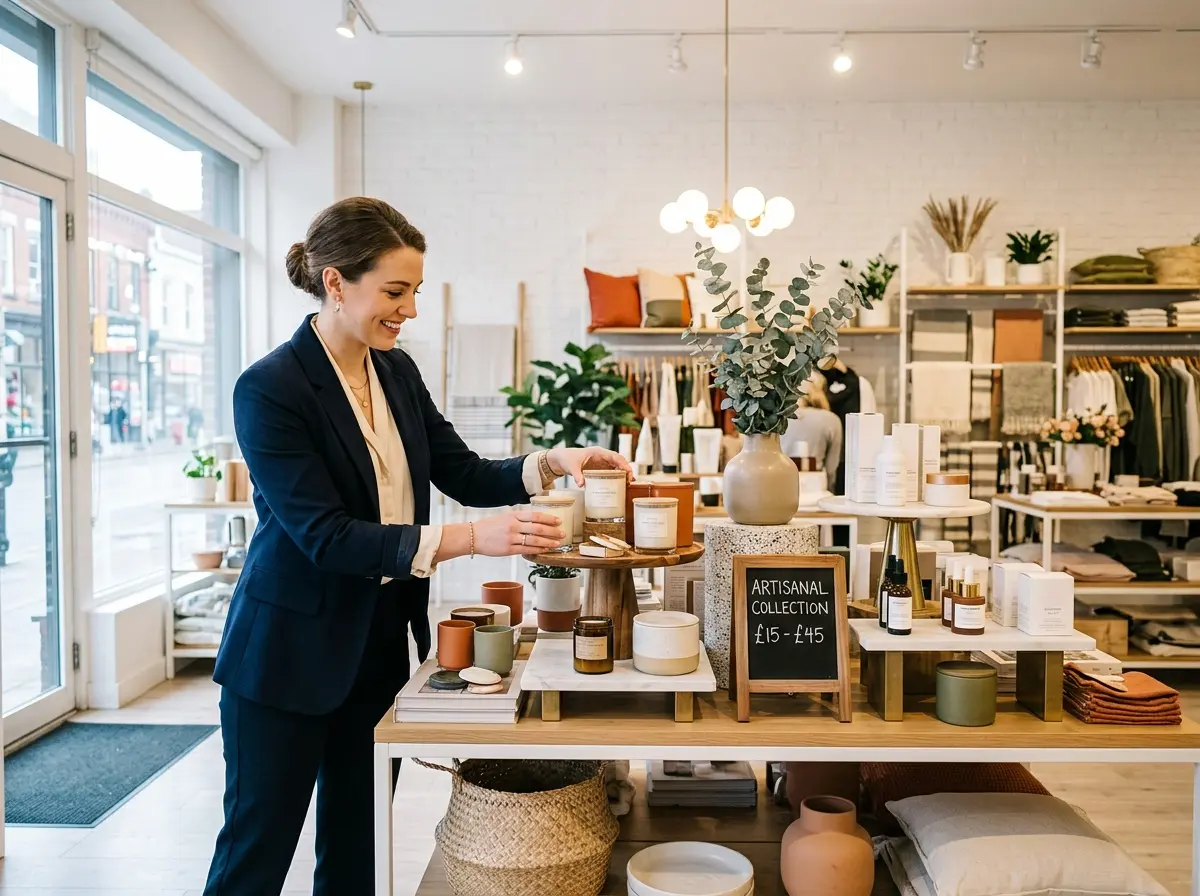
Try this: take three products of varying heights and group them together on a shelf or table. Place the tallest item at the back, a medium-height item to one side, and the shortest item in front. Suddenly, you have depth, movement, and visual interest — all without spending a dime. A gift shop in Portland famously tripled its candle sales simply by regrouping their flat, evenly spaced shelf into tiered clusters of three. Small change, big impact.
Use Height to Your Advantage
Flat displays are flat-out boring (pun intended). Varying the height of your displays creates visual drama and guides the customer's eye through your space. You don't need expensive risers — books, wooden crates, upturned bowls, or even stacked shoeboxes covered with fabric work beautifully. The goal is to create a landscape, not a plateau.
Think of it this way: a mountain range is interesting. A parking lot is not. Your display should be a mountain range. Tall items in the back, shorter items in front, with a few medium-height pieces breaking up the middle. Customers will linger longer, and lingering longer almost always leads to buying more.
Color Blocking: The Lazy Genius Move
Color blocking — grouping items of similar colors together — is one of the simplest and most effective visual merchandising techniques available to you. It creates a clean, curated look that signals professionalism without requiring any actual effort beyond reorganizing what you already have. Retail giants like H&M and IKEA use color blocking religiously, and there's no reason your boutique, bakery, or beauty supply store can't do the same.
Start by sorting your products by color family rather than by category or brand. Yes, it feels counterintuitive. Yes, it works anyway. Customers are drawn to aesthetically pleasing arrangements, and a rainbow-blocked wall of products is genuinely satisfying to look at. Bonus: it also makes restocking easier because gaps in the color block are immediately obvious.
Using Technology to Complement Your Visual Game
Let Your In-Store Experience Do Double Duty
Visual merchandising draws customers in, but keeping them engaged — and informed — is where many businesses drop the ball. Your beautifully arranged display catches someone's eye, but then they have questions: "Does this come in other sizes?" "What's the difference between these two products?" "Is there a current promotion?" And if your staff is busy (or, let's be honest, nowhere to be found), that moment of curiosity often ends in a shrug and a quiet exit.
This is where Stella, the AI robot employee and phone receptionist, fits in nicely. Stella stands inside your store and proactively engages customers as they browse — answering questions about products, highlighting current deals, and even upselling related items. She's basically a knowledgeable salesperson who never needs a break, never calls in sick, and never forgets about your current promotion. She also answers your business phone calls 24/7, so the customer who saw your window display and calls after hours to ask about your hours or pricing gets a real, helpful response instead of a voicemail black hole.
Visual merchandising gets customers interested. Stella keeps them that way — and helps convert that interest into a purchase.
Advanced Tricks That Still Won't Cost You Much
The Focal Point: Give Their Eyes a Destination
Every display needs a focal point — one hero item or arrangement that immediately draws the eye when a customer enters the area. Without a focal point, the eye doesn't know where to start, and the brain interprets that as "overwhelming." Customers don't say "I felt visually overwhelmed by the lack of hierarchical display structure." They say "I didn't see anything I liked" and walk out.
Choose your best-selling, highest-margin, or newest product and make it the undeniable star of the show. Position it at eye level (roughly 4.5 to 5 feet from the floor — the retail sweet spot), light it if possible, and build supporting items around it rather than competing with it. Even a simple spotlight from a clip-on LED can make a product look like it belongs in a museum. Which, at your prices, it practically does.
Storytelling Displays: Sell the Lifestyle, Not Just the Product
The most powerful visual merchandising doesn't just show products — it tells a story. Apple doesn't display laptops; it displays creative workspaces. Williams-Sonoma doesn't sell cookware; it sells Sunday morning brunches with people you love. You can do the same thing on a fraction of the budget.
Create a small lifestyle vignette around your products. If you sell bath products, arrange them around a folded towel, a rubber duck, and a candle. If you sell outdoor gear, prop your items against a background of a trail map and a worn-in hiking boot. The props don't need to be expensive — they need to be evocative. Customers aren't just buying a product; they're buying an idea of who they'll be when they use it. Make that idea visible.
Signage That Actually Gets Read
Most retail signage fails because it either says too much or too little. A sign that reads "New Arrivals" tells a customer nothing useful. A sign that reads "Just landed: our best-selling lavender hand cream — now in three new scents" tells them exactly why they should stop and look. Keep your signage punchy, specific, and benefit-focused. Handwritten signs, believe it or not, often outperform printed ones in smaller retail environments because they feel personal and authentic — just make sure the handwriting is legible, or you'll create a whole different kind of problem.
Use signs to call attention to promotions, bestsellers, or product stories. If an item has an interesting origin or a compelling use case, put it on a small card next to the product. Customers who read that card are already more invested — and more likely to buy.
Quick Reminder About Stella
Stella is an AI robot employee and phone receptionist built for businesses like yours. In-store, she stands as a human-sized kiosk that greets customers, answers product questions, promotes specials, and supports your team without adding to your payroll headaches. For any business, she also handles phone calls around the clock — so your beautiful store and your professional reputation are represented consistently, whether customers visit in person or call at midnight.
Put It All Together: Your Action Plan
Visual merchandising doesn't require a renovation budget or a team of designers. It requires observation, intention, and a willingness to experiment. Start by walking into your store as if you're a customer seeing it for the first time — where does your eye go? What feels cluttered? What feels invisible? Then pick one area and apply the principles above: group in threes, vary the heights, create a focal point, and tell a story.
Here's a simple starting checklist to get you moving:
- Audit your current displays — identify one area that feels flat or cluttered and commit to fixing it this week.
- Apply the Rule of Three — regroup at least one shelf or table into clusters of odd numbers.
- Add height variation — use what you already have (crates, books, risers) to create visual depth.
- Create one focal point display — feature a hero product at eye level with supporting items around it.
- Write one compelling sign — make it specific, benefit-driven, and readable from five feet away.
- Build a lifestyle vignette — choose one product and tell its story with simple, inexpensive props.
Great visual merchandising is a living, evolving process. The stores that do it best rotate their displays regularly, test new arrangements, and pay close attention to what customers actually stop and look at. Start small, iterate often, and don't be afraid to move things around. After all, the worst-case scenario is that you have to rearrange a shelf — and you were probably going to tidy it up anyway.
Your products are great. Now make sure your store knows how to say so.