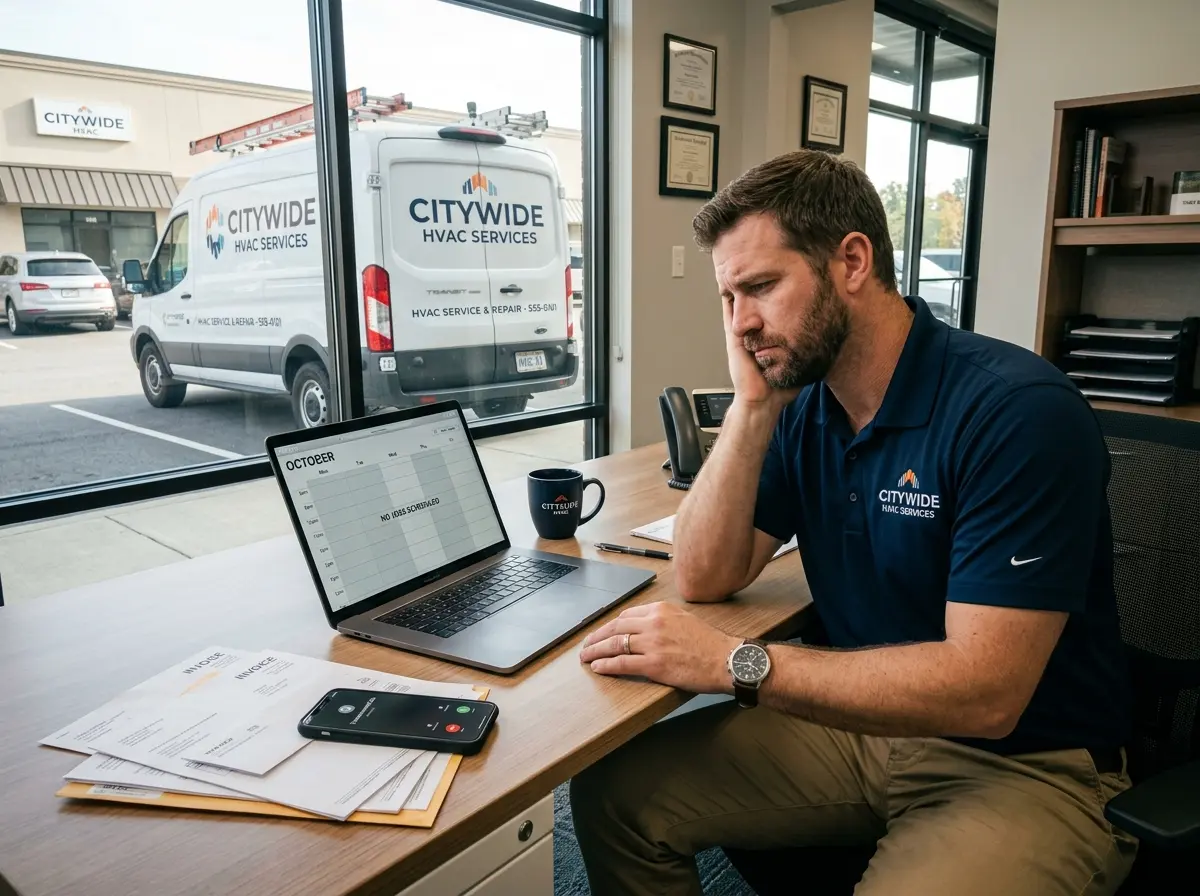
The Call You Never Knew You Missed
Here's a scenario that plays out hundreds of times a day across HVAC companies nationwide: a homeowner's AC unit gives up the ghost on a sweltering Tuesday afternoon. They grab their phone, search "HVAC repair near me," and start calling. The first company that answers gets the job. The second company gets a voicemail left out of desperation. The third company — and everyone after — gets nothing but a hang-up.
Guess which company you are?
If you're running a small-to-mid-sized HVAC operation, there's a very real chance you're losing jobs before your technician has even had a chance to lace up his boots. Not because your work is bad. Not because your prices are off. But because no one picked up the phone. According to a study by Invoca, 65% of people prefer to contact a business by phone, and missed calls in home services industries translate directly to lost revenue — often to a competitor who simply happened to answer.
The good news? This is one of the most fixable problems in your business. Let's dig into where the cracks are and how to seal them up.
Where HVAC Companies Bleed Leads Without Realizing It
The Missed Call Problem Is Bigger Than You Think
Your technicians are on rooftops. Your office manager is knee-deep in scheduling. Your dispatcher is juggling three calls at once. And somewhere in that beautiful chaos, a potential customer called, got voicemail, and called your competitor instead. Studies consistently show that 85% of people whose calls go unanswered will not call back. They move on. In HVAC — where urgency is the entire sales pitch — that window closes in minutes, not days.
It's not just after-hours calls either. Lunch breaks, peak service hours, and unexpected call surges during heat waves or cold snaps are all windows where your phone coverage becomes dangerously thin. A single missed call during a summer heat emergency could represent a $4,000 to $8,000 system replacement job. Do the math on how many of those your team misses in a month, and suddenly a staffing gap that seemed manageable starts looking like a serious revenue problem.
Slow Response Times Kill Conversions
Even when calls are answered eventually, delays are brutal. Research from Lead Connect found that 78% of customers buy from the company that responds first. In HVAC, "first" often means within the first few minutes. If a homeowner leaves a voicemail at 2 PM and someone calls them back at 4 PM, odds are strong they've already booked with someone else — and they're not losing sleep over it.
The same applies to online inquiry forms and web chat. Homeowners searching for HVAC help aren't in a "I'll think it over" mindset. They're in a "my house is 94 degrees and I'm losing my mind" mindset. Speed isn't just a competitive advantage — it's the entire game.
Inconsistent Intake Is Quietly Costing You Jobs
Let's say your call does get answered. Great start. But if the person answering doesn't capture the right information — system type, home size, nature of the issue, warranty status, preferred appointment windows — you're setting your dispatcher and technician up for inefficiency, and the customer experience starts crumbling before anyone's even been dispatched.
Inconsistent intake leads to double callbacks, scheduling errors, and the kind of friction that makes customers feel like they made a mistake calling you. That's the last impression you want to leave on someone you're hoping will become a loyal, repeat customer who refers their entire neighborhood.
A Smarter First Line of Response
How AI Can Plug the Gaps Without Replacing Your Team
This is where technology earns its keep. Stella is an AI robot employee and phone receptionist that answers calls 24/7, captures customer information through conversational intake forms, and hands off to your human staff when the situation calls for it. For HVAC companies specifically, that means every call during a heat wave gets answered — even when your dispatcher is already on three lines and your office manager is on lunch.
Stella doesn't just take a message and hope for the best. She collects the details your team needs — the nature of the issue, the customer's address, their system information, preferred contact times — and logs everything into a built-in CRM with AI-generated customer profiles and push notifications to managers. No more sticky notes. No more "I thought you called them back." Just clean, organized intake that sets your team up for a fast, professional dispatch. For HVAC companies dealing with high call volumes during seasonal surges, this kind of consistent coverage can be the difference between a record month and a frustrating one.
What Your Competitors Are Getting Right (That You're Probably Not)
They've Systematized Their Follow-Up
The top-performing HVAC companies in any market share one quiet habit: they have a system for following up with every lead, every time, without relying on memory or good intentions. Whether it's a CRM that triggers a callback reminder, an automated text confirmation after a call, or a dedicated person whose job it is to close open loops — they've removed the human error from the equation.
If your follow-up strategy is "we try to get back to everyone," that's not a strategy. That's optimism. And optimism doesn't book service calls. Systematized follow-up does. Start by auditing the last 30 days of missed calls and unclosed leads. What you find might be uncomfortable — but it will also show you exactly where to focus your energy first.
They Make Booking Frictionless
The best HVAC companies have made it embarrassingly easy to become a customer. Online booking, instant confirmations, clear communication about what happens next — these aren't luxury features anymore. They're baseline expectations, especially for homeowners under 45 who would genuinely rather book an appointment than talk to a human being on the phone.
Friction is the enemy of conversion. Every extra step — every "let me check and call you back," every form that requires follow-up clarification, every hold that stretches past 90 seconds — chips away at a customer's confidence in your operation. Streamlining your booking and intake process isn't just a customer experience upgrade; it's a direct revenue driver.
They've Stopped Treating Off-Hours as Dead Time
Here's something the savvy operators figured out a while ago: people search for HVAC help at all hours. A unit that dies at 9 PM doesn't wait until 8 AM to be an emergency. Customers who find your business at 10 PM on a Sunday and can actually reach someone — or at least interact with a system that captures their information and gives them a confirmation — are far more likely to be in your schedule Monday morning than customers who hit a dead end and tried again in the morning with fresh Google results.
Off-hours availability isn't just about answering calls. It's about being present when your competitors have clocked out. That window is wider than most HVAC owners realize, and the cost of coverage has never been lower.
Quick Reminder About Stella
Stella is an AI robot employee and phone receptionist that works around the clock for just $99/month — no upfront hardware costs, no turnover, no sick days. She answers calls, collects intake information, manages customer data through a built-in CRM, and keeps your team informed with AI-generated summaries and push notifications. For HVAC companies looking to stop bleeding leads through the cracks, she's worth a serious look.
Stop Losing Jobs You Already Earned
The irony of the missed-call problem is that the lead already found you. They searched, they clicked, they decided to call — and then nothing. All that marketing spend, all that reputation-building, all those years of doing good work in your community — undone by a ringing phone that nobody answered.
The fix isn't always dramatic. Here's where to start:
- Audit your call data. Pull your missed call report for the last 30 days. If your phone system doesn't have one, that's problem number one.
- Standardize your intake process. Define exactly what information needs to be collected on every inbound call and make sure everyone — human or AI — is following that script.
- Close the after-hours gap. Whether it's an AI phone receptionist, an answering service, or a rotating on-call line, make sure no call after 5 PM disappears into a void.
- Speed up your follow-up. Set a hard internal standard: every lead gets a response within 15 minutes during business hours. Then build the systems to actually enforce it.
- Make booking easy. Review your booking flow from the customer's perspective. Count the steps. Eliminate at least two of them.
You've built a business worth calling. Make sure someone — or something — is always there to answer.