Introduction: Accessibility Is the Floor, Not the Ceiling
Congratulations — your store has a ramp, wide aisles, and a handicap-accessible restroom. You've met the legal minimum. You deserve a gold star. But here's the uncomfortable truth: accessibility compliance and genuine inclusivity are two very different things, and your customers who don't fit the "average" mold can tell the difference immediately.
Inclusivity in retail means creating an environment where every customer — regardless of ability, age, language, neurodivergence, or communication preference — feels genuinely welcomed, understood, and served. Not just technically accommodated. According to the CDC, 1 in 4 adults in the United States lives with some form of disability. Add in elderly shoppers, non-native English speakers, and customers with temporary impairments, and you're looking at a massive portion of your customer base who may be quietly struggling — and silently taking their money elsewhere.
The good news? Making your store truly inclusive doesn't require a full renovation or a six-figure budget. It requires intention, smart process changes, and — increasingly — the right technology. This guide walks you through practical, actionable steps to transform your retail space from merely compliant to genuinely welcoming for everyone who walks through your door.
Building a Physically and Sensory-Friendly Environment
Before you tackle policies and technology, let's talk about the space itself. Physical and sensory barriers are often invisible to neurotypical, able-bodied owners — which is exactly why they persist for so long unaddressed.
Physical Layout and Navigation
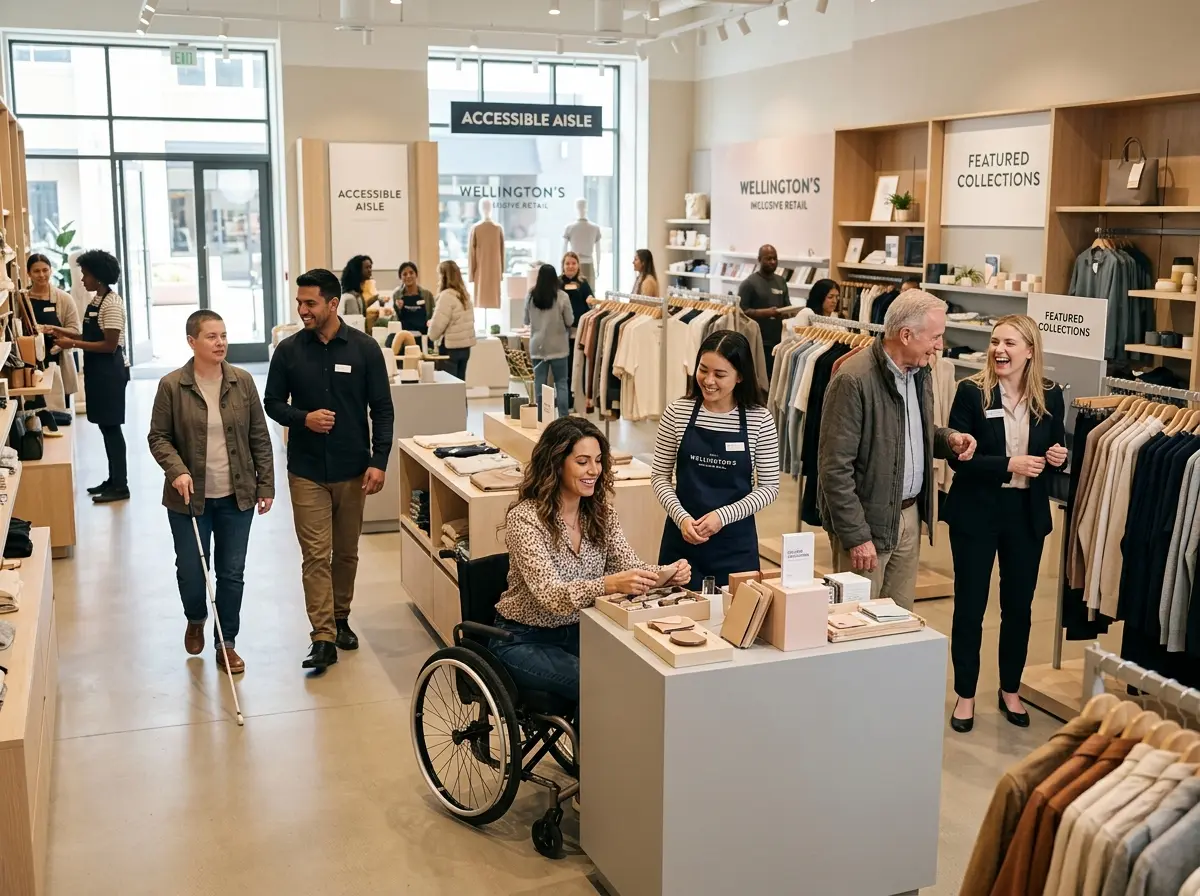
ADA compliance sets a minimum aisle width of 36 inches, but if you want a shopper using a power wheelchair to actually browse comfortably, aim for 44 inches or more. Consider the full journey through your store — not just the entrance. Are your product displays reachable from a seated position? Is your checkout counter at an accessible height? Small fixtures and impulse-buy displays have a habit of creeping into pathways over time, so build in a monthly walkthrough specifically to audit your floor plan from the perspective of someone using a mobility aid.
Signage matters enormously. High-contrast text, large fonts, and clear directional signs help everyone from visually impaired shoppers to exhausted parents chasing toddlers. If your store has multiple sections, floor decals or color-coded zones can make navigation intuitive without requiring customers to ask for help — because not everyone wants to ask for help, and that's completely valid.
Sensory Considerations for Neurodiverse Shoppers
Retail environments are, frankly, sensory battlegrounds. Bright fluorescent lighting, loud background music, overwhelming scents, and cluttered displays can be genuinely distressing for customers with autism spectrum disorder, sensory processing differences, PTSD, migraines, or anxiety. And this isn't a fringe concern — autism alone affects roughly 1 in 36 children in the U.S., and many of those children grow up to be adults who shop.
Consider designating specific "quiet hours" — typically early morning — when music is turned off or lowered, lighting is dimmed, and staff are briefed to minimize unnecessary announcements. Major retailers like Target and Walmart have experimented with this model with significant positive community response. You don't have to redesign your entire store; you just have to be thoughtful about when and how you create sensory intensity.
Clear, Inclusive Signage and Communication
Your signage should do the heavy lifting so your staff doesn't have to explain everything verbally to every single visitor. Use plain language — no jargon, no cleverly vague marketing speak that leaves shoppers guessing. If you carry products relevant to specific health needs or accessibility features, call that out clearly on the shelf. Consider adding QR codes that link to expanded product information, ingredient lists, or how-to guides for customers who need more detail than a price tag can provide.
Technology That Levels the Playing Field
Here's where things get genuinely exciting — and where modern retail has a real advantage over the "we've always done it this way" approach.
How Stella Can Help Create a More Inclusive In-Store Experience
One often-overlooked barrier to inclusion is the social barrier of asking for help. Many customers — particularly those who are deaf or hard of hearing, non-native English speakers, or simply introverted — find it uncomfortable or difficult to flag down a staff member and initiate a conversation. Stella, an AI robot kiosk and phone receptionist, addresses this beautifully. As a friendly, human-sized AI kiosk stationed inside your store, she proactively greets customers and invites interaction on their terms. Customers can engage with her at their own pace, ask questions without social pressure, and get accurate answers about products, services, pricing, and promotions without needing to track down a busy employee.
For customers who prefer to call ahead — perhaps to confirm accessibility features, ask about specific products, or simply avoid uncertainty — Stella also handles phone calls 24/7 with the same knowledge she uses in person. That means a customer with mobility challenges can call Saturday evening to confirm your accessible parking situation before making a trip, and get a real, accurate answer rather than a voicemail. At just $99/month with no upfront hardware costs, she's one of the more practical inclusive-technology investments available to independent retailers.
Staff Training and Inclusive Customer Service Culture
Technology is a powerful tool, but it doesn't replace a well-trained, genuinely empathetic team. If your staff hasn't received meaningful disability awareness or inclusive customer service training, that's a gap worth closing — and closing soon.
Training for Disability Awareness and Communication
The foundation of inclusive service is simple: follow the customer's lead. Don't assume what kind of help someone needs, and never speak to a companion instead of the customer themselves. Train your staff to ask open-ended questions like "How can I help you today?" rather than making assumptions based on appearance or mobility aids. Teach them person-first language (though note that many in the disability community also prefer identity-first language — this is a nuance worth understanding and respecting).
Practical training scenarios go a long way. Role-play interactions with customers who use wheelchairs, customers who are deaf, customers experiencing a sensory overload moment, or customers with cognitive disabilities who may need extra time or simpler explanations. The goal isn't to make staff nervous about saying the wrong thing — it's to build confidence and genuine comfort so they can focus on being helpful rather than awkward.
Building a Culture of Proactive Inclusion
Inclusive service can't just live in a training manual that gets dusted off once a year. It needs to be part of your store's daily culture. That means celebrating when team members go above and beyond for a customer with specific needs, sharing feedback from customers about what's working, and creating a genuine open-door policy for staff to flag barriers they observe on the floor.
Consider appointing an "inclusion champion" on your team — someone who stays current on best practices, liaises with local disability organizations, and keeps inclusive thinking on the agenda at team meetings. This doesn't need to be a separate role or salary; it's simply an ownership of responsibility that ensures the topic doesn't get perpetually bumped for more "urgent" matters.
Language, Representation, and Marketing
Inclusion doesn't stop at your front door — it extends to how you represent your store online, in advertising, and in your physical marketing materials. Are people with disabilities represented in your product photography? Are your promotional emails readable by screen readers? Is your website WCAG 2.1 compliant? These aren't just ethical considerations; they're business ones. Customers notice when they see themselves reflected in a brand — and they notice when they don't.
Use inclusive language across all customer communications. Avoid euphemisms or outdated terminology. And if you're not sure whether something is appropriate, the simplest approach is to consult directly with people from the communities you're trying to serve. Genuine feedback from actual customers with disabilities is worth infinitely more than any internal brainstorm.
Quick Reminder About Stella
Stella is an AI robot employee and phone receptionist that works inside your store as a friendly kiosk and answers your business phone calls 24/7 — no breaks, no bad days, no turnover. She greets customers, answers questions, promotes your current deals, and ensures every visitor gets prompt, knowledgeable attention the moment they arrive or call. At $99/month with easy setup and no upfront hardware costs, she's a practical addition for retail businesses looking to improve the customer experience across the board.
Conclusion: Inclusion Is a Competitive Advantage
Here's the bottom line: a truly inclusive retail store isn't just the right thing to do — it's a smart business decision. The disability market alone represents an estimated $490 billion in disposable income in the United States. Elderly shoppers, parents with strollers, customers recovering from injuries, neurodiverse individuals — these are not niche demographics. They are your customers. And when they find a store that genuinely accommodates and respects them, they return. They tell their friends. They become your most loyal advocates.
Start with an honest audit of your store through fresh eyes — better yet, invite someone with a disability to walk through and give you unfiltered feedback. Then tackle changes in order of impact: physical barriers first, staff training second, sensory environment third, technology fourth. You don't have to solve everything overnight, but you do have to start.
Inclusivity isn't a checklist you complete once and file away. It's a commitment you renew every time you make a decision about your store — from where you place your displays to how you answer your phone after hours. The businesses that understand this aren't just better neighbors. They're better businesses. And in a retail landscape where differentiation is everything, that matters more than ever.