When Your Front Desk Is Costing You More Than Just a Salary
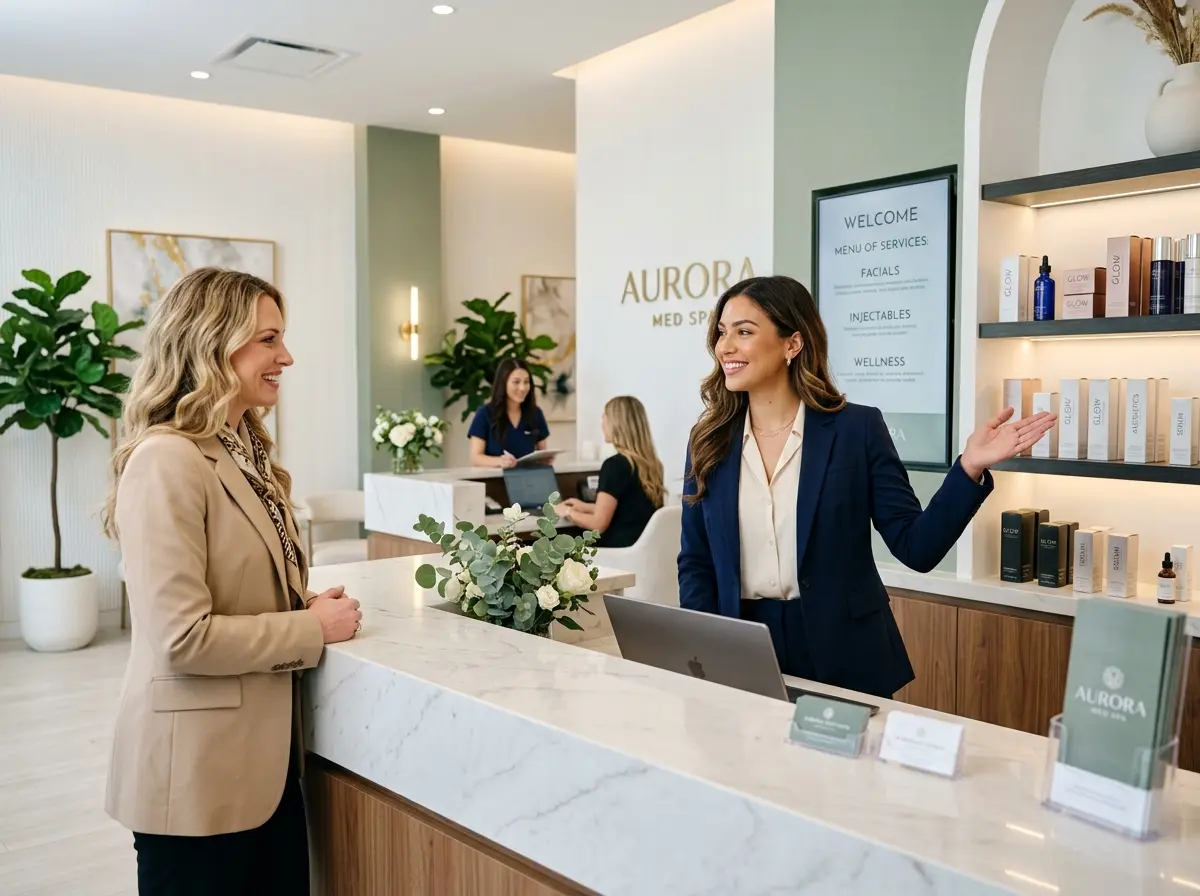
Let's paint a familiar picture: it's a Tuesday afternoon at your medical spa. Three clients are waiting. Your phone is ringing. Your receptionist is mid-booking with a new client and also somehow expected to answer questions about your HydraFacial packages, confirm tomorrow's appointments, and remember to upsell the new lash lift promo. Oh, and take a lunch break at some point. As a human.
If you've ever watched this particular chaos unfold in slow motion, you already know the problem. Booking and front desk management at a busy medical spa is a full-contact sport — and it's quietly eating your staff's time, your operational budget, and your sanity. The average medical spa loses 10–20 hours per week to manual scheduling tasks alone, according to industry estimates. That's practically a part-time employee's worth of hours spent on hold, playing phone tag, and answering "what are your hours?" for the 47th time this week.
The good news? Automation has entered the building. And in this post, we're going to walk through exactly how a medical spa streamlined its entire booking operation, reclaimed 15 hours a week, and managed to keep its clients even happier in the process. No magic wand required — just smart systems and a willingness to stop doing things the hard way.
The Booking Problem Is Bigger Than You Think
Where the Time Actually Goes
Most spa owners, when asked where their time goes, will say something vague like "managing the front desk" or "dealing with scheduling." But when you actually sit down and map it out, the picture becomes a lot more specific — and a lot more alarming. Here's what a typical day at an unautomated medical spa looks like from a time perspective:
- Answering incoming calls about appointment availability: 2–3 hours
- Manually confirming or rescheduling appointments: 1–2 hours
- Responding to after-hours voicemails the next morning: 45–60 minutes
- Answering repetitive questions about services, pricing, and policies: 1–2 hours
- Collecting new client intake information over the phone or via paper forms: 1 hour
Add it up and you're looking at 6–9 hours per day of largely repetitive, automatable work. Multiply that across the week and you've found your missing 15 hours. The real kicker? Much of this work isn't even happening during business hours. Clients want to book at 9 PM when they're finally done with their own workday, and if no one picks up, they move on to the next spa that has an online booking option — or an AI that actually answers the phone.
The Real Cost of Manual Booking
It's easy to think of booking management as "just part of running a business." But there's a hard financial cost hiding in there that deserves a second look. Hiring a full-time front desk receptionist typically costs between $30,000 and $45,000 per year in salary alone, before you factor in benefits, training, turnover, and the weeks where they call in sick right before your busiest Saturday. When that receptionist spends a significant portion of their day on tasks that could be automated, you're essentially paying premium wages for work that a well-configured system could handle for a fraction of the cost.
Then there's the missed revenue from unanswered calls. Studies consistently show that over 60% of callers who reach voicemail don't leave a message — they simply hang up and try a competitor. For a medical spa with premium service pricing, even one missed booking per day can represent hundreds of dollars in lost weekly revenue. That's not a rounding error; that's a real and recurring leak in your business.
How Automation (and a Little AI) Can Help
Where Tools Like Stella Come In
This is where modern AI receptionist technology starts to look genuinely compelling rather than just futuristic and slightly intimidating. Stella is an AI robot employee and phone receptionist designed specifically for businesses like medical spas. She can answer every incoming call 24/7, handle questions about services, pricing, and availability, collect new client intake information through conversational forms, and even forward calls to a human staff member when the situation genuinely requires it.
For spas with a physical location, Stella also operates as a human-sized in-store kiosk, greeting walk-in clients proactively, promoting current specials, and answering questions so your licensed staff can stay focused on delivering treatments rather than fielding "do you do microblading?" from the waiting room. Her built-in CRM automatically builds client profiles, logs interactions, and captures intake data — which means less paperwork, fewer dropped details, and a smarter record of who your clients are and what they care about. At $99 per month with no upfront hardware costs, she's considerably easier to onboard than your last receptionist.
The 15-Hour Turnaround: A Real-World Example
What the Spa Changed (and Why It Worked)
A mid-sized medical spa offering services like Botox, fillers, laser treatments, and facials was running lean — two part-time receptionists, one full-time, and a backlog of voicemails every single morning. The owner estimated her team was spending close to three hours every day just managing phone inquiries and scheduling, and that didn't include the time lost to no-shows that could have been reduced with better confirmation workflows.
The first change was implementing an AI phone receptionist to handle all incoming calls. Overnight, the "missed call" problem disappeared. Clients calling after hours received a real, conversational response — not a voicemail prompt — and could get answers to their questions or complete a booking intake while the spa was closed. Within the first week, the morning voicemail backlog shrank by over 80%.
The second change was integrating automated appointment reminders and confirmations into the workflow. Clients received text and email reminders 48 hours and 24 hours before their appointments, with easy rescheduling options built in. No-show rates dropped by approximately 30% within the first month. That alone recovered several billable hours of treatment time per week.
The Compounding Effect Nobody Talks About
Here's the part that doesn't show up in the initial ROI calculation but absolutely should: when your front desk staff isn't buried in repetitive administrative tasks, they become dramatically more effective at everything else. The spa's remaining reception team went from frantic and reactive to calm and client-focused. They had time to have real conversations with clients, actually promote new services, and handle the genuinely complex situations that require a human touch — rather than spending their shifts on hold with a client who just wants to know if you're open on Sundays.
Staff satisfaction improved. Client experience improved. And the owner reclaimed enough time in her own week to focus on actually growing the business rather than troubleshooting the operational equivalent of a slow leak in the roof. The 15 hours weren't just "saved" — they were redistributed into work that actually moved the needle.
Actionable Steps You Can Take Right Now
You don't need to overhaul everything at once. Here's a practical sequence for a medical spa looking to automate its booking operations without losing its mind in the process:
- Audit your current time spend. Track how many hours per week go toward inbound calls, scheduling, confirmations, and intake. The number will probably surprise you.
- Identify your highest-friction touchpoints. Is it after-hours calls? New client intake? Rescheduling? Start there.
- Implement AI phone coverage first. This is typically the fastest win — 24/7 call answering eliminates missed revenue and frees your team immediately.
- Set up automated reminders. Even simple text reminders can reduce no-shows significantly and require almost zero ongoing effort once configured.
- Centralize your client data. Make sure intake information flows into a CRM so nothing gets lost in sticky notes and email threads.
A Quick Reminder About Stella
Stella is an AI robot employee and phone receptionist built for businesses of all sizes — including medical spas, salons, gyms, and service providers who are tired of watching revenue walk out the door because no one picked up the phone. She works in-store as a conversational kiosk and answers calls around the clock, with a built-in CRM, intake forms, and smart call forwarding — all for $99 a month with no upfront hardware costs and no sick days. Ever.
It's Time to Stop Trading Hours for Headaches
The medical spa in this story didn't do anything revolutionary. They didn't reinvent their services, rebrand, or hire a consultant to tell them what they already knew. They just stopped doing things manually that didn't need to be done manually — and the results were immediate, measurable, and compounding.
If your front desk is your biggest operational bottleneck, the solution probably isn't hiring another receptionist. It's building a system that handles the repetitive work reliably so your people can focus on the work that actually requires them. Start small, measure honestly, and automate incrementally. The 15 hours are in there — you just have to be willing to go find them.
Ready to see what that looks like for your spa? Take a hard look at your current booking workflow this week and identify the single most time-consuming task your front desk handles. Then ask yourself: does this actually need a human? More often than not, the honest answer is no — and that's where your 15 hours are hiding.