Your Customers Are Texting Everyone Else — Why Not You?
Let's paint a familiar picture: a customer is sitting in your waiting room, staring at a three-year-old magazine, wondering if their car is going to cost them a vacation or just a weekend. They have questions. They want updates. But instead of asking your front desk staff — who are already juggling three phone calls and a walk-in — they just... wait. Silently. Stewing.
Meanwhile, in their personal life, they've already texted their dentist to confirm an appointment, chatted with their bank's support bot, and gotten a delivery update from Amazon. The bar for communication convenience has never been higher, and auto shops that ignore this reality are leaving both customer satisfaction and serious revenue on the table.
Here's the good news: building a text-based customer support system for your auto shop doesn't require a six-figure IT budget or a team of developers. It requires a little strategy, the right tools, and the willingness to meet your customers where they already live — on their phones. This guide will walk you through exactly how to do it.
Building the Foundation of Your Text Support System
Choose a Dedicated Business Texting Platform
First things first — do not, under any circumstances, use your personal cell phone to text customers. We know it seems harmless at first, but the moment you're fielding "Is my Civic ready?" texts at 10 PM on a Sunday, you'll understand why boundaries matter. You need a dedicated business texting platform that keeps all communications organized, trackable, and separated from your personal life.
Look for platforms that offer two-way SMS messaging, message templates, conversation history, and ideally some level of automation. Popular options in the auto shop space include Podium, Kenect, and ServiceTitan's built-in messaging features. When evaluating platforms, prioritize ease of use for your staff — because the most powerful tool in the world is useless if your service advisors refuse to actually use it.
According to SimpleTexting, SMS messages have an open rate of around 98%, compared to roughly 20% for email. That alone should be enough to make you take texting seriously as a customer communication channel.
Define What Your Text System Will Handle
Not every customer interaction belongs in a text thread, and trying to do everything via SMS will create chaos fast. Be intentional about what your text support system is designed to handle. Common use cases for auto shops include appointment reminders and confirmations, service status updates ("Your oil change is done — we also noticed your air filter is looking rough"), estimate approvals, and post-service follow-ups requesting reviews.
What text support is not ideal for: complex diagnostic explanations that require a real conversation, disputes or complaints that need a human touch, or anything involving sensitive financial negotiations. Have a clear internal policy so your staff knows when to keep it in text and when to pick up the phone or walk over to the waiting area.
Set Up Message Templates and Automation
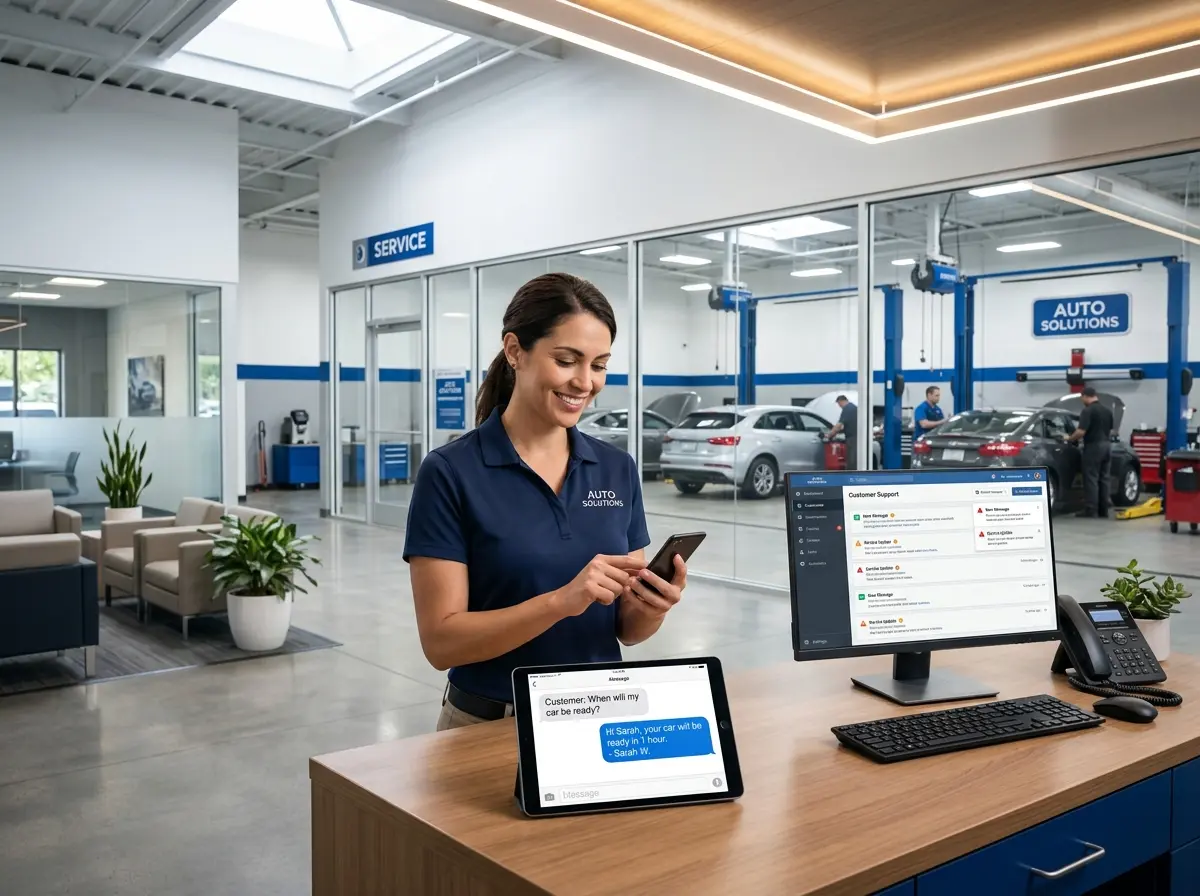
Your service advisors are busy. If texting customers feels like yet another manual task piled onto their day, adoption will be poor and inconsistent. The solution is to build out a library of message templates for your most common scenarios — appointment confirmations, "your car is ready" notifications, estimate approvals, and review requests — so sending a professional message takes five seconds, not five minutes.
Most business texting platforms also allow automated triggers. For example, when a repair order is marked "complete" in your shop management software, an automated text can fire off to the customer letting them know. This kind of automation doesn't just save time — it makes your shop look impressively organized and customer-focused, even if the reality is controlled chaos behind the counter.
Keeping Customers Informed Without Overwhelming Your Staff
Automate the Updates That Eat Up Your Day
If you ask most service advisors what consumes a disproportionate amount of their time, "answering the same five questions over and over" usually ranks near the top. "Is my car ready?" "Did you find anything else?" "How much is this going to cost?" These are entirely legitimate questions — but when they come in via phone every 45 minutes from the same customer, it adds up to a significant operational drain.
A well-designed text support system solves this elegantly. Proactive status updates — sent at key milestones like vehicle check-in, inspection complete, estimate sent, and repair finished — dramatically reduce inbound calls. Customers feel informed and respected, and your staff can focus on actually completing the work rather than narrating it in real time. It's one of those rare wins where the customer experience improves and your team gets their sanity back simultaneously.
How Stella Can Reinforce Your Communication Strategy
While your text system handles outbound updates, your phone lines still need coverage — and that's where Stella, the AI robot employee and phone receptionist, becomes a genuinely useful ally. Stella answers calls 24/7 with the same knowledge your staff uses in person, which means customers calling after hours to ask about services, hours, or pricing get real answers instead of voicemail. For auto shops with a physical waiting area, Stella's in-store kiosk presence also means walk-in customers can get immediate assistance — asking about services, current promotions, or wait times — without interrupting a service advisor mid-conversation.
Stella also includes a built-in CRM with intake forms, so customer information collected during phone calls or at the kiosk feeds directly into organized contact profiles — giving your team better context for every interaction without the manual data entry headache.
Turning Text Support Into a Revenue and Loyalty Engine
Use Texts to Drive Upsells and Approvals
Here's where text-based communication starts to pay for itself in a very tangible way. When a technician discovers that a customer's brake pads are borderline and they'd previously only come in for an oil change, your old workflow might involve a phone call that goes to voicemail, followed by a callback attempt, followed by the customer just picking up their car without the additional work done.
With a text-based approval system, you can send a concise message with the issue, the estimated cost, and a simple "Reply YES to approve / Reply NO to decline" format. Approval rates for text-based estimates consistently outperform phone-based approvals because customers can respond on their own time, review the message without pressure, and feel in control of the decision. Some shops report approval rate improvements of 20–30% after switching to text-based estimate approvals — and that translates directly to additional revenue per repair order.
Build Long-Term Loyalty with Post-Service Follow-Up
The work doesn't end when the customer drives off the lot. A thoughtful follow-up text sent 24 to 48 hours after service — asking if everything is running well and including a link to leave a Google review — is one of the highest-ROI touchpoints your shop can implement. It's low effort, feels genuine (especially if it references the specific service performed), and directly contributes to your online reputation.
Beyond reviews, consider building a simple re-engagement sequence. Customers who haven't visited in six months can receive a friendly check-in text with a seasonal maintenance reminder or a limited-time offer. This kind of proactive outreach keeps your shop top of mind without the awkwardness of a cold call. Done right, it feels like good service rather than marketing — and that's exactly the tone you want to strike.
Measure What's Working and Refine Over Time
A text support system isn't a "set it and forget it" tool — it's a communication channel that should improve as you learn more about what your customers respond to. Track metrics like response rates on estimate approval texts, review generation rates from follow-up messages, and reductions in inbound call volume. Most texting platforms provide at least basic analytics, and even a simple monthly review of these numbers will surface opportunities to refine your templates and timing.
Pay attention to which automated messages generate questions or confusion — those are signals that the message needs to be clearer. And periodically ask your service advisors for feedback on what's working in practice, since they're the ones interfacing with the system daily. The shops that treat their text support system as a living, evolving tool will consistently outperform those that set it up once and never look back.
A Quick Reminder About Stella
Stella is an AI robot employee and phone receptionist designed for businesses exactly like yours — greeting customers, answering calls around the clock, managing intake, and supporting your team without burnout or sick days. At $99/month with no upfront hardware costs, she's available for auto shops of any size. Whether she's standing in your waiting room helping customers or answering after-hours calls with accurate, professional responses, she's built to make your operation look sharp and run smoother.
Your Next Steps Start Today
Building a text-based customer support system for your auto shop is not a moonshot project — it's a series of practical, achievable steps that compound into a significantly better customer experience and a more efficient operation. Start by selecting a business texting platform that integrates with your shop management software. Build out a core set of message templates for your highest-frequency scenarios. Implement automated status updates so your team isn't manually narrating every repair. Then layer in text-based estimate approvals and post-service follow-ups to capture additional revenue and reviews.
As your text system handles the day-to-day communication load, make sure your phone and in-person touchpoints are equally covered — because customers who can't reach you will find a shop that they can. The combination of a solid texting strategy and reliable front-line support, whether human or AI-assisted, is what separates the auto shops customers return to year after year from the ones they used that one time and forgot about.
Your customers are already texting everyone else. It's time to get in the conversation.