When Families Move, Someone Needs to Find a New Dentist — Why Not Yours?
Let's be honest: most pediatric dentists don't think of themselves as marketers. They think of themselves as people who convince terrified six-year-olds to open wide while a masked stranger pokes around with sharp metal tools. Heroic work, truly. But here's the thing — being exceptional at what you do doesn't automatically fill your waiting room with new patients. Especially when a significant chunk of your potential patient base just pulled a moving truck into the neighborhood and has absolutely no idea you exist.
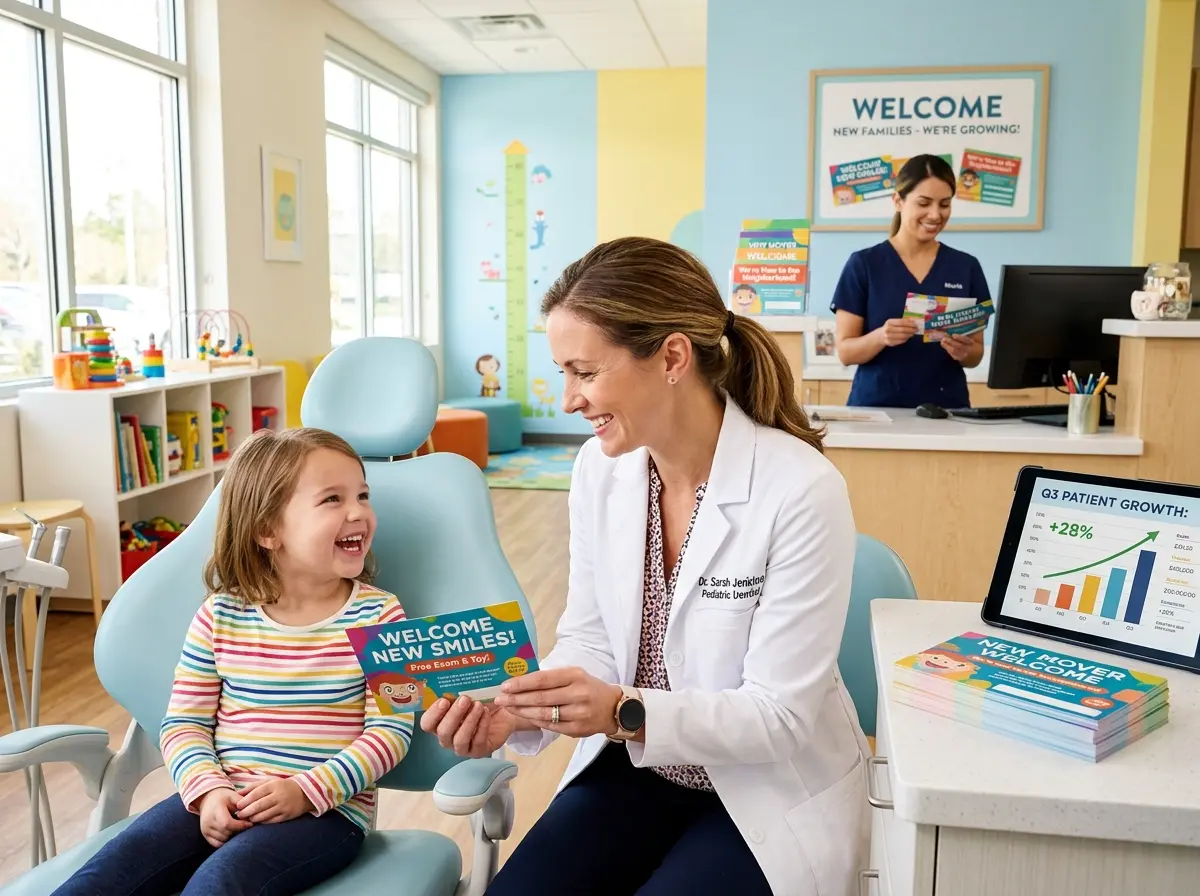
That's exactly the situation Dr. Amanda Chen found herself in. Her pediatric dental practice was solid — great reviews, loyal families, a team that actually liked coming to work. But growth had plateaued. She needed a reliable stream of new patients, not just referrals from existing ones. So she tried something refreshingly old-school in a world obsessed with TikTok algorithms: a targeted mailer campaign aimed specifically at new movers. The result? 30% practice growth in a single year.
Here's how she did it, why it worked, and what you can steal from her playbook — even if your business has nothing to do with teeth.
The New Mover Opportunity Most Businesses Are Completely Ignoring
New Families Are Actively Looking for Local Services
When a family moves to a new area, they don't already have a pediatric dentist. They don't have a go-to pizza place, a trusted mechanic, or a favorite hair salon either. They are, in marketing terms, wide open. Research from the direct mail industry consistently shows that new movers spend significantly more in their first six months in a new home than established residents — some studies put that figure at two to five times more. They're building their entire local ecosystem from scratch, and whoever reaches them first with a compelling offer has a massive advantage.
Dr. Chen understood this intuitively. A family with two kids under ten who just moved across town isn't going to wait a year to find a dentist. They need one now. The question is simply whether they'll find her practice or her competitor's.
Why Direct Mail Still Works (Yes, Really)
Direct mail has the reputation of being your grandmother's marketing strategy, but the data tells a more interesting story. According to the Data & Marketing Association, direct mail achieves a response rate of roughly 4.4% — compared to email's average of around 0.12%. When your mailbox only gets three pieces of actual mail per week, a well-designed postcard stands out. It's tactile, it's visible, and it doesn't get filtered into a spam folder.
For Dr. Chen, the physical nature of the mailer mattered. Parents stuck it on the refrigerator. They referenced it weeks later when their child's cleaning was finally overdue. It had staying power that a Facebook ad simply doesn't.
How She Set Up the Campaign
Dr. Chen worked with a new mover mailing list service — several reputable ones exist, including USPS's Every Door Direct Mail program and commercial providers like New Mover Marketing or Vericast — to target households with children that had moved within a defined radius of her practice in the past 30 to 60 days. She sent a simple, friendly postcard that included a welcoming message, a brief description of her practice's kid-friendly environment, and a clear introductory offer: a complimentary new patient exam for new movers.
The campaign ran consistently every month, not as a one-time blast. That consistency was critical. New families were moving in continuously, and she wanted to be the first dental practice they heard from — every single month.
How Technology Helped Her Practice Actually Handle the Growth
The Problem With Working Harder Without Working Smarter
Here's a problem nobody warns you about: what happens when your marketing actually works? Dr. Chen's phones started ringing more. New families were calling to ask about services, hours, insurance acceptance, and how to book that introductory exam. Her front desk team — already handling check-ins, billing, and the general organized chaos of a pediatric office — was getting stretched thin.
This is where a tool like Stella becomes genuinely useful for a practice like hers. Stella is an AI robot employee and phone receptionist that answers calls 24/7, handles routine questions about services, hours, and promotions, and can collect new patient intake information through conversational forms — all without putting a single extra task on your front desk team's plate. For a pediatric dental office fielding a surge of "we just moved here, do you take new patients?" calls at 7pm, that kind of always-on coverage is not a luxury. It's a practical necessity. Stella also includes a built-in CRM to track new contacts, tag them by source (like "new mover mailer"), and keep everything organized as your patient pipeline grows.
Building a Campaign That Actually Converts Calls Into Patients
Craft an Offer That Earns a Response
A mailer without a compelling offer is just a very expensive piece of paper. The key is to lead with value, not with a sales pitch. Dr. Chen's complimentary new patient exam worked because it removed the financial barrier for a family that was already juggling moving costs. They had nothing to lose by calling.
Your offer doesn't need to be free to be effective. It simply needs to feel like a genuine gesture of welcome. A discounted first visit, a complimentary add-on service, or a small gift for new patients are all approaches that communicate generosity and lower the barrier to that first contact. The goal of the mailer is one thing: get them to pick up the phone or visit your website. The conversion happens after that.
Make It Easy to Respond — and Respond Quickly
One of the fastest ways to waste a good mailer campaign is to be hard to reach when the calls come in. Response time matters enormously. Studies on lead response suggest that the odds of qualifying a new lead drop dramatically — some research puts it at over 80% — if you don't respond within the first five minutes of contact. New movers are often making quick decisions. If they call and get voicemail, there's a real chance they're calling the next practice on their list before you call them back.
This means your phone system needs to be as ready for the campaign as your mailers are. Make sure your hours are accurate everywhere, your voicemail is professional, and your callback process is fast. Pair your mailer with a clear call-to-action — a phone number, a website URL, or even a QR code linking to a booking page — and make every path to contact frictionless.
Track, Measure, and Refine
Dr. Chen tracked the source of every new patient inquiry during her campaign, which is how she knew the mailers were working. This is a step many small business owners skip, and it's a mistake. If you don't know which marketing efforts are producing results, you're essentially flying blind with your budget.
Simple tracking methods include using a dedicated phone number on your mailers, asking new patients directly how they heard about you, or adding a unique promo code to the mailer offer. Over time, this data tells you how many new patients the campaign is generating per month, what your cost-per-acquisition looks like, and whether it's worth scaling up. For Dr. Chen, the numbers made a strong case: the campaign's monthly cost was comfortably covered by the lifetime patient value of just one or two new families.
Quick Reminder About Stella
Stella is an AI robot employee and phone receptionist designed to help businesses of all kinds — including medical and dental offices — handle customer interactions without burning out their staff. She answers calls around the clock, promotes your current offers, collects intake information, and keeps everything organized in a built-in CRM. At $99/month with no upfront hardware costs, she's a practical upgrade for any practice experiencing growth.
Your Next Steps: Steal This Strategy
Dr. Chen's 30% growth didn't happen because she invented something revolutionary. It happened because she identified a high-intent audience — new movers — delivered a relevant, welcoming message at exactly the right moment, made it easy to respond, and stayed consistent month after month. That's a replicable formula for virtually any local business.
Here's where to start:
- Define your new mover radius. How far are your customers realistically willing to travel? For most local businesses, this is somewhere between two and ten miles. That's your target zone.
- Choose a new mover list provider. USPS Every Door Direct Mail is cost-effective for broad coverage. Commercial providers offer more demographic filtering if you want to target families, homeowners, or specific income brackets.
- Create a simple, compelling offer. Make it feel like a welcome gift, not a sales tactic. Keep the mailer clean, warm, and easy to act on.
- Commit to monthly sends. People move every single month. A one-time campaign captures this month's movers. A recurring campaign builds a steady pipeline.
- Make sure you're ready to receive the response. Fast phone pickup, a professional first impression, and a smooth intake process will determine whether your mailer investment actually converts into revenue.
New families are moving into your area right now. They need a dentist, a restaurant, a gym, a salon, or whatever it is you offer. The only question is whether they're going to find you first — or find your competitor. A well-executed new mover campaign is one of the most straightforward ways to make sure the answer is you.
Now go get those refrigerator magnets ready.