Stop Wasting Your Team's Time on Leads Who Were Never Going to Buy
Let's paint a familiar picture: your staff spends 20 minutes on the phone with someone who has three pages of questions, a very specific budget of "as cheap as possible," and absolutely no intention of booking anything today. Meanwhile, a genuinely qualified lead tried to call, got a busy signal, and went straight to your competitor. Lovely.
The dirty secret of running a customer-facing business is that not all inquiries are created equal — but most businesses treat them like they are. Every call gets the full-service treatment, every walk-in gets the same pitch, and your team burns through energy on tire-kickers while hot leads slip through the cracks. The fix isn't hiring more staff. It's qualifying smarter, before anyone even picks up the phone.
Enter the intake form — not the boring, PDF-attached-to-an-email kind, but a fast, conversational, five-minute experience that gently separates the serious buyers from the browsers. Done right, it saves your team hours every week and actually improves the customer experience at the same time. Here's how to build one that works.
Why Most Intake Forms Fail (and What to Do Instead)
The Form That Feels Like a Tax Return
Most intake forms were clearly designed by someone who has never had to fill one out. Forty fields, mandatory checkboxes for things that don't apply, a file upload that doesn't work on mobile, and a submit button that does nothing for three seconds before returning an error. Customers abandon these forms at staggering rates — studies suggest that reducing form fields from 11 to 4 can increase conversions by up to 120%. That's not a rounding error. That's a completely different business outcome.
The goal of a qualifying intake form is not to collect every possible piece of information about a person before you'll agree to talk to them. It's to collect the right information — just enough to determine whether this person is a good fit, what they need, and how urgently they need it. Think of it less like a questionnaire and more like the first few minutes of a really good sales conversation.
What "Qualifying" Actually Means in This Context
Qualifying a lead means identifying whether they meet the basic criteria to become a paying customer. Depending on your business, that might mean confirming they're in your service area, that their timeline aligns with your availability, that their budget is in the right ballpark, or simply that they understand what you actually offer. None of these things require a 30-minute consultation. They require three to five smart questions, asked at the right moment.
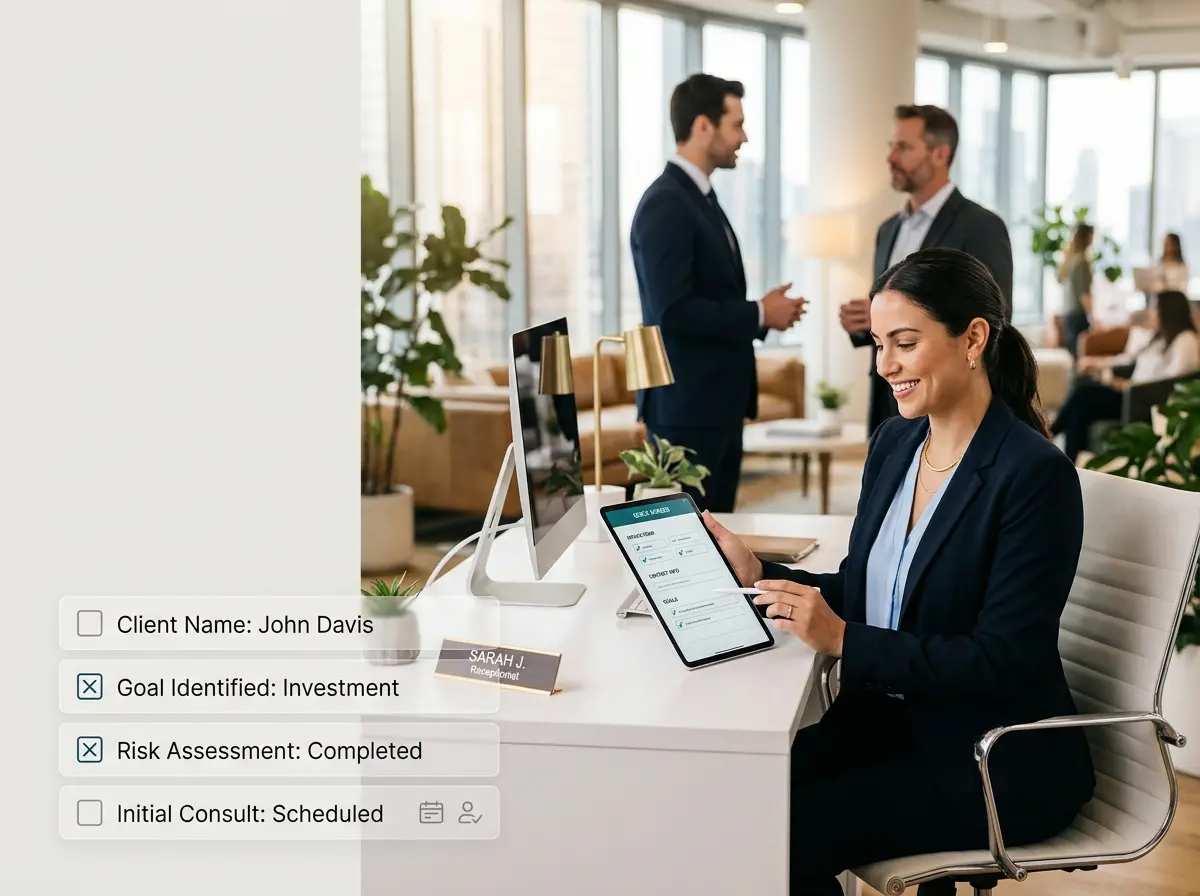
A well-designed intake form addresses four core areas: who they are (name, contact info), what they need (service or product interest), when they need it (timeline and urgency), and how serious they are (budget range, prior research, decision-making authority). That's it. Anything beyond that can wait for the actual conversation — which, thanks to the form, will be far more productive.
Timing and Placement Matter More Than You Think
A qualification form that lives three clicks deep on your "Contact Us" page is a form that nobody fills out. For maximum effectiveness, your intake experience should appear at natural moments of high intent — after someone clicks "Book a Consultation," during a phone call before being connected to staff, or proactively when a customer is actively browsing. The moment of interest is fleeting. Capture it then, not later.
Building Your 5-Minute Qualifying Form
The Five Questions Every Intake Form Needs
You don't need a committee meeting to design this. You need five questions that do real work. Start with a warm, low-friction opener — something like "What brings you in today?" or "What can we help you with?" This sets a conversational tone and gets the customer thinking about their need, not about filling out a form.
From there, move into your qualifying criteria. For a medical spa, that might be "Have you had this treatment before?" For a law firm, it might be "Do you have an upcoming deadline or court date?" For a gym, it might be "Are you looking for personal training, group classes, or just a membership?" These aren't trick questions — they're genuinely useful for routing the right customer to the right staff member, and they signal to serious buyers that your business is organized and professional.
Finish with a timeline question and a preferred contact method. That's your form. Five questions, five minutes, done.
How to Use the Data Before the First Conversation
The real magic of a qualifying intake form isn't the form itself — it's what happens with the data afterward. When your staff knows, before picking up the phone or walking over to a customer, that this person is a returning client interested in a specific upgrade with a two-week timeline and a flexible budget, they can skip the small talk and go straight to value. That's a better experience for the customer and a more efficient use of your team's time.
Build a simple routing system around your intake responses. High-urgency leads with clear budgets go straight to your most experienced closer. General inquiries with no timeline get a nurture email sequence. Out-of-area requests get a polite, quick redirect. This doesn't have to be complicated — even a basic tagging system in a CRM can accomplish it effectively.
How Stella Handles Intake Automatically
Stella was built with exactly this workflow in mind. As an AI robot employee and phone receptionist, she collects intake information conversationally — whether a customer calls in, walks up to her in-store kiosk, or engages through a web form. She asks your qualifying questions naturally, without making the customer feel like they're being screened, and stores every response directly in her built-in CRM with custom fields, tags, and AI-generated contact profiles.
For businesses that receive a high volume of calls, Stella is particularly valuable because she can handle the entire intake process before a human ever gets involved — forwarding only the calls that meet your criteria, and sending AI-generated summaries for everything else. Your staff walks into every qualified conversation already briefed, without lifting a finger to collect the background information themselves.
Turning Qualified Leads Into Booked Clients
Don't Let Qualified Leads Go Cold
Here's the part most businesses get wrong: they build a decent intake process, collect genuinely useful information, and then let it sit in an inbox for two days. By the time someone follows up, the customer has already booked with someone else. Speed-to-response is one of the strongest predictors of conversion — research from Harvard Business Review found that companies that respond to leads within an hour are nearly seven times more likely to qualify that lead than those who wait even 60 minutes longer.
This means your intake form needs to trigger an immediate action — whether that's an automated acknowledgment email, a push notification to the right team member, or a direct call transfer. The form qualifies the lead; your response speed closes the gap. Don't do all the hard work of building a smart intake system and then blow it by waiting until Monday morning to follow up.
Continuous Improvement: Treating Your Form Like a Living Document
Your intake form is not a set-it-and-forget-it tool. Review it quarterly. Are certain questions consistently left blank? Remove them. Are customers frequently asking a question during their first call that could have been answered in the form? Add it. Are you seeing a pattern in the leads who convert vs. those who don't? Let that inform your qualifying criteria.
Pay particular attention to the drop-off point — if most customers abandon the form after question three, question three is the problem. Rewrite it to be clearer, less invasive, or more obviously relevant to their outcome. Small adjustments in language and order can have outsized effects on completion rates and lead quality.
Matching Your Form to Your Industry
A qualifying intake form for a high-end salon looks different from one for an auto shop, which looks different from one for a law firm. Take the time to tailor your questions to the specific signals that predict a good client in your business. A spa might want to know about skin sensitivities and previous treatments. An auto shop needs the year, make, and model upfront. A consultant needs to know the size and type of the client's business before the conversation even starts. Generic forms get generic results. Specificity signals professionalism and filters out the wrong fits before they consume your team's time.
A Quick Word About Stella
Stella is an AI robot employee and phone receptionist that works for businesses of all sizes — greeting customers in-store, answering calls 24/7, and collecting intake information automatically through conversational forms. She runs on a $99/month subscription with no upfront hardware costs, integrates with her own built-in CRM, and never calls in sick. If your team is still doing intake manually, she's worth a very close look.
Start Qualifying Smarter — Your Team Will Thank You
The businesses that win aren't always the ones with the biggest teams or the most ad spend. They're the ones that use their team's time strategically — and that starts with knowing, before any conversation begins, whether the person on the other end is actually ready to buy.
Here's your action plan: Sit down this week and identify the three to five questions that, if you knew the answers before a conversation, would completely change how you approach it. Build those into a short, conversational intake form. Place it at every high-intent touchpoint — your booking page, your phone intake process, and if you have a physical location, your in-store experience. Set up a simple routing system so that responses trigger the right next action immediately. Then review it in 30 days and refine based on what you learn.
You built your business by being good at what you do — not by fielding three-hour phone calls from people who were never going to commit. Give your team the gift of qualified conversations, and watch what they can actually accomplish when they're not stuck in intake purgatory.