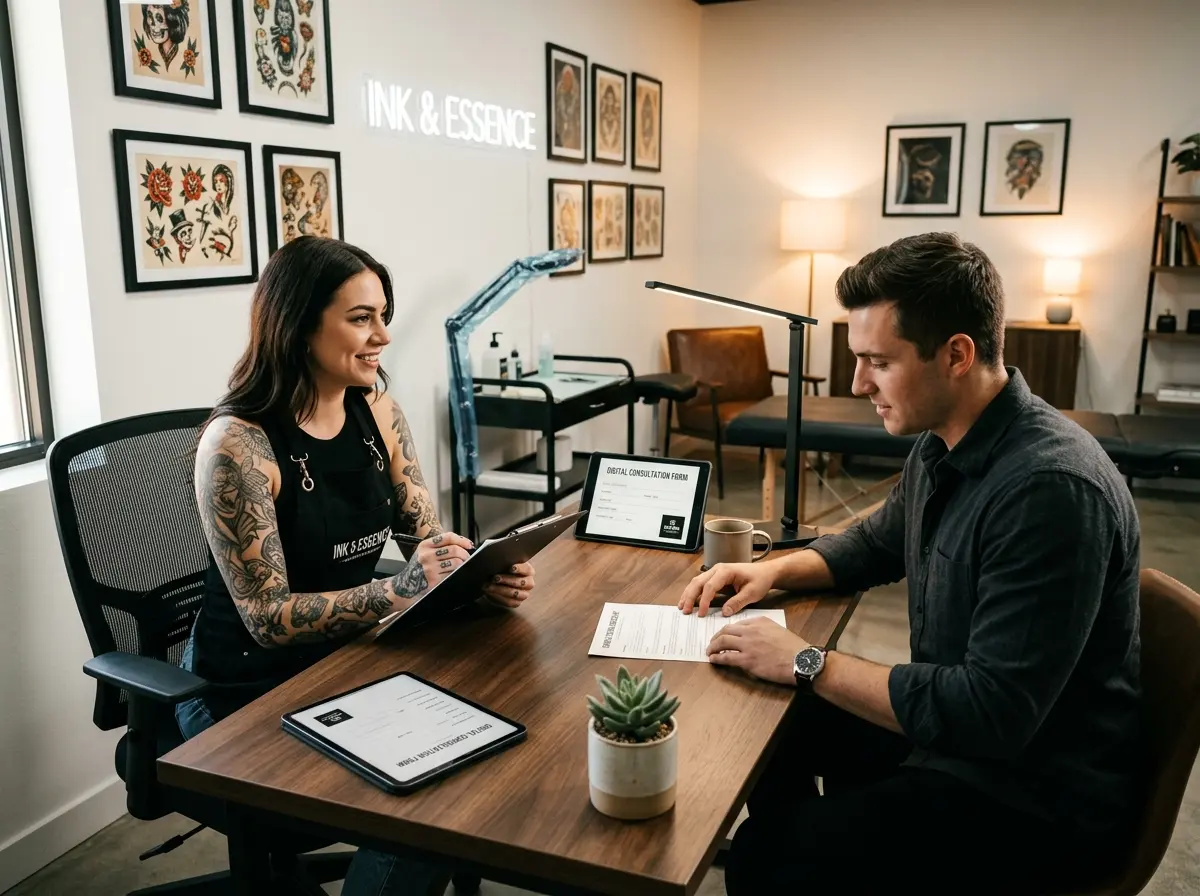
So You're Tired of Tattooing "Whatever Fits" on Walk-Ins Who Had No Idea What They Wanted
Let's set the scene. Someone walks into your studio, sits down across from your best artist, and when asked what they're looking for, says: "I don't know... something cool. Maybe a wolf? Or like, a compass? Can you just come up with something?" Your artist smiles. Professionally. Internally, they are somewhere else entirely.
Running a tattoo studio is an art business — literally — and like any creative business, it lives and dies by client communication. The problem is that most studios are still relying on Instagram DMs, walk-ins, and vibes to bring in new clients. The result? Mismatched expectations, wasted consultation time, no-shows, and artists who spend more time managing confusion than making art.
Enter the consultation form. Not the dusty paper kind you photocopy at the office supply store. A properly designed client intake and pre-qualification form that filters out the vague, the unprepared, and the budget-mismatched — before they ever sit down in your chair. This post will walk you through how to build one, what to put in it, and how to make it work for your studio.
Why Most Tattoo Studios Waste Time on the Wrong Clients
The Cost of an Unqualified Consultation
Here's a number worth thinking about: the average tattoo consultation runs 20 to 45 minutes. If your artist is doing three of those per week with clients who ultimately don't book — because of price shock, vague ideas, or placement issues they hadn't considered — that's potentially two hours of billable studio time gone. Per artist. Every week. Over a year, that's real money walking out the door wearing a confused expression.
The issue isn't that clients are bad people. It's that they showed up without enough information, and nobody asked them the right questions beforehand. A good pre-qualification form changes the entire dynamic. It sends a clear message: this studio is professional, intentional, and values your time as much as it values ours.
The Difference Between Interest and Intent
Not everyone who messages your studio asking about a tattoo is ready to get one. Some are dreaming. Some are price-shopping. Some are still trying to convince their partner it's a good idea. That's fine — but you don't need to spend an artist's afternoon on them right now.
A consultation form is your first filter. When someone has to fill out a structured form — describing their idea, selecting a placement, acknowledging your minimum pricing, and sharing their timeline — only the serious ones follow through. The dreamers tend to quietly disappear, and honestly, that's a feature, not a bug.
Setting Expectations Before the Conversation Even Starts
There's another benefit that often gets overlooked: the form itself educates the client. When they have to select a size range, they start thinking about size. When they see a field about reference images, they start gathering them. When they read that custom designs require a deposit, they come in already understanding the process. You've done half the consultation before anyone's said a word.
What to Actually Put in Your Pre-Qualification Form
The Non-Negotiable Fields
A solid tattoo consultation form doesn't need to be a legal document, but it does need to cover the essentials. At minimum, your form should collect the following:
- Full name and contact information — obvious, but make sure you're getting their preferred method of contact
- Tattoo concept description — ask for a written description in their own words, not just a style dropdown
- Placement on the body — this affects sizing, artist fit, and complexity
- Approximate size — in inches, even if it's a rough estimate
- Style preference — fine line, traditional, blackwork, realism, neo-trad, etc.
- Reference images — a file upload or link to a Pinterest board goes a long way
- Timeline — are they looking to book next week or "sometime this year"?
- Budget acknowledgment — a simple checkbox confirming they've reviewed your minimum pricing
- First tattoo or returning client? — helps set appropriate expectations
The Questions That Do the Real Pre-Qualifying
Beyond the basics, a few strategic questions can tell you a lot about whether this client is the right fit. Consider adding a field that asks: "Have you been tattooed at another studio before, and if so, are you looking for a cover-up or continuation of existing work?" That single question can reveal clients bringing in complex cover-up work without framing it as such — which affects artist selection, time estimates, and pricing entirely.
You might also ask: "Is there anything about your skin or health history we should know before your consultation?" This surfaces relevant information early — skin conditions, medications that affect healing, or prior reactions to ink. It's not a medical intake form, but it plants the seed for an honest conversation before anyone picks up a machine.
Finally, ask about artist preference. If your studio has multiple artists with distinct styles, let clients indicate who they'd like to work with — and briefly explain why. If someone requests your fine-line specialist for a portrait piece, that's useful to know before the consultation, not during it.
How to Automate and Streamline the Intake Process
Getting the form designed is step one. Making sure it actually gets used — and that the information goes somewhere useful — is where studios often drop the ball. This is where a little smart automation pays off significantly.
Where Stella Comes In
Stella, the AI robot employee and phone receptionist, can handle the entire intake process conversationally — whether a potential client is calling in or interacting at the studio kiosk. Instead of someone calling to ask about booking and then getting sent a form via email they may or may not complete, Stella walks them through the consultation questions in real time during the call itself. The information is captured, organized, and pushed into her built-in CRM — complete with custom fields, tags, and AI-generated client profiles — so your artists and front desk staff already have context before the consultation ever happens.
For walk-ins who approach the kiosk, Stella can proactively engage them, explain the booking process, and collect their initial intake information on the spot. It's a first impression that's professional, consistent, and doesn't depend on whether your receptionist is having a good day. At $99/month, it's a fraction of what it costs to hire someone to manage phones part-time — without the scheduling conflicts or the sick days.
Turning Form Responses Into Better Consultations (and Better Bookings)
Review Before You Respond
Once a form comes in, resist the urge to immediately fire back a booking link. Take two minutes to actually read the submission. Does the concept match the artist you'd assign? Does the budget acknowledgment checkbox get checked, or did they skip it? Is the timeline realistic given your current waitlist? Reviewing submissions before responding lets you personalize your reply, address any red flags early, and — when needed — redirect clients to a better-fit artist without making it awkward.
Create a Tiered Response System
Not every inquiry needs the same response. Consider building a simple tier system based on form responses. Clients who clearly describe their concept, provide references, acknowledge pricing, and have a realistic timeline get priority booking. Clients who are vague, haven't looked at pricing, or list a timeline of "ASAP" for custom work get a friendly email with resources — your portfolio, your pricing page, an FAQ — and an invitation to resubmit when they're ready. This isn't gatekeeping; it's protecting your artists' time and setting clients up for a better experience when they do come in prepared.
Use Responses to Match Artists to Clients
One of the most underused benefits of a pre-qualification form is artist matching. If your form includes style preference, placement, and a concept description, you have everything you need to route the right client to the right artist before a single back-and-forth email is sent. This means fewer consultations that end with "actually, I think you'd be better suited to work with Jamie," and more sessions where artist and client arrive already aligned on vision and approach. Happy artists do better work. Better work brings in better referrals. It's a simple chain with a strong return.
A Quick Note on Stella
Stella is an AI robot employee and phone receptionist that works around the clock — greeting walk-ins at the kiosk, answering calls after hours, collecting intake information, and keeping your CRM organized without anyone having to babysit the process. For tattoo studios juggling artists, bookings, and a steady stream of inquiries, she's the kind of front-of-house presence that doesn't require a W-2 or a lunch break.
Your Next Steps: From "Contact Us" to a System That Actually Works
If your studio is still relying on an Instagram DM thread and a general email address to manage new client inquiries, this is your sign to upgrade. Building a consultation form doesn't require a developer, a big budget, or a week of your time. It requires knowing what you need to know before a client sits down — and making it easy for them to tell you.
Start by drafting your form with the core fields outlined above. Add two or three questions that reflect your studio's specific needs and values. Publish it on your website, link it in your bio, and make it the standard first step for every new client inquiry. Then build a simple response workflow — ideally with some automation behind it — so no submission falls through the cracks.
The studios that thrive aren't always the ones with the most talent. They're the ones that run like a business: with clear processes, professional communication, and systems designed to attract the clients they actually want to work with. A well-crafted consultation form is one of the simplest, highest-leverage things you can do to get there.
And if you want someone reliable handling the phones and walk-ins while you focus on the art? You know who to call.