Your Appointment Book Shouldn't Be a Part-Time Job
Let's be honest — you didn't open a spa to spend half your day playing phone tag, chasing down no-shows, or answering the same "Do you offer couples massages?" question for the forty-seventh time this month. You opened it to help people relax. And yet, here you are, stressed out about missed calls while a potential client books with your competitor because nobody picked up.
The good news? You're not alone. The better news? There's a smarter way to run the front desk — one that doesn't require hiring a fourth receptionist or cloning yourself. Spas across the country are quietly filling their appointment books on autopilot using AI-powered tools, and the results are making a lot of spa owners wonder why they waited so long.
This post breaks down exactly how it's happening, what strategies are working best, and how you can start doing the same thing — without a tech degree or a Silicon Valley budget.
The Real Cost of a Leaky Front Desk
Missed Calls Are Missed Revenue
Here's a sobering statistic: 62% of calls to small businesses go unanswered. For a spa, every one of those unanswered calls is a potential facial, a hot stone massage, or a full day-of-pampering package that walked out the door and landed in someone else's calendar. The average spa service runs anywhere from $75 to $300 or more. You do the math on what a few missed calls per day costs you over a year. Spoiler: it's a lot.
The problem isn't that your staff doesn't care. It's that they're doing three things at once — checking someone in, processing a payment, and trying to keep the ambiance "serene" — while the phone rings in the background like an alarm nobody wants to silence. Something has to give, and unfortunately, it's usually the caller.
The Scheduling Chaos Spiral
Even when calls do get answered, there's a whole other layer of chaos waiting underneath. Double bookings, incorrectly logged intake information, clients who weren't told about your cancellation policy, gaps in the schedule that could've been filled — it adds up fast. Manual scheduling isn't just inefficient, it's error-prone by design. Humans get distracted, forget to write things down, or abbreviate notes in ways that make zero sense two days later.
Spas that are winning the scheduling game have moved toward systems where client information is captured accurately, consistently, and without relying on a staff member having a perfect day. That's not a knock on your team — it's just reality. Automation doesn't have bad days.
The After-Hours Appointment Opportunity
Here's something most spa owners overlook entirely: a significant portion of appointment booking intent happens after business hours. People decompress in the evenings, scroll their phones, think "I really need a massage," and reach out — only to find a voicemail box or a generic auto-reply. By morning, they've moved on or forgotten entirely. The businesses capturing those after-hours inquiries are operating like they never close, because for all intents and purposes, they don't. That's a competitive edge that compounds over time.
How AI Receptionists Are Changing the Game for Spas
Always On, Never Overwhelmed
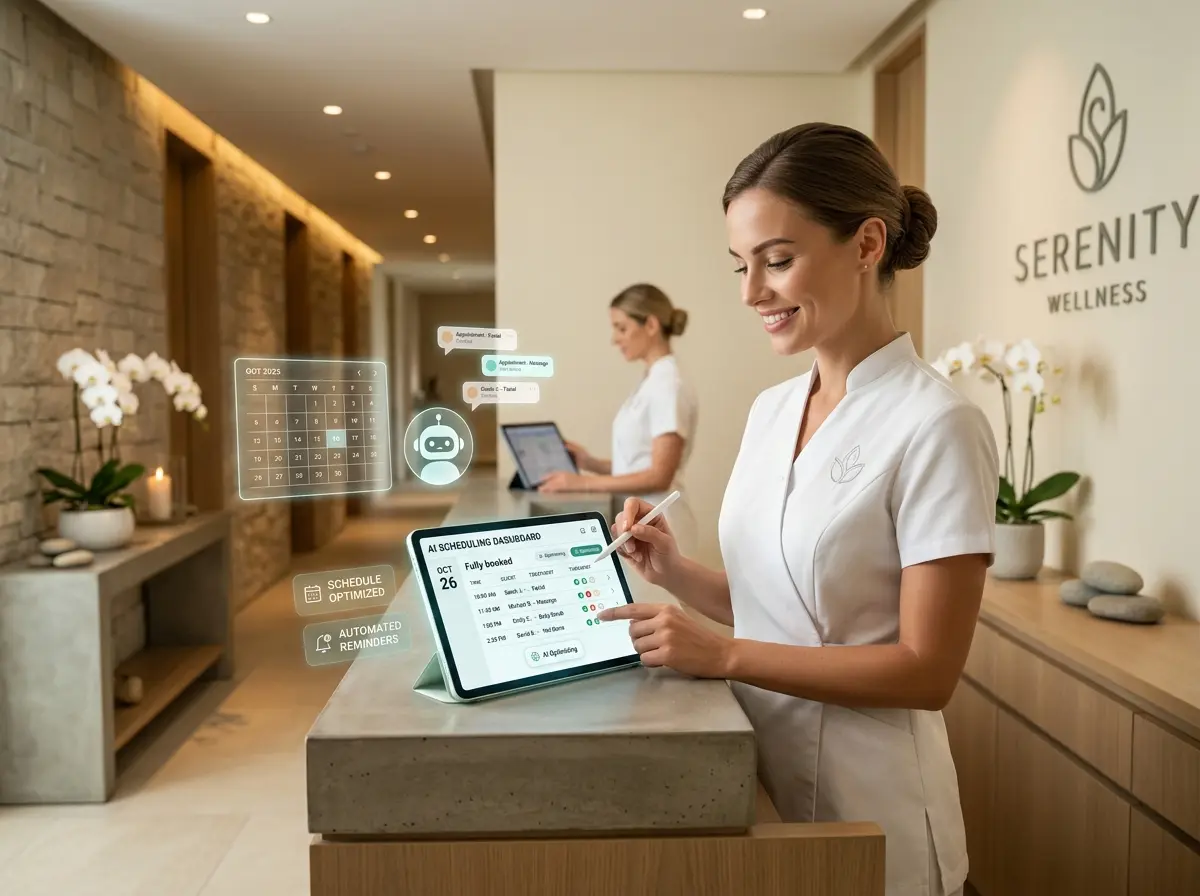
Stella is an AI robot employee and phone receptionist built specifically for businesses that can't afford to miss a beat — and spas are a perfect fit. On the phone side, she answers every call, 24 hours a day, seven days a week, with the same warmth and knowledge your best human receptionist brings on a good Tuesday morning. She can walk callers through your service menu, answer questions about pricing and availability, collect client intake information through natural conversation, and even promote your current specials or seasonal packages.
For spas with a physical location, Stella also shows up as a friendly, human-sized kiosk inside your space — greeting walk-ins, answering questions so your staff doesn't have to stop mid-service, and proactively highlighting promotions to clients waiting in the lobby. It's like having a knowledgeable team member permanently stationed at the front who never needs a coffee break or calls in sick on your busiest Saturday of the year.
Smart Intake and CRM That Actually Stays Updated
One of the quieter superpowers here is what happens to client data. Stella collects information through conversational intake forms — during phone calls, at the kiosk, or on the web — and feeds it directly into a built-in CRM with custom fields, tags, notes, and AI-generated client profiles. No more sticky notes. No more spreadsheets that are three months out of date. Every client interaction gets logged, summarized, and made useful. For spas, that means knowing who's a first-timer, who's a loyal monthly facial client, and who mentioned last time that they prefer light pressure and hate eucalyptus. That's the kind of personalization that turns one-time visitors into regulars.
Strategies Top Spas Are Using to Fill Appointments on Autopilot
Turning Promotions Into a Conversion Machine
The spas seeing the biggest gains aren't just automating their reception — they're using automation strategically to push the right offers at the right moment. When a client calls to book a Swedish massage, that's the perfect time to mention the add-on aromatherapy upgrade or the membership that saves them 20% every visit. When a walk-in asks about facials, the moment they're browsing is the moment to highlight the current promotion before they leave without booking.
Done manually, upselling depends entirely on whether your receptionist remembered to mention it and felt comfortable doing so. Done with AI, it's consistent, timely, and framed naturally as helpful information rather than a hard sell. That consistency across every single interaction is where the revenue impact really shows up.
Reducing No-Shows Through Better Intake and Communication
No-shows are the bane of every spa owner's existence — an empty table is a revenue loss you can't recover. Many spas are dramatically reducing their no-show rates by capturing better information upfront and using that data to send timely, personalized reminders. When a client's contact information is collected properly during booking (rather than scrawled illegibly on a paper sign-in sheet), your follow-up process actually works.
The other piece of this puzzle is policy clarity. Clients who are verbally walked through your cancellation policy during the booking conversation — not just pointed to a sign on the wall — are far more likely to give you advance notice if they need to reschedule. That gives you a fighting chance to fill the slot rather than eating the loss.
Leveraging Insights to Optimize Your Offerings
One underrated benefit of AI-powered client interactions is the data trail they leave behind. Every conversation is a data point: What services are people asking about most? Which promotions generate the most interest? What questions keep coming up that suggest a gap in your marketing or menu clarity? Spas that are paying attention to this kind of interaction data are making smarter decisions about which services to promote, which packages to bundle, and where their messaging needs work.
It's the difference between running your business on gut instinct and running it on actual evidence. Both can work, but one of them scales a lot better.
Quick Reminder About Stella
Stella is an AI robot employee and phone receptionist that works for spas both in-store as a physical kiosk and over the phone as a 24/7 receptionist — answering questions, collecting client information, promoting services, managing a built-in CRM, and never once calling in sick before a holiday weekend. She runs on a straightforward $99/month subscription with no upfront hardware costs and is designed to be up and running without a complicated setup process.
What to Do Next (Seriously, Don't Just Close This Tab)
If you've read this far, you already know your front desk has some gaps. The question is whether you're going to do something about it or keep hoping things improve on their own. Spoiler: they won't. Your competitors are moving, and the spas that automate their client experience now are going to have a very unfair advantage in twelve months.
Here's what a practical next step looks like:
- Audit your missed calls. Pull your call logs for the last 30 days and count how many went unanswered or to voicemail. Put a dollar value on it using your average service price. Let that number bother you appropriately.
- Map your current intake process. Where does client information get lost, abbreviated, or never collected at all? That's your biggest operational leak.
- Look at your after-hours inquiry rate. Check your voicemails, your website contact forms, and your missed calls by time of day. If you're losing after-hours business, you're leaving consistent money on the table.
- Explore AI reception options. Whether it's Stella or another tool, the technology is affordable, accessible, and not nearly as complicated to implement as you might think.
The goal isn't to replace the human warmth that makes a great spa experience — it's to make sure that experience starts before the client even walks through your door. First impressions happen on the phone, on your website, and in your lobby. Nail all three, and your appointment book will start filling itself in ways that'll make your old spreadsheet cry tears of joy.
You built something worth booking. Now let's make sure nobody misses the chance to do it.