When "Just a Polish" Becomes a $85 Ticket
Let's be honest — most nail salon clients walk in with a very specific budget in mind. They've already mentally committed to a number, usually the one printed on your basic service menu, and they're prepared to defend it like it's personal. So how did one nail salon manage to increase their average ticket size by 28% without raising prices, guilt-tripping their guests, or hiring a pushy salesperson? They built a smarter add-on menu and made sure every single customer actually heard about it.
The math on this is worth pausing for. If your average ticket is currently $55 and you bump that to $70 — a roughly 28% increase — across just 20 clients a day, that's an additional $300 per day. Over a month, you're looking at around $9,000 in revenue you weren't collecting before. Not bad for services you were probably already offering but failing to consistently present.
The gap between "we offer that" and "the customer actually knew about it" is where most salons are quietly hemorrhaging money. This post is about closing that gap — with a real-world example, a practical add-on structure, and some tips on how to make sure your team (human or otherwise) is doing the work of presenting your full menu every time.
The Add-On Menu That Changed Everything
The Problem With the Old Menu
The salon in question — a mid-size nail bar with six technicians — had a perfectly reasonable service menu. Manicures, pedicures, gel, acrylics, the usual suspects. They also had a handful of upgrades: cuticle treatments, paraffin wax, nail art, extended massage. The problem? These add-ons were buried at the bottom of a laminated menu card that most clients never flipped over, and technicians only mentioned them when they remembered to — which, during a busy Saturday, was approximately never.
The owner recognized that the issue wasn't product — it was presentation. Customers weren't saying no to paraffin wax. They just didn't know it was an option until they were already elbow-deep in a soak bowl and the timing felt awkward.
Building the Tiered Add-On Structure
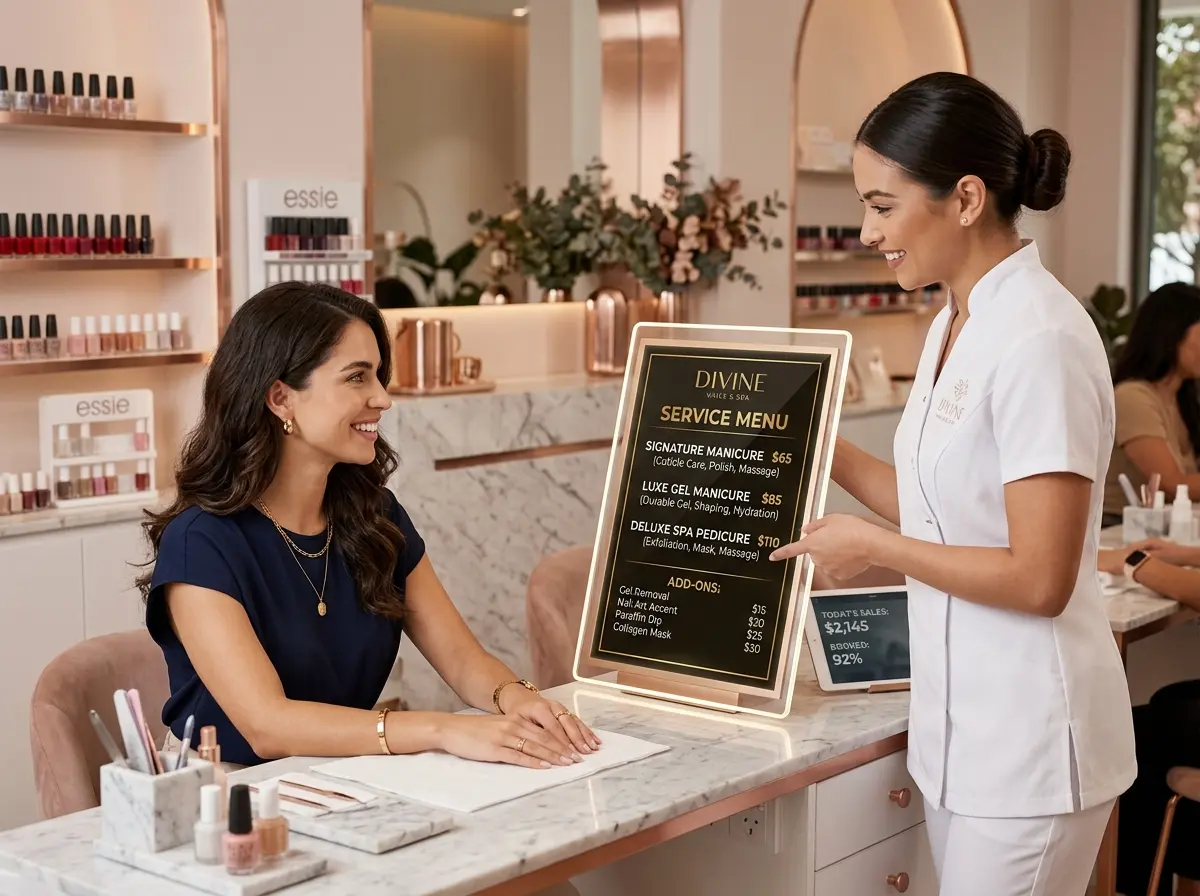
The solution was a deliberate, tiered add-on menu that was visually separated from the main service list and strategically placed — at the front desk, at each station, and verbally introduced at the point of booking and again at arrival. The structure looked something like this:
- Quick Enhancements ($8–$15): Cuticle repair treatment, nail strengthening base, express massage extension (5 min), nail art accent (1–2 nails)
- Experience Upgrades ($18–$28): Paraffin wax dip, hot stone massage add-on, aromatherapy soak, extended massage (15 min)
- Premium Packages ($35–$50): Full nail art set, luxury cuticle and hand treatment combo, spa pedicure upgrade with scrub, mask, and wrap
The genius of this structure is psychological. When someone sees a $12 cuticle treatment sitting next to a $75 gel set, it feels practically free. The tiering also gives technicians a clear, non-pushy script: "We have a few quick enhancements today — a lot of our clients love the paraffin dip, especially in winter. Want to add that on?" Simple, specific, and easy to say without feeling like a car dealership upsell.
The Presentation Is Everything
The salon didn't just create the menu — they trained every technician to introduce add-ons at a specific moment in the service flow: right after the client chose their color and settled in, before the service began. That window is golden. The client is relaxed, committed to being there, and not yet mentally checked out toward the exit. Presenting add-ons then, rather than at checkout, made a measurable difference in acceptance rates.
They also added add-on prompts to their booking confirmation texts, which saw a surprisingly high engagement rate. Clients who pre-selected an add-on during booking almost never cancelled it at the appointment — they'd already mentally committed. Pre-selling through booking platforms is an underused strategy that costs nothing extra to implement.
How Technology Can Do the Presenting For You
Consistency Is the Real Upsell Engine
Here's the uncomfortable truth: even with great training, human staff will not present add-ons consistently 100% of the time. They get busy. They forget. They read the room wrong on a stressful afternoon. That inconsistency is normal — but it's also fixable, at least partially, with the right tools in place.
This is where Stella, the AI robot employee and phone receptionist, becomes genuinely useful for salons. Stella can greet every client who walks through the door, proactively mention current promotions and service add-ons, and answer questions about what's available — all without ever forgetting, getting distracted, or feeling awkward about it. She stands in-store as a friendly kiosk presence, which means the upsell conversation starts before the client even sits down. On the phone side, Stella answers booking calls 24/7 and can mention add-ons naturally during the conversation — so the pre-sell happens at the moment of booking, every single time, without relying on a front desk employee to remember the script.
Pricing, Packaging, and Psychology
Anchoring and the Power of Bundles
One of the most effective tactics the salon implemented was bundling. Rather than leaving add-ons as purely à la carte options, they created two or three named "experience packages" that combined services at a slight discount versus buying each piece separately. The Signature Spa Pedicure, for instance, bundled the standard pedicure with a paraffin dip, extended massage, and aromatherapy soak at a price about 15% lower than the sum of parts — but 40% higher than the base pedicure alone.
Bundling works because it removes decision fatigue. Instead of a client weighing each individual add-on, they're making one decision: do I want the standard or the signature? That's a much easier conversation, and the word "signature" does a lot of heavy lifting on its own. Nobody wants the non-signature version of anything.
Training Staff to Frame, Not Push
There's a meaningful difference between upselling and informing, and your technicians need to feel that distinction clearly or they'll default to silence every time. Framing add-ons as recommendations rather than pitches changes the entire dynamic. Phrases like "A lot of our clients with your nail type love the strengthening treatment — it's only $10 today" feel like insider advice, not a sales tactic. Seasonal framing helps too: paraffin wax in winter, UV-protection top coat in summer, moisturizing treatments year-round.
The salon ran brief weekly huddles — no longer than five minutes before opening — where the owner highlighted one or two specific add-ons to focus on that week. This kept the team aligned and gave technicians a fresh talking point rather than trying to remember an entire menu of options simultaneously.
Tracking What's Actually Working
You can't optimize what you're not measuring. The salon started tracking add-on attachment rates by technician, by time of day, and by service type. What they found was illuminating: certain technicians had significantly higher add-on rates not because they were pushier, but because they introduced the conversation earlier. They also discovered that pedicure clients accepted add-ons at nearly twice the rate of manicure clients — likely because pedicure appointments are longer and clients feel more relaxed. That insight alone reshaped how they allocated their premium add-on focus.
A Quick Reminder About Stella
Stella is an AI robot employee and phone receptionist designed for businesses exactly like yours — salons, spas, retail shops, and beyond. She greets walk-in customers in person, answers phone calls around the clock, promotes your current offerings, and never has an off day. At just $99/month with no upfront hardware costs, she's the kind of staff member that never calls in sick and always remembers to mention the paraffin dip.
Start Selling What You're Already Offering
The 28% increase at this salon didn't come from adding new services or hiring additional staff. It came from presenting existing services more consistently, more strategically, and at the right moment. That's a replicable playbook, and the barriers to implementing it are genuinely low.
Here's where to start:
- Audit your current add-ons. List every service that could logically be paired with a primary booking. If your menu doesn't have them, create two or three simple ones this week.
- Build a tiered structure. Organize add-ons into low, mid, and premium price points so both staff and clients can navigate them easily.
- Define the moment. Pick a specific point in your service flow where add-ons will always be introduced, and make it a non-negotiable part of the process.
- Create one or two named bundles. Give them appealing names and price them to feel like a value without cannibalizing your margins.
- Track and iterate. Measure attachment rates weekly and adjust your focus based on what the numbers tell you.
The revenue is already in your building. You just need a better system for making sure clients know it's there. Build the menu, train the team, and let every touchpoint — human or AI — do its part in the conversation.