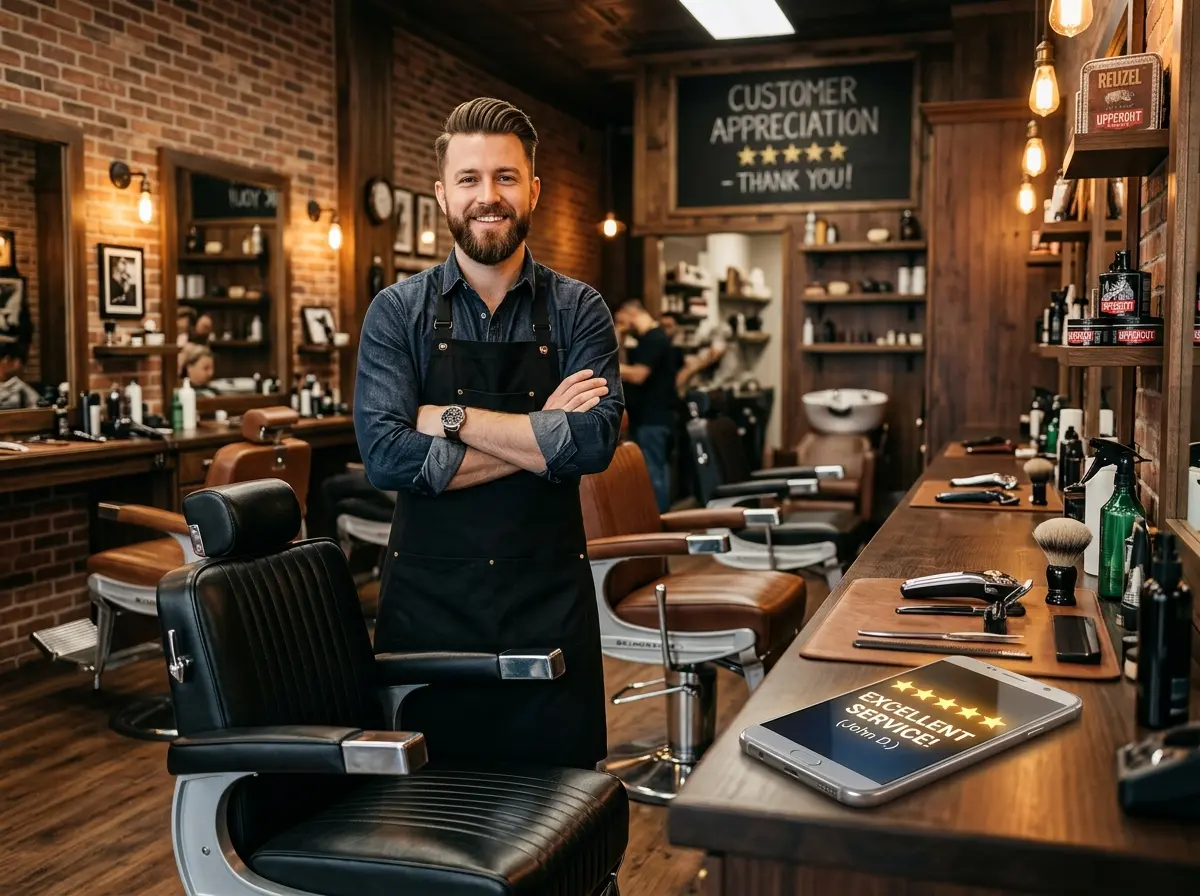
From Tumbleweeds to Testimonials: The Review Revolution Nobody Saw Coming
Let's paint a picture. It's a Tuesday afternoon, and a potential customer is standing on a sidewalk, phone in hand, deciding between two barbershops. One has 12 reviews, two of which are from 2019 and one of which is suspiciously from someone named "Owner Reply Test." The other has 500 glowing reviews, including a dozen posted in the last week. Which shop gets the walk-in? Exactly.
Online reviews are the modern word-of-mouth, and for local businesses like barbershops, they're essentially the difference between a packed Saturday and a very quiet one. Yet most shop owners treat review collection the way most people treat flossing — they know they should do it, they intend to do it, and then somehow, they never quite get around to it. The result? A sparse review profile that sends potential customers straight to the competition.
This post breaks down exactly how one barbershop went from practically invisible online to boasting 500 verified reviews in just 12 months — without begging customers, spamming inboxes, or doing anything remotely shady. Spoiler: it mostly came down to timing, systems, and a little bit of smart automation.
The Foundation: Building a Review-Ready Business
Fixing the Experience Before Asking for the Review
Here's an uncomfortable truth: no review strategy in the world will save you if the experience inside your shop is mediocre. The barbershop in question — let's call them Razor Sharp, because that's a great name and they deserve one — started their journey not by chasing reviews, but by auditing their customer experience from the moment someone walked in to the moment they walked out.
They looked at wait times, how new clients were greeted, whether the staff knew the current promotions, and even how the checkout process felt. What they found was a patchwork of great service and awkward gaps — a killer haircut preceded by a confusing check-in process, for example. Once those gaps were addressed and the experience felt consistently excellent, customers were actually happy enough to leave a review when asked. Shocking concept, right?
Claiming and Optimizing Every Profile
Before Razor Sharp could collect reviews, they needed somewhere to put them. That meant fully claiming and optimizing their Google Business Profile, Yelp listing, and Facebook page. This sounds obvious, but you'd be amazed how many businesses have unclaimed or half-finished profiles floating around the internet like lost luggage.
They added updated hours, high-quality photos of the shop and their work, a clear description with relevant keywords, and accurate service listings with pricing. This step alone improved their discoverability — Google rewards complete, active profiles with better visibility in local search. Think of your business profile as a digital storefront. Would you leave your actual storefront half-painted with a handwritten sign in the window? Hopefully not.
The Strategy: Asking at the Right Moment
Timing Is Everything (And Most Businesses Get It Wrong)
The single biggest mistake businesses make with review requests is asking at the wrong time. Sending a generic email blast two weeks after a visit asking for a review is the digital equivalent of asking someone how much they enjoyed dinner while they're still deciding if they liked it. The moment that matters is the one immediately after a genuinely positive interaction.
Razor Sharp trained their staff to read the room. After a client laughed at a joke, complimented their cut in the mirror, or mentioned they'd be back, that was the moment — right then, before they left the chair — to say something like, "Hey, we'd really appreciate it if you dropped us a review on Google. It takes about 30 seconds and it helps us a ton." Simple, human, and effective. Their in-person ask conversion rate climbed to around 20%, which is remarkably high compared to the industry average of 5–10% for email-based requests.
Automating the Follow-Up Without Being Annoying
Not every customer is going to act on the in-person ask, no matter how charming your staff is. That's where a follow-up text message came in — sent within two hours of the appointment, personalized with the client's name and a direct link to the Google review page. No login required, no hunting around for where to click. Just a tap and they're there.
Razor Sharp used their booking software to trigger these messages automatically. The result was a second wave of reviews from clients who genuinely intended to leave one but would have forgotten by the time they got home. Between the in-person ask and the automated follow-up, their monthly review volume jumped from 3–5 per month to over 40 within the first 90 days.
Using Technology to Keep the Momentum Going
How Smart Tools Can Handle the Heavy Lifting
One of the quieter secrets behind Razor Sharp's success was that they stopped relying entirely on their staff to remember every customer touchpoint. Human staff are wonderful, but they're also busy, distracted, and occasionally running on their third cup of coffee and zero patience. Automation filled the gaps.
This is exactly where tools like Stella — an AI robot employee and phone receptionist — become genuinely useful for a shop like this. Stella stands inside the business and greets every customer who walks in, answers questions about services and pricing, and promotes current specials — all without any staff effort. On the phone side, she handles incoming calls 24/7, captures customer information through conversational intake forms, and manages contacts through a built-in CRM. For a barbershop that was missing calls during busy hours and losing track of new client data, this kind of consistent presence meant fewer dropped balls and more opportunities to deliver the kind of experience that earns five stars.
Responding to Reviews: The Secret Weapon Nobody Uses
Why Responding to Every Review Is Non-Negotiable
Here's a stat worth paying attention to: 89% of consumers read business responses to reviews, and businesses that respond to reviews are seen as 1.7 times more trustworthy than those that don't, according to Google's own research. Yet the majority of small businesses respond to fewer than half of their reviews. That's a massive missed opportunity.
Razor Sharp made a policy of responding to every single review — positive or negative — within 24 hours. For positive reviews, they kept responses warm, specific, and brief. For negative reviews, they responded calmly, acknowledged the concern, and offered to resolve it offline. The result? Several unhappy customers updated their reviews to four or five stars after seeing the response and receiving a follow-up call. Publicly handling criticism with grace is one of the most powerful trust signals a business can send.
Turning Negative Reviews Into Loyal Customers
Counterintuitive as it sounds, a thoughtfully handled negative review can actually help your business. A perfect 5.0 rating with zero complaints looks suspicious to savvy consumers — it reads as either fake or heavily filtered. Real businesses have the occasional off day, and real customers know this. What they're watching for is how you handle it.
Razor Sharp's owner personally called back every customer who left a negative review, offered a complimentary service, and genuinely listened to the feedback. Of the 11 negative reviews they received in 12 months, 7 were updated to three stars or above. More importantly, several of those customers became regulars — because being heard and taken seriously after a bad experience is surprisingly rare, and people remember it.
A Quick Reminder About Stella
Stella is an AI robot employee and phone receptionist built for businesses exactly like yours. She greets customers in-store, answers calls around the clock, promotes specials, collects customer info, and keeps your CRM organized — all for $99 a month with no upfront hardware costs. If your staff is too busy to consistently ask for reviews or follow up with new clients, Stella picks up the slack without calling in sick or forgetting the script.
Your Action Plan: Start Collecting Reviews This Week
Five hundred reviews in 12 months sounds like a lot — and it is — but it breaks down to roughly 42 reviews per month, or about 10 per week. That's not a marketing department. That's a system. Here's how to build yours:
- Audit your customer experience first. Don't ask for reviews until you're confident the experience is worth five stars. Fix the friction points, train your staff on the greeting, and make sure every touchpoint feels intentional.
- Claim and fully optimize every business profile. Google Business Profile is the priority, but don't neglect Yelp and Facebook. Complete profiles rank better and convert better.
- Train staff to ask in the moment. Right after a positive reaction — not at checkout, not via email two weeks later. In the moment, when the feeling is fresh.
- Set up an automated follow-up text within two hours. Include the customer's name and a direct link to your review platform. Make it one tap, not a scavenger hunt.
- Respond to every single review within 24 hours. Every positive one, every negative one. No exceptions.
- Use technology to stay consistent. Whether it's your booking software, a CRM, or an AI tool like Stella, automate the parts your team can't reliably do manually under pressure.
The barbershop down the street isn't beating you because they're better at cutting hair. They're beating you because they've made it easy for happy customers to tell the world about it. That's fixable — and it starts this week.