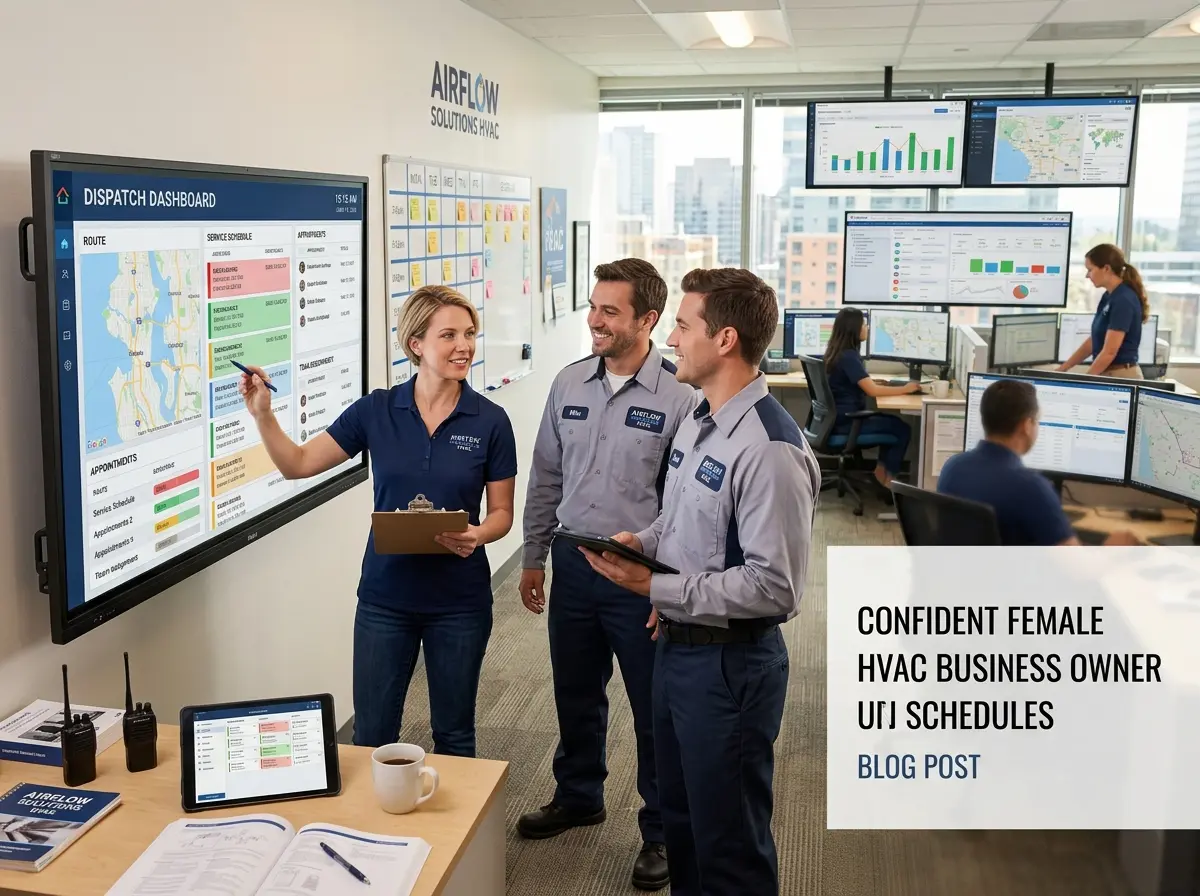
Introduction: Herding Technicians Is an Art Form
Running an HVAC company means you're essentially managing a fleet of highly skilled professionals who spend most of their day in attics, crawl spaces, and mechanical rooms — places where Wi-Fi goes to die and communication goes to suffer. If you've ever had a technician show up to the wrong address, a customer call three times asking where their tech is, or a job get invoiced three days after it was completed, congratulations: you're running a completely normal HVAC operation. That doesn't mean it should stay that way.
Managing a field service team is genuinely one of the most logistically complex challenges in the trades. You're coordinating scheduling, routing, customer communication, parts inventory, invoicing, and quality control — all while your technicians are scattered across a 50-mile radius. The good news? There are proven systems and tools that make this dramatically more manageable. The better news? Most of your competitors haven't bothered to implement them yet, which means you still have a window to pull ahead.
This guide walks through the essential pillars of field team management for HVAC companies — from dispatching and communication to customer experience and operational follow-through. Let's get into it.
Building a Dispatching and Scheduling System That Actually Works
Dispatching is where chaos is either created or contained. Most HVAC companies start with a whiteboard, a spreadsheet, and a prayer — and there's no shame in that. But once you're running more than two or three techs, informal systems start costing you real money in missed appointments, overtime, and customer churn.
Invest in Field Service Management Software
Field service management (FSM) platforms like ServiceTitan, Housecall Pro, or Jobber exist specifically for businesses like yours. These tools let you schedule jobs visually, assign technicians based on availability and location, and push job details directly to a mobile app on your tech's phone. No more "I didn't get the message" conversations. No more double-bookings. Customers also tend to love the automated appointment reminders these platforms send — it's a simple feature that significantly reduces no-shows and "I forgot you were coming" moments.
According to a report by Field Technologies Online, companies that implement FSM software see an average productivity increase of 20–30% among field technicians. That's not a rounding error — that's the difference between running five jobs a day and running six or seven.
Use Smart Routing to Stop Burning Time and Fuel
Route optimization isn't just a nice-to-have anymore — it's a cost control strategy. When your techs are crisscrossing town inefficiently, you're paying for fuel, extra drive time, and wear on your vehicles. FSM platforms with built-in routing tools (or integrations with Google Maps and similar services) can sequence jobs in ways that minimize drive time and maximize billable hours per day. It's boring stuff on paper, but it adds up to thousands of dollars in savings over the course of a year.
Set Clear Scheduling Standards and Stick to Them
Even the best software fails if your scheduling policies are vague. Establish and document clear rules: How much buffer time goes between jobs? How are emergency calls handled without derailing the whole day? Who has the authority to re-assign jobs in real time? When technicians and dispatchers know exactly how the system is supposed to work, exceptions become easier to handle — because everyone understands what they're deviating from.
Keeping the Office Running While Your Team Is in the Field
Here's a fun scenario: your technicians are all out on jobs, your dispatcher is juggling three things at once, and the phone is ringing with a customer who wants to book an appointment, ask about a maintenance plan, and complain about last week's service — all in the same call. This is Tuesday for most HVAC companies. The office side of a field service business is perpetually understaffed relative to demand, and that gap has a direct impact on customer satisfaction and revenue.
Don't Let Calls Fall Through the Cracks
Missed calls are missed revenue. Studies suggest that up to 62% of calls to small businesses go unanswered — and most callers won't leave a voicemail or try again. For an HVAC company, a single missed call during peak season could represent a $500 tune-up, a $3,000 equipment replacement, or a long-term maintenance contract. The math gets uncomfortable fast.
This is where Stella can quietly become one of your most valuable team members. Stella is an AI receptionist that answers every phone call, 24 hours a day, seven days a week — with full knowledge of your services, pricing, hours, and policies. She can handle appointment intake, answer common questions, collect customer information through conversational forms, and even forward urgent calls to your team based on conditions you configure. For HVAC companies that also have a physical showroom or office, she's also available as an in-store kiosk that greets walk-in customers and helps them explore your offerings. Stella's built-in CRM also keeps a running record of every customer interaction, so nothing gets lost between calls, and your team always has context before picking up the phone.
Managing Technician Performance Without Micromanaging
There's a fine line between accountability and surveillance, and most techs will tell you they'd rather work in a ditch than feel like someone's watching their every move. The goal isn't to micromanage your field team — it's to build systems that make performance visible, feedback consistent, and problems detectable before they become crises.
Define and Track the Metrics That Matter
You can't manage what you don't measure, and in field service, the right metrics tell a compelling story. Track things like first-time fix rate (the percentage of jobs resolved in a single visit), average job completion time, customer satisfaction scores tied to individual technicians, and revenue per tech per day. A tech who closes jobs quickly but generates a lot of callbacks is actually costing you more than their paycheck. Conversely, a tech who takes longer but has a near-zero callback rate and strong upsell numbers might be your most valuable field asset — a fact that's easy to miss if you're only looking at clock-in and clock-out times.
Create a Structured Feedback Loop
Regular one-on-ones with field technicians aren't just for HR purposes — they're a practical management tool. Use them to review job history, discuss recurring issues, and surface insights your techs have from being in the field every day. Your technicians often know about common equipment failures, customer complaints, and competitor activity before that information ever reaches the office. A short monthly check-in can surface that intelligence before it becomes a problem or a missed opportunity.
Invest in Ongoing Training
HVAC equipment evolves constantly. New refrigerants, smart thermostats, variable-speed systems, and energy efficiency standards mean that training isn't a one-time onboarding event — it's an ongoing operational requirement. HVAC Excellence, NATE certification programs, and manufacturer training resources are all worth building into your team's annual calendar. Techs who feel invested in tend to stay longer, perform better, and represent your brand more professionally. That last part is important: in most cases, your technicians are your brand. The customer never meets the owner. They meet the tech.
Quick Reminder About Stella
If your office phone goes quiet after hours but your customers' problems don't, Stella is worth a look. She's an AI robot employee and phone receptionist that answers calls around the clock, handles intake, manages a built-in CRM, and even greets walk-in customers at your location — all for $99/month with no hardware costs to get started. For an HVAC company that lives and dies by phone calls and customer relationships, that's a pretty reasonable line item.
Conclusion: Systems Win in the Long Run
Managing a field service team will never be entirely frictionless — there are too many variables, too many humans, and too many attics involved. But the HVAC companies that grow consistently and profitably aren't the ones with the most talented technicians. They're the ones with the best systems supporting those technicians.
Here's where to start:
- Audit your current scheduling process and identify the top three points of failure. Is it communication breakdowns? Double-booking? Poor routing? Fix the biggest one first.
- Evaluate your call handling honestly. Pull your call logs from the last 30 days and count how many calls went unanswered or to voicemail. Multiply that number by your average job value. That's your missed revenue floor.
- Pick two or three technician performance metrics and start tracking them consistently. You don't need a dashboard with 40 KPIs — you need a few meaningful numbers reviewed regularly.
- Talk to your techs. Schedule 30-minute check-ins this month. You'll learn something useful, guaranteed.
The field service business is hard. But it rewards operators who take the time to build real infrastructure around their team. Get the systems right, and the rest becomes a lot more manageable — even on the Tuesdays when everything is going sideways at once.