Introduction: Because "Just Keep Showing Up" Isn't a Retention Strategy
Let's be honest — you didn't become a personal trainer because you love spreadsheets. You became one because you love helping people transform their lives, hit their goals, and finally deadlift more than they thought possible. But here's the uncomfortable truth that no certification course bothered to mention: getting clients results is only half the battle. Showing them their results is the other half.
Studies consistently show that acquiring a new client costs five to seven times more than retaining an existing one. Yet most personal trainers spend the majority of their marketing energy chasing new leads while quietly watching long-term clients drift away — not because the training wasn't working, but because the client simply couldn't see how far they'd come. They forgot the struggle of week one. They got bored. They felt like they were "maintaining" rather than progressing. And then, almost without drama, they cancelled.
A well-built client progress portfolio solves this problem elegantly. It creates a documented, visual, and emotionally resonant record of each client's journey — something they can look at during a tough week and think, "Oh right, I actually am crushing this." More importantly, it gives you a powerful retention tool, a referral conversation starter, and a professional differentiator that most of your competitors have never even considered. Let's build one.
Building the Foundation of Your Client Progress Portfolio
What to Track (Beyond the Obvious Before-and-After Photo)
Before-and-after photos are great, but they're the tip of the iceberg. A truly comprehensive client progress portfolio captures the full picture of a client's transformation — physical, functional, and even psychological. The more dimensions you document, the harder it becomes for a client to feel like "nothing is changing."
Consider tracking the following across every client:
- Body composition metrics: weight, body fat percentage, measurements (waist, hips, arms, chest, thighs)
- Performance benchmarks: max lifts, rep counts, run times, flexibility assessments, VO2 max estimates
- Energy and lifestyle indicators: sleep quality ratings, stress levels, daily step counts
- Milestone achievements: first pull-up, first 5K, first time carrying all the groceries in one trip (a personal favorite)
- Client-reported wins: fitting into old jeans, keeping up with their kids, feeling confident at a wedding
That last category is often the most powerful. Numbers are meaningful, but stories are sticky. When a client tells you something emotional happened as a result of their training, write it down immediately and add it to their portfolio. Those moments become the anchors that keep people coming back.
How to Structure the Portfolio for Maximum Impact
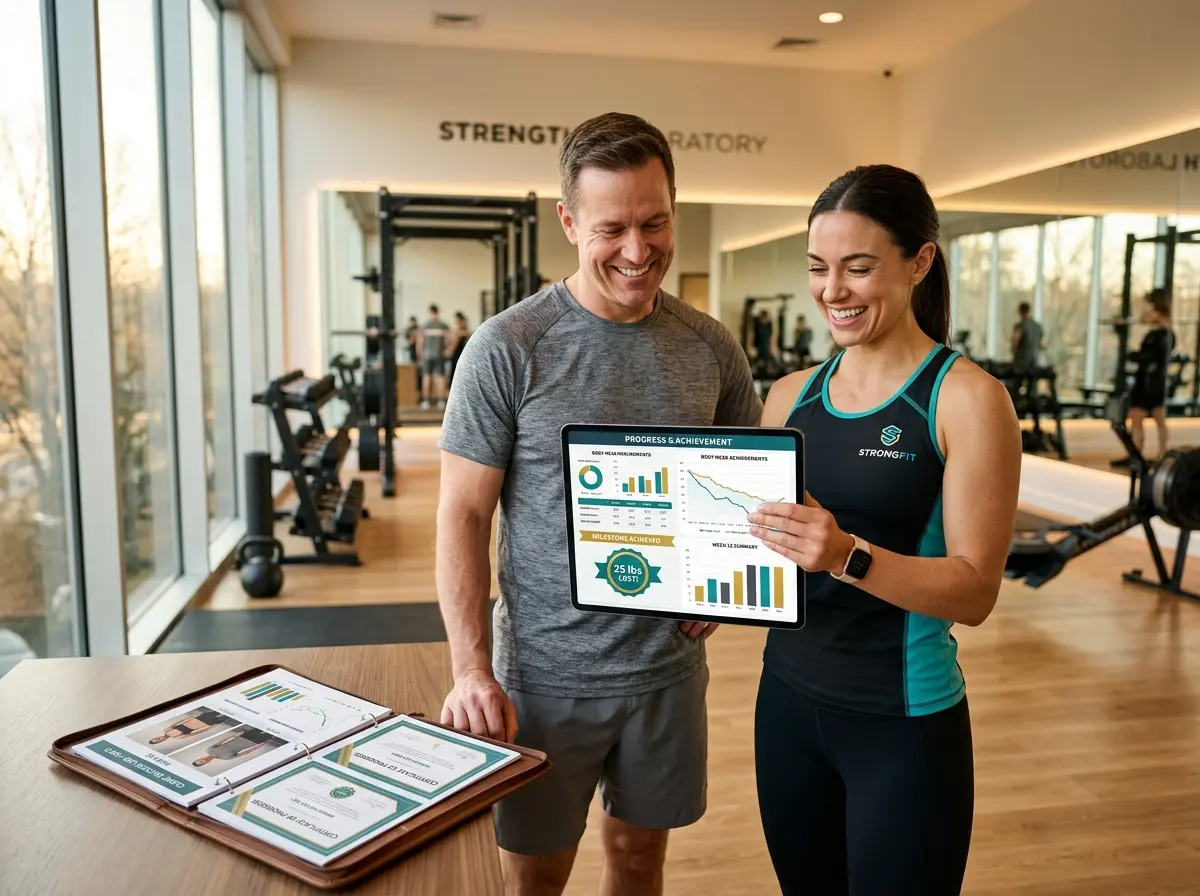
Think of the portfolio less like a medical file and more like a highlight reel. It should be organized chronologically, easy to navigate, and genuinely exciting to flip through. You can build these digitally using tools like Canva, Notion, Google Slides, or dedicated fitness software — or keep it beautifully simple with a well-designed PDF template you update monthly.
A solid portfolio structure might look like this: a one-page intake snapshot (starting stats, goals, any relevant health history summary), followed by monthly progress updates that include updated metrics, a key performance win, a photo comparison, and a short trainer's note. End each monthly section with a forward-looking goal to create anticipation. Clients who are excited about what comes next don't cancel their memberships.
Review the portfolio together with your client at each milestone — the one-month mark, three months, six months, and annually. These check-ins don't need to be long, but they are enormously valuable. Clients who feel seen, measured, and celebrated are loyal clients.
Streamlining Client Intake and Communication With the Right Tools
How Stella Can Help Your Training Business Run Smoother
Here's where we talk about the part of running a fitness business that trainers really don't love: the administrative side. Following up with leads, answering the same five questions about your packages, playing phone tag with prospective clients — it's exhausting, and it pulls you away from the work that actually moves the needle.
Stella, the AI robot employee and phone receptionist, can handle a surprising amount of that operational friction on your behalf. If your training business has a physical location — a gym, studio, or wellness center — Stella can stand at the entrance as a kiosk, greet walk-ins, answer questions about your services and pricing, and even collect intake information through conversational intake forms before a prospect ever speaks to you. On the phone side, she answers calls 24/7, which matters more than you might think. Research suggests that a large percentage of potential clients who call a business and reach voicemail simply hang up and call a competitor instead.
Stella's built-in CRM also makes it easier to keep client information organized and accessible — including the kind of custom notes and tags that feed directly into a well-maintained progress portfolio system. Less time hunting through email threads, more time actually training people.
Turning Progress Portfolios Into a Retention and Referral Engine
Using Portfolios to Anchor Renewal Conversations
There's an art to the renewal conversation, and most trainers stumble through it awkwardly because they're essentially asking a client to spend more money without giving them a compelling reason why. A progress portfolio changes that dynamic completely. Instead of a vague pitch about "continuing the momentum," you sit down with a client, open their portfolio, and walk through everything they've accomplished together. You let the data and the story do the selling.
The psychology here is well-documented. The peak-end rule — a concept from behavioral economics — tells us that people judge an experience based on how it felt at its most intense moments and at the end. When you create a structured, emotionally resonant portfolio review at the end of a training package, you're engineering a positive peak-end moment that makes renewal feel natural, even exciting. Clients leave the conversation feeling proud and motivated, not pressured.
Consider building a renewal offer directly into the portfolio review — a small loyalty discount, a complimentary nutrition consultation, or an upgraded training frequency. Present it as a reward for their commitment, not a sales tactic, and most clients will happily move forward.
Leveraging Client Stories for Word-of-Mouth Marketing
A progress portfolio isn't just a retention tool — it's referral fuel. When clients have a beautiful, organized record of their transformation, they naturally want to share it. Encourage clients (with their permission, always) to share portfolio highlights on social media, and make it easy by creating shareable graphic templates that feature their stats and milestones without necessarily showing personal photos if they prefer.
You can also use anonymized portfolio data — with explicit client consent — as social proof in your marketing. "Client A lost 18 pounds and increased her squat by 60 pounds in 90 days" is far more compelling than a generic testimonial. It signals to prospective clients that you track things carefully, that your methods produce measurable outcomes, and that you take their progress seriously. That professionalism is worth more than any ad spend.
Gamifying the Journey to Keep Engagement High
One underutilized strategy is building a milestone badge or achievement system into the portfolio itself. Think of it as a loyalty card, but for fitness accomplishments. First 10 sessions completed? Badge. Hit your first major strength goal? Badge. Six consecutive months without missing a session? That one gets a certificate and a badge. It sounds a little playful, but the research on gamification in fitness and health contexts is genuinely compelling — small, symbolic rewards dramatically increase engagement and long-term adherence.
Display these achievements prominently in the portfolio and acknowledge them publicly (again, with consent) in your studio or social channels. Clients who feel celebrated become clients who stay, and clients who stay become clients who refer.
Quick Reminder About Stella
Stella is an AI robot employee and phone receptionist that works for businesses of all sizes — including personal training studios and independent trainers — for just $99/month with no upfront hardware costs. She greets clients at your location, answers phone calls around the clock, manages intake forms and client information, and keeps your operation running professionally even when you're elbow-deep in a coaching session. She doesn't take breaks, doesn't call in sick, and never forgets to mention your current promotion.
Conclusion: Start the Portfolio, Keep the Client
The business case for client progress portfolios is straightforward: clients who can clearly see their results stay longer, refer more often, and are far more resistant to cancellation during the inevitable rough patches. The emotional case is even simpler — people deserve to know how far they've come, and you deserve credit for the role you played in getting them there.
Here's how to get started this week:
- Choose your format. Pick a digital tool you'll actually use consistently — Canva, Notion, Google Slides, or dedicated fitness software all work well. Consistency matters more than perfection.
- Audit your current clients. Pull together whatever baseline data you already have and build a retroactive starting point for each active client. It's never too late to begin.
- Create a standard intake process. Every new client should complete a thorough baseline assessment in session one. Make this non-negotiable.
- Schedule your first portfolio review. Book a milestone check-in with your longest-standing client this month and walk through their journey together. Notice what happens to the conversation.
- Systematize and automate where possible. The less friction in your admin processes, the more energy you have for actual coaching. Tools like Stella can help handle the front-end communication load while you focus on the work that only you can do.
Retention isn't magic. It's documentation, celebration, and consistent proof that your work is making a difference. Build the portfolio. Have the conversation. Keep the client.