Introduction: Herding Cats Has Nothing on Managing HVAC Technicians
If you've ever tried to coordinate a field service team, you already know the drill. One technician is stuck in traffic, another just discovered a job will take twice as long as quoted, a third hasn't updated their job status since this morning, and somehow — somehow — three customers have all called in the last hour asking where their technician is. Welcome to the glamorous world of HVAC field service management.
Running an HVAC company is genuinely hard. You're not just managing a business — you're orchestrating a moving puzzle of equipment, schedules, skilled labor, and customer expectations, all while trying to keep your margins intact. According to the Service Council, 52% of field service organizations cite scheduling and workforce management as their top operational challenge. So if it feels like controlled chaos, that's because it often is.
The good news? The HVAC companies that thrive aren't the ones that get lucky — they're the ones that build smart systems. This guide breaks down exactly how to manage your field service team more effectively, from scheduling and communication to accountability and customer experience. Let's get into it.
Building a Scheduling System That Doesn't Fall Apart by Tuesday
Scheduling is the heartbeat of your operation. Get it right, and everything flows. Get it wrong, and you're spending half your day putting out fires that a better calendar could have prevented.
Ditch the Whiteboard and Embrace Field Service Software
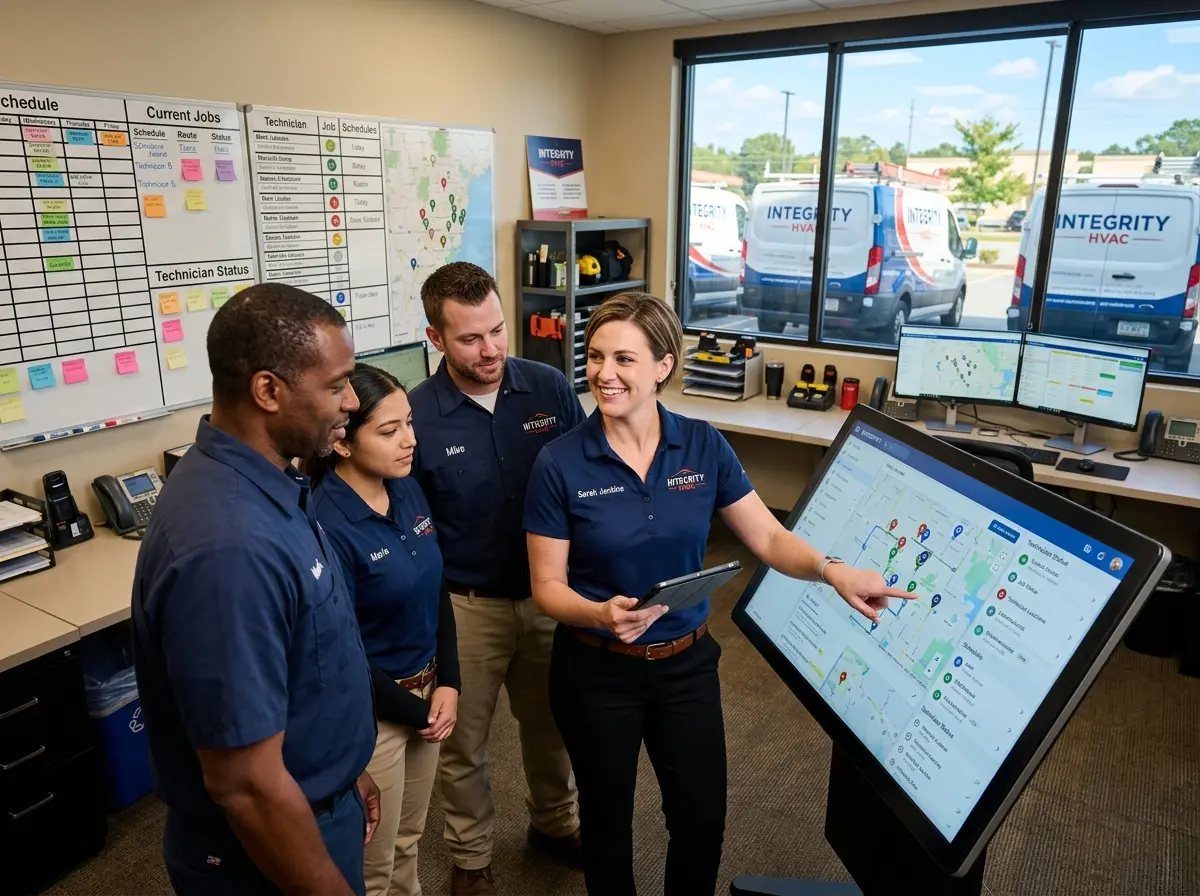
If you're still managing technician schedules on a whiteboard, a shared Google Sheet, or — bless your heart — a paper calendar, it's time to upgrade. Field service management platforms like ServiceTitan, Jobber, or Housecall Pro are purpose-built for HVAC companies and allow you to assign jobs, track technician locations, and update schedules in real time. These tools also give your techs the job details they need right on their phones, reducing the number of "wait, where am I going next?" calls you get every afternoon.
The key features to look for include drag-and-drop scheduling, GPS tracking, job history access, and customer notification automation. When your dispatcher can see at a glance that a tech just finished a job in one neighborhood and a new call just came in two miles away, that's not just convenient — that's money saved on drive time and fuel.
Build Buffers and Stop Overpromising
One of the most common scheduling mistakes HVAC owners make is packing the day too tightly. It looks great on paper until a furnace replacement takes three hours longer than expected and the rest of the day's appointments domino into chaos. Build buffer time between jobs — especially for diagnostic calls, where the scope of work is unknown until a tech is on-site.
Train your front office team or whoever handles scheduling to underpromise and overdeliver on arrival windows. Customers appreciate honesty far more than a missed two-hour window they were told with false confidence. A simple rule of thumb: if the job could go long, assume it will.
Prioritize and Tier Your Calls
Not all HVAC calls are created equal. A commercial client with a broken rooftop unit in August is a different level of urgency than a residential customer requesting a maintenance tune-up. Build a clear tiering system for your dispatch — emergency, priority, standard, and scheduled maintenance — and make sure your dispatchers and techs understand the hierarchy. This prevents situations where a non-urgent call gets slotted in ahead of a business that's losing revenue by the hour because their AC is down.
Keeping Your Front Office and Field in Sync
The gap between your office and your field team is where customer experience goes to die. When the phone is ringing off the hook, dispatchers are juggling updates, and techs are heads-down on jobs, communication breaks down fast. This is an area where smart tools make a real difference — and where Stella, the AI robot receptionist, quietly earns her keep.
Let Technology Handle Routine Customer Communication
Your front office team shouldn't have to answer the same five questions fifty times a day. "What are your rates?" "Do you service my area?" "Can someone come out today?" These are legitimate questions — but they don't need a human to answer them every single time. Stella handles inbound calls 24/7, answers questions about your services, pricing, hours, and service areas, and can collect customer information through conversational intake forms before a human ever needs to get involved. That means your office staff can stay focused on dispatching, coordination, and the calls that actually require human judgment — not explaining your service area for the hundredth time this week.
For HVAC companies that get slammed with calls during peak season (and you know the summer heat doesn't wait for your receptionist to get back from lunch), having a reliable, always-on front line means fewer missed calls and more booked jobs. Stella also takes voicemails with AI-generated summaries and sends push notifications to managers, so nothing falls through the cracks overnight or on weekends.
Managing Technician Performance and Accountability
Your technicians are the face of your company. Every interaction they have with a customer either builds your reputation or chips away at it. Managing their performance isn't about micromanagement — it's about setting clear expectations, measuring the right things, and creating a culture where quality work is the standard.
Define and Track the Right KPIs
You can't improve what you don't measure. For HVAC field service teams, the metrics that matter most include first-time fix rate (did they resolve the issue on the first visit?), job completion time (are they on pace or consistently running over?), customer satisfaction scores, and upsell conversion rate (are they recommending and selling maintenance plans, filters, or system upgrades when appropriate?). Most field service management platforms will generate these reports automatically — the key is actually reviewing them regularly and using them in performance conversations with your team.
A first-time fix rate below 70% is a red flag worth investigating. It could point to parts availability issues, insufficient diagnostic time, or technicians who need additional training. Either way, the data gives you somewhere to start.
Invest in Ongoing Training
The HVAC industry doesn't stand still. New refrigerants, smart thermostat integrations, heat pump technology, and evolving energy efficiency standards mean your technicians need continuous training to stay current. Companies that invest in regular training — whether through manufacturer certifications, NATE credentials, or in-house knowledge sharing — see measurably better outcomes in job quality and customer satisfaction.
Consider holding monthly team meetings where techs share tricky jobs they encountered and how they solved them. This kind of peer learning is low-cost, builds team cohesion, and keeps your whole crew sharp. It also signals to your technicians that you're invested in their growth, which goes a long way toward retention in a notoriously tight labor market.
Create a Culture of Accountability Without Micromanaging
There's a meaningful difference between accountability and micromanagement. Accountability means your team understands expectations, has the tools to meet them, and knows there are consequences — both positive and negative — tied to their performance. Micromanagement means you're calling your tech every forty-five minutes to ask if they're done yet. One builds a strong team; the other drives good people out the door.
Set clear job update protocols — for example, techs mark jobs as "en route," "on-site," "complete," and "follow-up needed" in your field service app. Hold that standard consistently. Recognize and reward technicians who consistently hit their KPIs. Address underperformance early and privately. It sounds simple because it is — but consistency is the part most owners struggle with.
Quick Reminder About Stella
Stella is an AI robot employee and phone receptionist that answers calls 24/7, greets customers at your physical location, and handles the routine communication that eats up your team's time. At just $99/month with no upfront hardware costs, she's an affordable way to make sure your front office never goes dark — even when your season is at full throttle and every human on staff is already stretched thin.
Conclusion: Build Systems, Then Let Your Team Run
Managing an HVAC field service team well comes down to three things: smart scheduling that accounts for reality, seamless communication between your office and the field, and a performance culture built on clear expectations and genuine accountability. None of this requires a massive budget or an operations degree — it requires intention and consistency.
Here's your action plan to get started:
- Audit your current scheduling process and identify where jobs most frequently go sideways. Is it the initial time estimates? Communication gaps mid-job? Implement one improvement this week.
- Identify your top three KPIs for technician performance and make sure you have a way to measure them in your existing software.
- Evaluate your front office communication load and identify which inbound questions could be handled automatically — freeing your team for higher-value work.
- Schedule a team meeting focused on one specific operational improvement. Get buy-in from your techs. They're on the front lines and often have the best ideas.
The HVAC companies that consistently outperform the competition aren't the ones with the most trucks or the lowest prices. They're the ones that run the tightest operations. Build those systems now, and the rest of your season — and every season after it — gets a whole lot easier.