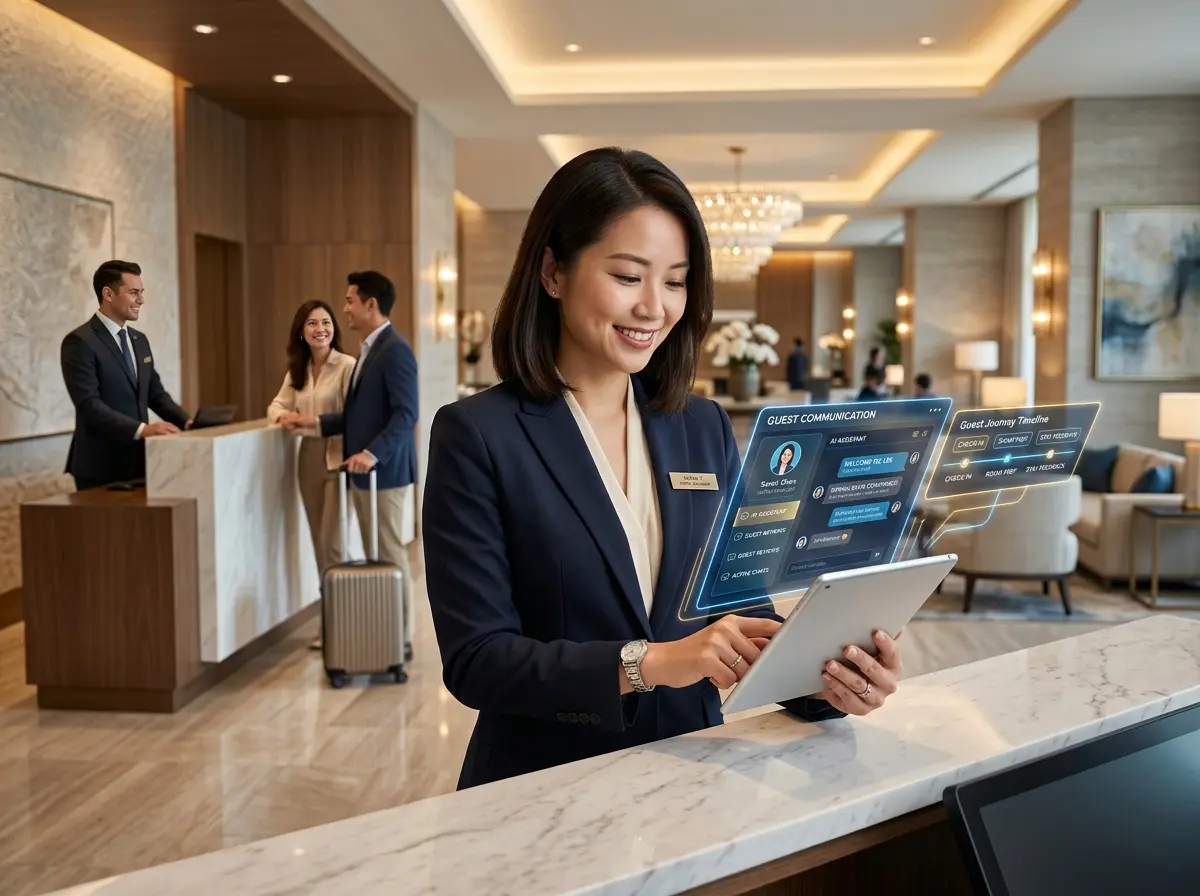
The Awkward Silence Between "Booking Confirmed" and "Welcome, Mr. Johnson"
Picture this: A guest books a room at your independent hotel. They're excited. You're excited. Everyone is excited. And then... nothing. Days — sometimes weeks — pass in complete silence until they show up at your front desk, luggage in hand, armed with a list of questions they never got answers to. Is there parking? Can I check in early? Do you allow pets? Is the rooftop bar open on Tuesdays?
If this sounds familiar, you're not alone. For independent hoteliers, the window between booking and arrival is one of the most underutilized opportunities in the entire guest experience. Large hotel chains have entire automated CRM systems and dedicated communication teams to fill that gap. Independent properties? They're usually relying on one overworked front desk staffer who is simultaneously checking someone in, answering the phone, and trying to find a plunger for Room 204.
The good news is that AI has quietly become a practical, affordable tool for exactly this kind of challenge — and one boutique hotel's experience with it is worth paying attention to.
The Problem with the Pre-Arrival Communication Gap
Guests Who Feel Ignored Are Already Planning Their One-Star Review
Research from the hospitality industry consistently shows that guest satisfaction is shaped long before anyone sets foot in the lobby. According to a study by Revinate, hotels that send personalized pre-arrival emails see significantly higher guest satisfaction scores and revenue per booking. Yet the majority of independent hotels send a single automated confirmation email and call it a day — which is roughly the equivalent of inviting someone to your dinner party and then ghosting them until they ring your doorbell.
The result? Guests arrive with unmet expectations, unanswered questions, and a vague sense that nobody really cares they're coming. That's not a great foundation for the five-star experience you're trying to deliver.
The Front Desk Can't Do Everything (Even If They Pretend They Can)
Independent hotels run lean. Very lean. The same person checking in a family of four at 3 PM is also fielding calls from prospective guests, managing housekeeping requests, and answering the same seven questions about parking for the fifteenth time that week. Expecting your front desk team to proactively reach out to every pre-arrival guest, answer their questions in a timely way, and still maintain a warm smile for the person standing right in front of them is... optimistic.
This is where a structured, automated — but still human-feeling — communication strategy becomes not just helpful, but genuinely transformative for both staff and guests.
What One Independent Hotel Did Differently
A boutique hotel with 42 rooms implemented an AI-driven pre-arrival communication workflow to address exactly this problem. Starting three days after a booking was confirmed, guests began receiving a short, friendly message acknowledging their upcoming stay and inviting them to ask questions or share preferences. The AI handled incoming replies — answering questions about amenities, local recommendations, early check-in availability, and special requests — routing only the genuinely complex or sensitive issues to a human team member.
The results after 90 days were notable: front desk call volume during peak hours dropped by roughly 30%, guest satisfaction scores on pre-arrival communication improved measurably, and the team reported spending significantly less time on repetitive informational inquiries. More importantly, guests arrived feeling like they already had a relationship with the property — which is exactly the competitive advantage an independent hotel needs.
Where AI Tools Like Stella Fit Into Your Hotel's Communication Strategy
Handling the Phones So Your Staff Doesn't Have To (All Day, Every Day)
One of the most immediate pain points for independent hotels isn't the emails — it's the phone calls. Pre-arrival guests call to confirm amenities, ask about parking, inquire about early check-in, and occasionally just to make sure their reservation actually exists. These calls are important, but they're also relentless, repetitive, and poorly timed (somehow always arriving during the busiest possible moment at the front desk).
Stella is an AI robot employee and phone receptionist that can answer these calls 24/7 with full knowledge of your property's services, policies, amenities, hours, and current promotions. She handles routine inquiries conversationally and naturally, forwards calls to human staff when the situation genuinely requires it, and takes voicemails with AI-generated summaries so nothing falls through the cracks. For hotels with a physical check-in area, she also works as an in-person kiosk — greeting arriving guests, answering questions, and reducing the line at your front desk during high-traffic periods. Her built-in CRM and conversational intake forms make it easy to collect and organize guest preferences before they arrive, giving your team a head start on delivering a personalized experience.
Building an Effective Pre-Arrival Communication Sequence
Timing Is Everything — Don't Be Weird About It
There's a fine line between a hotel that communicates proactively and one that makes guests feel like they're being tracked. The sweet spot for pre-arrival outreach typically looks something like this:
- Immediately after booking: A warm, personalized confirmation that goes beyond the standard transactional email. Include your cancellation policy, a link to your FAQ, and a genuine invitation to reach out with questions.
- 5–7 days before arrival: A pre-arrival touchpoint that highlights relevant amenities, asks about special occasions or dietary needs, and offers add-ons like early check-in or room upgrades if applicable.
- 1–2 days before arrival: A practical, logistics-focused message covering check-in time, parking, directions, and any need-to-know information that will make arrival smoother for everyone.
This isn't about flooding someone's inbox — it's about showing up at the right moment with the right information. Each touchpoint should feel like a helpful nudge, not a marketing campaign wearing a hospitality costume.
Personalization Without a Full-Time Concierge Team
Guests booking directly with independent hotels often do so precisely because they expect a more personal experience than a chain can offer. The challenge is delivering that personalization at scale without hiring a full concierge staff. AI communication tools allow you to capture guest preferences during the booking or pre-arrival phase — anniversary trip? Traveling with a dog? Need a ground-floor room? — and use that information to tailor every subsequent interaction automatically.
Even small gestures land powerfully. A message that says "We noticed you're celebrating a birthday during your stay — we'd love to help make it special" costs almost nothing to send and creates a guest experience that generates the kind of organic word-of-mouth no advertising budget can buy.
Upselling That Doesn't Feel Like Upselling
Pre-arrival communication is also your single best opportunity for revenue-generating upsells — and guests are far more receptive to them before they arrive than after. Late checkout, room upgrades, breakfast packages, spa services, and local experience packages all convert significantly better when offered in a warm, conversational pre-arrival message than when pitched at the front desk during a rushed check-in.
The key is framing. An offer that feels like a personalized recommendation ("Since you're staying through Sunday, a late checkout might be worth it — here's what it costs") outperforms one that reads like a generic sales email every single time. AI can handle this kind of nuanced, context-aware communication at a scale no human team could reasonably sustain across every single booking.
Quick Reminder About Stella
Stella is an AI robot employee and phone receptionist designed to help businesses — including independent hotels — handle customer communication professionally and consistently, without the overhead of additional staff. She answers calls around the clock, manages guest inquiries, collects information through conversational intake forms, and even greets guests in person at the front of your property. At $99/month with no upfront hardware costs, she's built for businesses that need enterprise-level communication capabilities without an enterprise-level budget.
Your Next Steps Toward a Better Guest Experience
The gap between booking and arrival isn't a dead zone — it's a canvas. Independent hotels that treat it as an opportunity to build relationships, answer questions before they become frustrations, and deliver small moments of personalization are consistently outperforming their competitors on guest satisfaction and repeat bookings. And you don't need a team of ten to do it.
Here's where to start:
- Audit your current pre-arrival communication. What does a guest actually receive between booking confirmation and check-in? If the honest answer is "not much," you have an immediate opportunity.
- Map out a simple three-touchpoint sequence based on the timing framework above. Even a basic, well-crafted version of this will outperform the status quo.
- Identify your highest-volume repetitive inquiries — the questions your front desk answers on autopilot every single day — and make sure your pre-arrival communication answers them proactively.
- Consider an AI communication tool to handle inbound guest questions and phone calls so your team can focus on delivering the in-person experience that made guests choose your property in the first place.
The independent hotel's biggest competitive advantage over a chain has always been the feeling that someone actually cares. With the right communication strategy in place, you can deliver that feeling starting the moment a guest clicks "confirm" — not just when they walk through your door.