When "We'll Call You Back" Stops Being Good Enough
Picture this: it's a Tuesday afternoon, your front desk receptionist is elbow-deep in paperwork, the phone is ringing off the hook, and three clients are standing at the counter waiting to book appointments. Meanwhile, your social media is blowing up with DMs asking about your latest laser treatment special. Somewhere in this beautiful chaos, a potential client gives up, hangs up, and books with your competitor down the street.
Sound familiar? For medical spas, this isn't a hypothetical — it's Tuesday.
The good news is that one medical spa decided enough was enough, took a hard look at where their time was actually going, and made a few strategic changes that freed up 15 hours a week. Not by hiring more staff. Not by working nights. By automating the parts of their booking process that didn't need a human touch in the first place. Here's how they did it — and how you can too.
Where the Hours Were Actually Going
The Hidden Time Sink Nobody Talks About
When this medical spa's owner, let's call her Dr. Rivera, sat down to audit her team's time, she expected to find inefficiencies in treatment scheduling or inventory management. What she actually found was that her front desk staff was spending an enormous chunk of every workday doing the same five things over and over: answering calls about pricing, confirming appointments, explaining what a HydraFacial actually does, relaying messages to the clinical team, and booking appointments that could have been self-serve.
According to industry research, the average medical spa receptionist spends between 30 and 40 percent of their workday on repetitive inquiry calls — questions that have the exact same answer every single time. That's not customer service. That's a very expensive FAQ page with a pulse.
The After-Hours Black Hole
Here's the part that really stings: medical spas don't have the luxury of a 9-to-5 client base. People research cosmetic treatments in the evening, after the kids are in bed and the wine is poured. They're ready to book at 10 PM on a Wednesday. But the office is closed, the phone goes to a generic voicemail, and by morning they've either forgotten or found someone else.
Dr. Rivera's team was losing an estimated 8 to 12 potential bookings per week simply because there was no one available to capture interest after hours. Those aren't just lost appointments — at an average medical spa service value of $200 to $400 per visit, that's a significant revenue leak happening quietly in the background every single week.
The Confirmation Carousel
Appointment confirmations and reminder calls were eating another three to four hours weekly. Staff would call, leave voicemails, wait for callbacks, update the schedule, then call again if they didn't hear back. It was a full-time job within a full-time job. And because humans are humans, things occasionally slipped through — leading to no-shows that cost the business both time and money.
How Automation (and a Little AI Muscle) Changed the Game
Letting Technology Handle the Repetitive Stuff
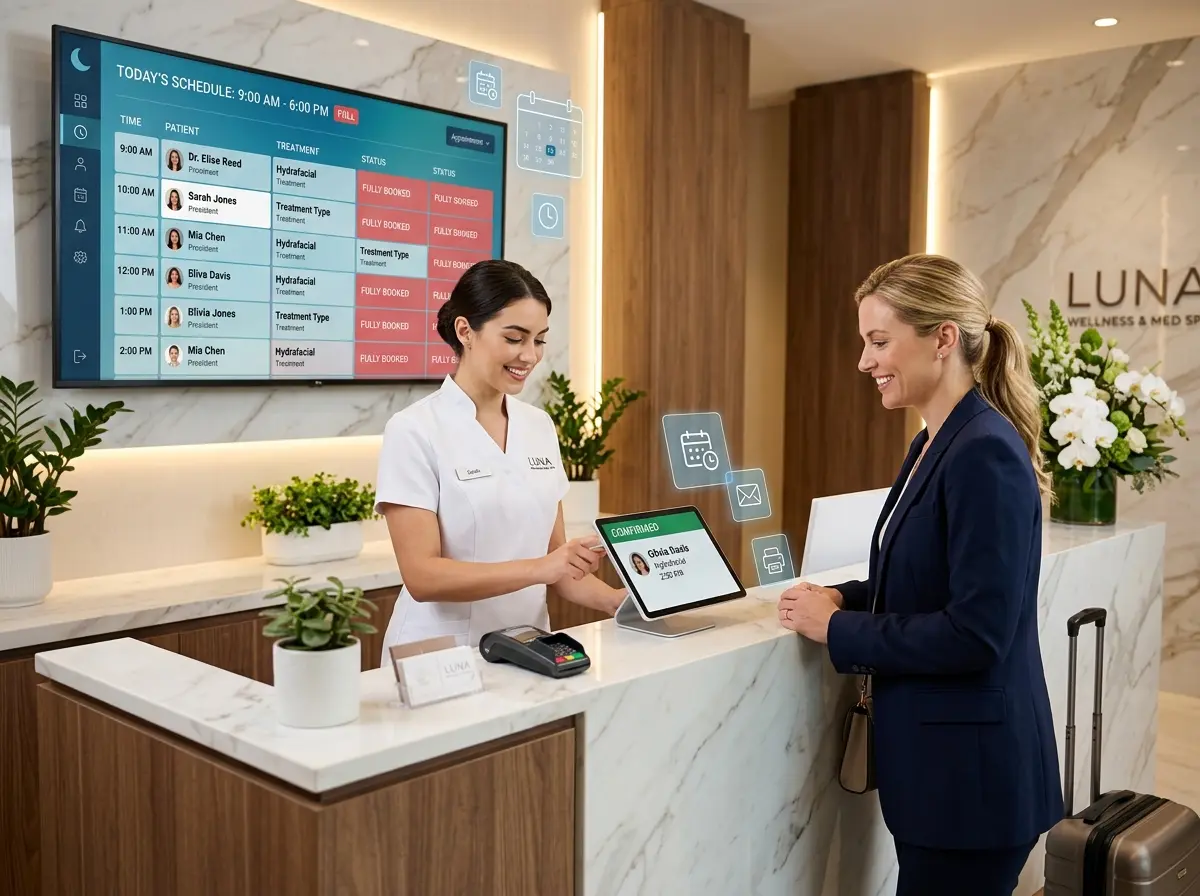
Dr. Rivera's first move was integrating an online booking system directly into her website and social profiles. Sounds obvious, right? And yet a surprising number of spas still rely on call-in booking as their primary method. By enabling 24/7 self-serve scheduling with automated confirmations and reminders, she immediately cut confirmation call time by more than half. The system handled the back-and-forth automatically — clients got texts, confirmed with a click, and the schedule updated in real time. Revolutionary? No. Effective? Absolutely.
The second move was addressing the phone problem, which is where things got genuinely interesting. Rather than hiring an additional receptionist (expensive) or letting calls continue going to voicemail after hours (losing money), she brought in an AI-powered solution to handle incoming calls around the clock.
Stella, the AI robot employee and phone receptionist, became the after-hours (and honestly, a lot of the during-hours) voice of the practice. Stella answers calls 24/7, handles questions about services, pricing, and availability, and collects client intake information conversationally — no forms to fill out later, no follow-up phone tag required. For the medical spa, this meant that a potential client calling at 9:30 PM to ask about microneedling pricing got a real, knowledgeable response and could book on the spot. Her built-in CRM automatically captured client details, tagged them appropriately, and gave the team an AI-generated profile to review in the morning. The front desk arrived to organized leads instead of a pile of vague voicemails.
Building a Booking System That Doesn't Need Babysitting
The Four Pillars of an Automated Booking Flow
If you want to replicate Dr. Rivera's results, the framework is straightforward. First, your booking system needs to be genuinely accessible — not buried three clicks deep on your website, not requiring account creation, and definitely mobile-friendly given that the majority of appointment searches happen on a phone. Second, automated reminders need to go out at multiple touchpoints: 48 hours before, 24 hours before, and a same-day nudge. Reducing no-shows by even 20 percent has an outsized impact on revenue.
Third, your intake process should happen before the appointment, not during it. Collecting health history forms, consultation questionnaires, and consent documents digitally in advance saves your clinical staff serious time and makes the client experience feel more premium. Fourth — and this is the one most spa owners skip — you need a system that captures and follows up with people who don't book. An abandoned booking attempt is a warm lead, and a timely, automated follow-up converts a meaningful percentage of them.
Measuring What Actually Matters
Dr. Rivera's 15-hour weekly savings didn't come from one big change — it came from stacking several smaller wins on top of each other. Roughly five hours came from eliminating manual confirmation calls. Four hours came from reducing repetitive phone inquiries during business hours. Three hours came from streamlining intake paperwork. And the remaining three-plus hours came from the after-hours call handling that previously required someone to sort through voicemails, research each inquiry, and return calls the next morning.
The key is to actually measure your baseline before you implement anything. Spend one week tracking where your front desk time goes in 30-minute blocks. The results are usually both illuminating and slightly depressing — which is exactly the motivation you need to actually make the changes.
Common Pitfalls to Avoid
Automation done poorly can feel cold and impersonal — especially in a medical spa environment where clients are making decisions about their appearance and want to feel taken care of. The goal is to automate the transactional parts of the experience while preserving the human warmth where it actually matters. A few things to watch out for: don't automate your complaint handling, don't let your AI communications sound robotic or templated, and always have a clear path for clients to reach a human when the situation warrants it. Configuring your phone system to forward calls to staff when a situation requires a personal touch is a simple safeguard that keeps clients feeling valued.
Quick Reminder About Stella
Stella is an AI robot employee and phone receptionist built for businesses of all sizes — whether you have a physical location or operate entirely online. She greets walk-in clients, answers phone calls 24/7, promotes your current specials, collects intake information, manages your CRM contacts, and never calls in sick. All of this runs on a $99/month subscription with no upfront hardware costs and no complicated setup. For a medical spa fielding dozens of calls and inquiries every week, she pays for herself before the month is out.
Your Next Steps Start This Week
The medical spa story isn't unique — it's just a particularly clear example of what happens when business owners stop accepting "this is just how it works" as a reasonable answer. Fifteen hours a week is nearly two full workdays. That's time your team could spend delivering exceptional client experiences, growing your service menu, or simply not burning out by 3 PM on a Friday.
Here's what to do right now. Audit your current booking process and identify the three tasks that consume the most repetitive time. Implement or upgrade your online booking with automated confirmations and reminders if you haven't already. Address your after-hours call gap — because if you're sending potential clients to voicemail at 9 PM, you're actively funding your competitor's growth. And take a serious look at whether AI-assisted phone handling is right for your practice, particularly if your front desk is spending more time on the phone than on the clients standing right in front of them.
The technology to run a leaner, more responsive, more profitable medical spa already exists. The only question is how many more Tuesdays you want to white-knuckle before you decide to use it.