When the Phone Won't Stop Ringing and You're Elbow-Deep in a Ductwork Crisis
Every HVAC owner knows the feeling. Summer hits like a freight train, temperatures spike, and suddenly every homeowner within a 30-mile radius has decided that right now is the moment their air conditioner has chosen to retire. Your technicians are booked solid, your office staff is fielding calls at a pace that would make an air traffic controller nervous, and somewhere in the chaos, a lead just called, got voicemail, and quietly scheduled with your competitor instead.
This is the busy season. It's the moment you've been building your business for — and ironically, it's also the moment your business is most likely to drop the ball on customer experience. The phones become a liability. Missed calls turn into missed revenue. And your best people spend half their day answering the same five questions instead of doing the work that actually makes you money.
The HVAC companies that are pulling ahead aren't necessarily working harder. They're working smarter — and a growing number of them are deploying AI receptionists to handle the communication surge so their human teams can focus on what they do best. Here's how they're doing it, and how you can too.
The Busy Season Communication Problem Is Bigger Than You Think
Missed Calls Are Missed Revenue — Full Stop
Let's talk numbers for a moment, because the math here is genuinely alarming. Studies consistently show that nearly 80% of callers who reach voicemail will not leave a message — they'll simply hang up and call the next HVAC company on the list. During peak season, when a single new customer relationship can be worth hundreds or even thousands of dollars in recurring maintenance contracts, emergency calls, and equipment upgrades, every missed call is a real dollar amount walking out the door.
For a mid-sized HVAC operation running at capacity during a summer heat wave, it's not unusual to miss 15 to 30 calls per day. Do that math over a six-week busy season and you're looking at a staggering volume of potential revenue that simply evaporated because nobody picked up the phone. The issue isn't that your team doesn't care — it's that there are only so many hours in the day and only so many hands available to answer calls while simultaneously dispatching technicians, ordering parts, and managing customer follow-ups.
Your Staff Has Better Things to Do
Here's a harsh truth: when your office manager spends 40 minutes of every hour answering "What are your hours?" and "Do you service Carrier units?" and "How much does a tune-up cost?" — that's 40 minutes they're not spending on scheduling optimization, technician coordination, customer retention follow-ups, or any of the dozen other things that actually move the needle for your business.
Repetitive, low-complexity phone inquiries during busy season create a kind of operational fog that slows everything down. The solution isn't necessarily hiring more people — because seasonal staff come with their own training costs, inconsistency issues, and the awkward conversation you'll need to have in September. The solution is making sure that the routine stuff gets handled automatically, so your human team can focus their energy where it truly matters.
How AI Receptionists Are Changing the Game for HVAC Companies
Meeting Customers Where They Are — Immediately
The HVAC companies winning right now with AI receptionists aren't using clunky old-school phone trees that make customers want to throw their phones into the sun. They're using conversational AI that actually understands what customers are asking, responds naturally, and handles the full intake process — collecting the customer's name, address, unit type, problem description, and preferred appointment window — all without a human being involved.
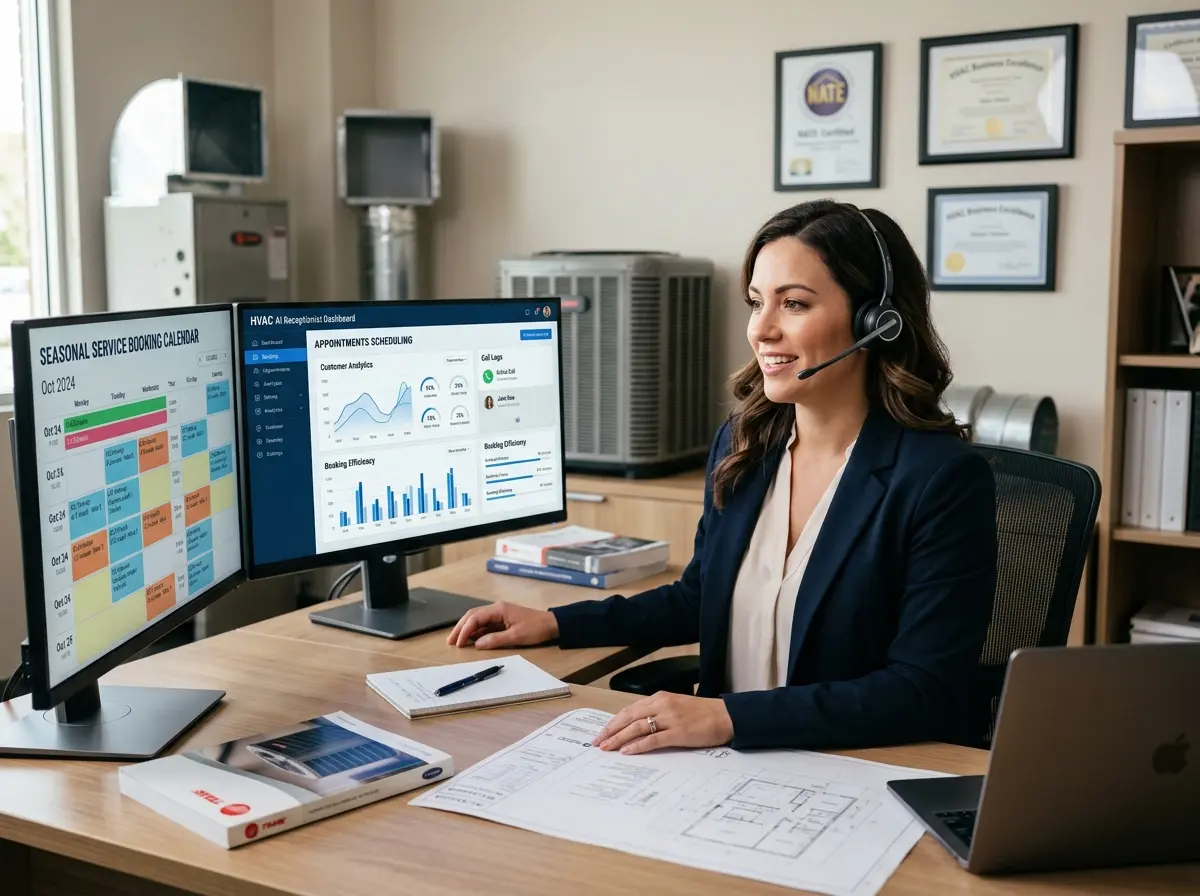
Stella, an AI robot employee and phone receptionist built for exactly this kind of scenario, answers calls 24/7 with the same knowledge your best office staff would have. She can explain your service offerings, quote general pricing ranges, confirm service area coverage, and walk a caller through a full intake form conversationally — so by the time a technician or dispatcher actually looks at the lead, all the relevant information is already captured and organized. For HVAC companies with a physical showroom or office, Stella also operates as a human-sized in-store kiosk, greeting walk-in customers and answering their questions proactively. Her built-in CRM stores every contact with AI-generated profiles, custom fields, and tags, so nothing falls through the cracks when things get hectic.
The result? Customers feel heard and taken care of immediately. Your team gets clean, organized lead information without playing phone tag. And nobody has to listen to hold music for 20 minutes before finding out you don't service their zip code.
Strategies HVAC Companies Are Using to Maximize Peak Season Performance
Tiered Call Handling: Let AI Handle the Routine, Humans Handle the Complex
One of the smartest approaches successful HVAC companies are taking is implementing tiered call handling — where an AI receptionist manages all incoming calls first and routes them based on complexity and urgency. General inquiries, appointment scheduling, pricing questions, and service area confirmations get handled entirely by the AI. True emergencies, complex commercial accounts, or upset customers get escalated immediately to a human team member.
This approach means your phones are never "closed." A homeowner whose AC fails at 11 PM on a Thursday gets a real, helpful, conversational response — not a voicemail. They can describe their issue, get basic troubleshooting guidance or confirmation that help is coming, and have their information captured for first-thing-in-the-morning dispatch. Your technicians arrive informed. Your customer wakes up feeling like someone actually listened. It's a win on every front.
Using Intake Forms to Pre-Qualify and Prioritize Service Calls
Not all service calls are created equal, and experienced HVAC operators know that a little bit of upfront information can make the difference between an efficient dispatch and a wasted trip. AI receptionists can conduct structured intake conversations that gather the unit's age and brand, the nature of the problem, whether the system is still under warranty, the customer's service history, and the urgency level — all before a human dispatcher ever gets involved.
This information flows directly into your customer management system, where calls can be prioritized and routed appropriately. A 78-year-old woman with no AC in triple-digit heat gets moved to the top of the list. A homeowner who wants a routine fall tune-up scheduled in July gets appropriately slotted. This kind of intelligent triage doesn't happen by accident — it happens when you have systems in place that capture the right information consistently, every single time, regardless of how busy the phones are.
Turning Every Interaction Into a Marketing Opportunity
Busy season is also prime time to move maintenance contracts, sell smart thermostat upgrades, and promote seasonal service bundles — but when your staff is drowning in call volume, upselling is usually the first thing to go. AI receptionists don't have that problem. They can be configured to mention current promotions, highlight maintenance plan benefits, and recommend complementary services as a natural part of every customer interaction, whether that's a phone call or an in-person visit.
Several HVAC companies have reported meaningful increases in maintenance contract sign-ups simply by ensuring that every new customer call includes a brief, natural mention of their preventative maintenance program. When a human receptionist is managing 60 calls a day, remembering to mention the promotion on every single one is unrealistic. An AI receptionist does it perfectly, every time, without exception — and without needing a commission check for the privilege.
A Quick Reminder About Stella
Stella is an AI robot employee and phone receptionist that answers calls 24/7, manages customer intake, promotes your services, and keeps your CRM organized — all for $99/month with no upfront hardware costs. She works for any business with a physical location or phone line, she never calls in sick, and she definitely doesn't need a break during the summer rush. Setup is straightforward, and she's ready to work from day one.
Your Next Steps Before the Next Heat Wave Hits
The HVAC companies that dominate their markets during busy season aren't the ones with the most technicians or the biggest advertising budgets. They're the ones that have built systems capable of handling volume without sacrificing quality — systems that capture every lead, communicate professionally at every touchpoint, and free up human talent for the work that actually requires human judgment.
If you're ready to stop losing leads to voicemail and stop burning out your office staff on repetitive inquiries, here's where to start:
- Audit your missed call rate. Pull your phone data from last busy season and count how many inbound calls went unanswered or to voicemail. That number will be motivating.
- Map your most common inbound inquiries. Document the top 10 questions your staff answers repeatedly. These are exactly the conversations an AI receptionist should be handling.
- Define your call escalation rules. Decide what types of calls should go straight to a human and what can be handled end-to-end by AI. Most HVAC companies find that 60–70% of calls fall into the "AI can handle this" category.
- Explore AI receptionist options that integrate naturally with your existing workflow, collect structured intake information, and operate 24/7 without additional staffing costs.
The busy season will come back around whether you're ready or not. The question is whether you'll spend it scrambling to answer every call yourself — or whether you'll have a system in place that handles the surge, captures every lead, and lets your team do what they're actually good at. One of those options sounds significantly less stressful than the other.