So, How Happy Are Your Patients — Really?
You think your practice is doing great. Your waiting room has decent magazines (okay, they're from 2022, but still), your staff smiles, and nobody has stormed out in a while. But here's the uncomfortable question: would your patients actually recommend you to a friend? Not just "sure, maybe" recommend you — but genuinely, enthusiastically refer someone they care about to your practice?
That's exactly what the Net Promoter Score (NPS) is designed to uncover. It's one of the simplest, most powerful metrics in customer experience, and yet most healthcare practices either ignore it entirely or collect the data and then... do nothing with it. If you're in that camp, this post is for you. We're going to break down what NPS actually is, how to use it in a medical or wellness practice, and — most importantly — how to turn that feedback into real improvements that keep patients coming back and sending their friends your way.
Understanding Net Promoter Score in a Healthcare Context
What Is NPS and How Does It Work?
Net Promoter Score is built around one deceptively simple question: "On a scale of 0 to 10, how likely are you to recommend our practice to a friend or family member?" Based on their response, patients fall into one of three categories:
- Promoters (9–10): Your biggest fans. They're likely already referring people and leaving glowing reviews.
- Passives (7–8): Satisfied but not enthusiastic. They could easily switch to a competitor if something better comes along.
- Detractors (0–6): Unhappy patients who may be actively discouraging others from visiting your practice.
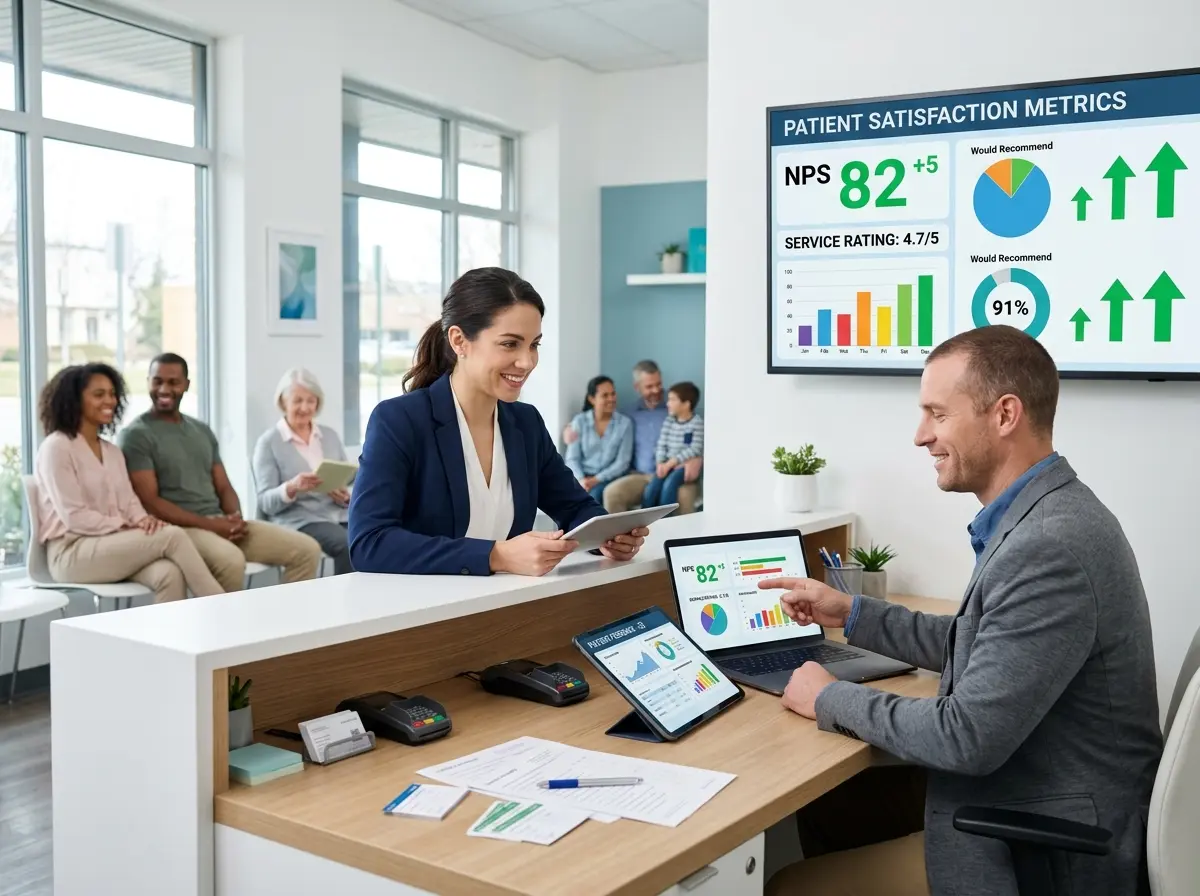
Your NPS is calculated by subtracting the percentage of Detractors from the percentage of Promoters. Scores range from -100 to +100. According to Bain & Company (the firm that created NPS), a score above 0 is considered good, above 50 is excellent, and above 70 is world-class. The average NPS for healthcare hovers around 58 — so there's both a benchmark to aim for and plenty of room to outperform your peers.
Why NPS Matters More Than Patient Satisfaction Surveys
Traditional patient satisfaction surveys are fine, but they tend to produce a lot of noise and not much signal. Patients rate everything a 4 or 5 out of 5 because they're polite, and you walk away thinking everything is wonderful — until you notice appointment volume quietly dropping. NPS cuts through the courtesy bias. Asking whether someone would stake their reputation on recommending you is a much higher bar than asking if they were "satisfied," and it tends to reveal the truth more quickly.
Beyond the score itself, the real gold is in the follow-up open-ended question: "What's the primary reason for your score?" This is where patients tell you about the 20-minute hold times, the confusing billing process, or the fact that your front desk staff made them feel like an inconvenience. That qualitative feedback is your roadmap.
When and How to Collect NPS Feedback
Timing matters enormously. The best window to send an NPS survey is within 24 hours of an appointment, while the experience is still fresh. You can use SMS, email, or a kiosk-based prompt right after check-out. Keep it short — two questions maximum. Response rates drop significantly with every additional question you add. Aim for a response rate of at least 20–30%, which is achievable if you send through the right channel at the right time. If you're only hearing from 5% of your patients, your data isn't reliable enough to act on.
Tools and Systems That Make Feedback Collection Easier
Reducing Friction at Every Touchpoint
One of the biggest barriers to collecting consistent NPS data isn't motivation — it's friction. Staff are busy, patients are rushing out the door, and that feedback request gets forgotten or feels awkward to push. This is where having the right systems in place makes a real difference. Automating your survey delivery through your practice management software or a dedicated NPS tool like Delighted, SurveyMonkey, or Medallia removes the burden from your team entirely.
For practices with a physical location, Stella — the AI robot receptionist — can help create a smoother patient experience from the moment someone walks in or calls. Her in-store kiosk presence means patients are greeted promptly and professionally, reducing the friction and frustration that often tanks NPS scores before the appointment even begins. On the phone side, Stella answers calls 24/7, collects patient information through conversational intake forms, and manages contacts through a built-in CRM — meaning the data you need to follow up with patients post-visit is already organized and ready to use. Fewer dropped calls, fewer frustrated patients, better scores.
Turning Your NPS Data Into Actionable Improvements
Diagnosing the Root Causes Behind Your Score
Once you have enough responses to be statistically meaningful (aim for at least 50 before drawing conclusions), it's time to actually read the qualitative feedback. Resist the urge to jump straight to the number. Group comments into themes — scheduling, wait times, communication, billing, bedside manner, follow-up care — and look for patterns. If seven different patients mention that they couldn't reach your office by phone, that's not a coincidence. That's a systemic problem with a fixable solution.
It also helps to segment your NPS by patient type, visit type, or provider if your practice has multiple staff members. A practice-wide score of 45 might mask the fact that one provider has a score of 70 and another is sitting at 20. Knowing where the gap is lets you address it directly rather than applying a blanket fix to something that doesn't need fixing across the board.
Closing the Loop With Detractors and Passives
Closing the loop — meaning actually following up with patients who gave you a low or middling score — is what separates practices that use NPS as a vanity metric from those that use it as a growth tool. When a patient scores you a 4, a personalized outreach from a practice manager saying "We noticed your experience wasn't great — can we talk about what happened?" can transform a detractor into a loyal patient. Research from the Harvard Business Review suggests that customers who have a complaint resolved quickly and effectively can end up more loyal than those who never had a problem at all.
For Promoters, closing the loop looks different — it's an invitation. Ask them to leave a Google review, refer a friend, or share their experience. Your Promoters are already happy; you just need to give them a nudge and an easy path to act on that enthusiasm.
Building a Continuous Improvement Cycle
NPS isn't a one-time project. It's a pulse check that should run continuously. Set a cadence — monthly or quarterly — to review your aggregate scores and trending themes. Share the data with your team in a way that's constructive, not punitive. Staff who understand how their interactions affect patient experience are far more motivated to improve than those who are simply told to "be nicer."
Document the changes you make in response to feedback, and then watch whether your scores shift over the following quarter. This creates a feedback loop that not only improves the patient experience but also builds a culture of accountability and continuous improvement throughout your practice. Over time, even small consistent gains in NPS translate to measurable increases in patient retention and word-of-mouth referrals — both of which directly impact your bottom line.
A Quick Reminder About Stella
Stella is an AI robot employee and phone receptionist that works 24/7 — greeting patients at your front entrance, answering calls, collecting intake information, and managing contacts through a built-in CRM, all for just $99/month with no upfront hardware costs. She's the kind of employee who never calls in sick, never puts a patient on hold to gossip with a coworker, and never forgets to follow your protocols. For practices looking to reduce the friction that drives NPS scores down, she's worth a serious look.
Start Measuring, Start Improving
If you've made it this far, you now have everything you need to launch a meaningful NPS program at your practice. Here's a simple action plan to get started:
- Choose your survey tool. Pick a platform that integrates with your existing systems and automates delivery within 24 hours of a visit.
- Start collecting responses. Aim for at least 50 before drawing any conclusions, and make sure you're asking the follow-up "why" question.
- Analyze the themes. Don't just look at the number. Read the comments, group them by category, and identify your top two or three pain points.
- Close the loop. Follow up personally with Detractors and invite your Promoters to leave reviews or refer friends.
- Share the results with your team and make at least one operational change per quarter based on what you hear.
- Repeat. Track your score over time and celebrate progress.
Your patients are already forming opinions about your practice — the question is whether you're listening. NPS gives you a structured, honest way to hear what they're really saying, and more importantly, to do something about it. A practice that actively seeks feedback and visibly responds to it doesn't just retain patients; it earns the kind of trust that turns patients into advocates. And in healthcare, where word-of-mouth is still one of the most powerful marketing forces there is, that's worth more than any ad spend you'll ever make.