When "We'll Get Back to You" Just Doesn't Cut It Anymore
Picture this: Someone finally works up the courage to reach out to a mental health practice. Maybe they've been sitting with that decision for weeks. They pick up the phone, or fill out a contact form, or send a message — and then they wait. And wait. And then they get a generic auto-reply that says something like, "Thanks for your message! We'll get back to you within 2-3 business days."
For most industries, a 2-3 day response window is mildly annoying. For mental health care, it can be genuinely damaging. Research from the National Alliance on Mental Illness suggests that delays in accessing care — even short ones — can cause prospective clients to disengage entirely. And in a field where the barrier to asking for help is already incredibly high, a cold, delayed, or impersonal first response isn't just a missed business opportunity. It's a missed human one.
So how do mental health practices balance compassion at scale? How do you respond promptly, warmly, and professionally to every single inquiry — without burning out your clinical staff or hiring a dedicated intake coordinator who works around the clock? The answer, increasingly, is AI-assisted intake and communication. And no, it doesn't have to feel robotic. Done right, it can actually feel more human than your current process.
The Hidden Crisis in Mental Health Practice Intake
The First Response Problem
Studies consistently show that speed of first response is one of the strongest predictors of whether a prospective client will actually schedule an appointment. A landmark study from Harvard Business Review found that companies (and yes, this applies to practices too) that responded to inquiries within an hour were seven times more likely to have meaningful follow-up conversations than those who waited even a few hours longer. In mental health care, where ambivalence and fear are already working against the client, the math gets even more unforgiving.
The challenge is that most small and mid-sized mental health practices simply don't have the infrastructure to respond instantly. Therapists are in sessions. Office managers are managing offices. And nobody — nobody — wants to be the person whose job it is to watch the inquiry inbox at 9:47 PM on a Tuesday.
The Tone Problem
Even when practices do respond quickly, the response often sounds like it was written by a compliance officer in 1997. Overly formal language, lengthy disclaimers, and clinical detachment all send the wrong message to someone who is already nervous about reaching out. The intake process is, in many ways, the first therapeutic interaction a client has with your practice — and if it feels cold or transactional, you've already started on the wrong foot.
Compassionate, warm, appropriately personalized responses require time and intentionality. When your front desk is also fielding phone calls, scheduling appointments, managing insurance questions, and probably also handling some other task that wasn't in the original job description, that kind of intentionality becomes a luxury.
The After-Hours Problem
Mental health struggles don't observe business hours. The moment someone decides they're ready to seek help is rarely 10 AM on a Wednesday. It's more likely to be a Sunday evening, a late-night spiral, or a quiet moment in the middle of a chaotic week. If your practice's response to those moments is a voicemail box or a contact form that disappears into the void, you're not just losing clients — you're failing people at a vulnerable moment.
This is the intake crisis hiding in plain sight at mental health practices everywhere. And it's entirely solvable.
How AI Can Help Mental Health Practices Respond with Warmth — Not Just Speed
Compassionate Automation Is Not a Contradiction
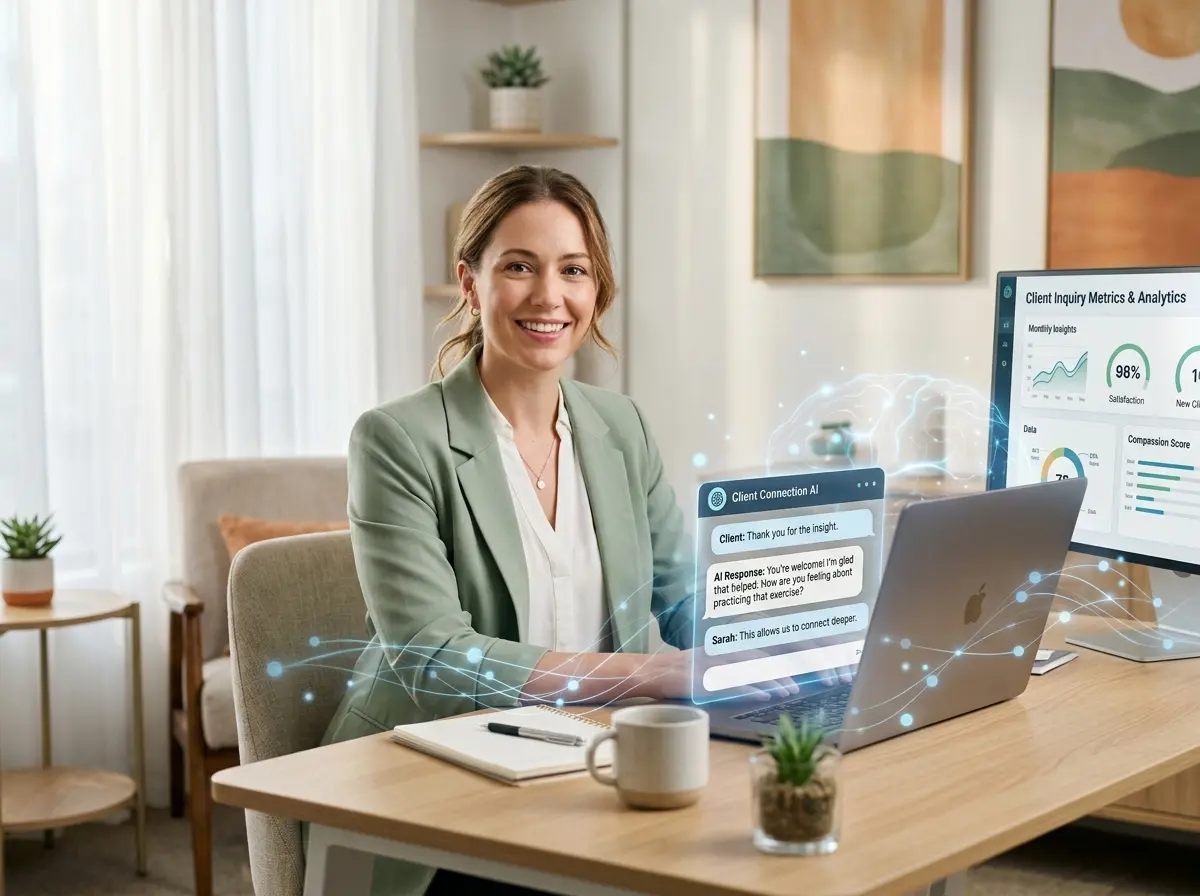
Here's where mental health practice owners often push back: "AI feels impersonal. My clients need human connection." Fair point. And completely compatible with using AI for intake — as long as you're using it thoughtfully. The goal isn't to replace human connection. It's to ensure that the first touchpoint a client experiences is warm, prompt, and informative, so that by the time they reach a human, they're already feeling welcomed rather than frustrated.
Stella, an AI robot employee and phone receptionist, is one platform helping practices accomplish exactly this. Stella answers phone calls 24/7 with the same warmth and knowledge as your best front-desk staff — without the burnout, the call-in-sick days, or the awkward training period. She can be configured to understand your practice's specific services, insurance policies, and intake process, and she collects prospective client information through conversational intake forms right on the phone call itself. That information feeds directly into a built-in CRM with AI-generated contact profiles, custom fields, and tags — so when your staff reviews the morning's inquiries, they already have a complete picture of each prospective client and can follow up with real context rather than starting from scratch.
For practices with a physical office, Stella also functions as an in-person kiosk — greeting visitors, answering questions, and providing a professional, consistent presence in your waiting area. It's not about replacing the human element. It's about making sure the human element shows up at the moments that matter most.
Building a Compassionate Intake Process That Actually Scales
Design Your Response Language Intentionally
Whether you're using AI, templates, or a combination of both, the language of your intake process matters enormously. Audit every touchpoint a prospective client experiences — your website contact form confirmation, your phone greeting, your voicemail message, your follow-up email — and ask yourself honestly: does this sound like a practice that genuinely cares about the people reaching out?
Some practical principles to apply: Acknowledge the courage it takes to reach out. Avoid clinical jargon in non-clinical contexts. Be specific about next steps so clients aren't left wondering what happens now. And always, always communicate a clear timeline for when they'll hear from a human — even if the initial response is automated.
Separate Triage from Treatment
One of the most important structural decisions a mental health practice can make is clearly defining which parts of the intake process require clinical judgment and which parts are purely logistical. Scheduling, insurance verification, intake form collection, FAQ responses, appointment reminders — none of these require a therapist. Freeing your clinical staff from administrative intake tasks doesn't just improve efficiency; it protects them from the kind of administrative fatigue that contributes to therapist burnout, which is its own crisis worth taking seriously.
When your therapists spend less time playing receptionist, they have more bandwidth for the actual work of therapy — which is better for clients and better for your practice's culture.
Create Consistent Follow-Up Protocols
Consistency is kindness in intake. A prospective client who reached out three days ago and hasn't heard back isn't just a lost lead — they're a person who took a risk and got silence in return. Build a follow-up sequence that triggers automatically after initial inquiry, with a clear escalation path if there's no response. This doesn't require sophisticated technology; it requires a deliberate process and the discipline to stick to it.
Consider a simple three-touch approach: an immediate automated acknowledgment, a personal outreach within one business day, and a gentle follow-up two to three days later if there's been no response. This structure respects the client's autonomy while making clear that your practice is genuinely invested in connecting with them.
A Quick Reminder About Stella
Stella is an AI robot employee and phone receptionist designed for businesses of all kinds — including mental health practices that need a warm, reliable, always-available first point of contact. At just $99/month with no upfront hardware costs, she answers calls 24/7, collects intake information conversationally, and keeps everything organized in her built-in CRM so your team can follow up with confidence. She's the intake coordinator who never has a bad day.
Your Practice Deserves an Intake Process as Good as Your Care
Mental health practitioners spend years developing the skills to meet clients with compassion, presence, and skill. It's genuinely frustrating — and a little ironic — that so many practices then send those same clients through an intake process that feels like filing a claim with a mid-tier insurance company.
The good news is that fixing this doesn't require a massive operational overhaul. It requires intentionality, the right tools, and a willingness to treat intake as an extension of care rather than an administrative nuisance. Here are your actionable next steps:
- Audit your current intake touchpoints — read every automated message, listen to your own voicemail greeting, and time your average first-response delay. Be honest about what you find.
- Identify your after-hours gap — if someone calls or submits an inquiry at 8 PM, what happens? If the answer is "nothing until tomorrow," that's your first fix.
- Separate administrative intake tasks from clinical ones — document which parts of intake need a human clinician and which don't, then build systems accordingly.
- Explore AI-assisted tools — whether it's Stella or another platform, the technology now exists to provide warm, responsive, 24/7 intake support at a price point that works for independent and group practices alike.
- Train your whole team on intake language — make sure everyone who interacts with prospective clients understands that this is the first chapter of the therapeutic relationship, not just an administrative formality.
Your clients are brave enough to ask for help. Make sure your practice is ready to receive them — every time, at any hour, with the warmth they deserve.