Why Your Medical Practice Needs a Free Consultation Strategy (And How to Make It Actually Work)
Let's be honest — most people don't wake up excited to call a medical office. Between navigating insurance questions, deciphering medical jargon, and the general anxiety that accompanies healthcare decisions, potential patients often do what any reasonable person does when overwhelmed: nothing. They close the tab, ignore the brochure, and tell themselves they'll "look into it later." Later, of course, never comes.
That's where the free consultation model becomes one of the most powerful lead magnets your medical practice can deploy. It lowers the barrier to entry, builds trust before a dollar changes hands, and — when executed properly — converts curious browsers into loyal, long-term patients. The challenge isn't convincing people that a free consultation is a good idea. The challenge is making the offer feel effortless to accept and seamless to fulfill. In a competitive healthcare landscape where patient experience begins the moment someone finds your number, you can't afford a clunky, frustrating first impression.
This post walks you through how to design, promote, and operationalize a free consultation strategy that genuinely grows your practice — without adding chaos to your front desk.
Designing a Free Consultation Offer That Actually Converts
Not all free consultations are created equal. A vague "call us to learn more" invitation is about as compelling as a waiting room magazine from 2019. A well-structured free consultation offer, on the other hand, gives potential patients a clear reason to act — and a clear expectation of what they'll receive.
Define the Scope and Format
The first step is deciding exactly what your free consultation entails. Is it a 15-minute phone call with a nurse practitioner? An in-office assessment? A telehealth discovery session? Be specific. Vague offers generate vague interest. When patients know they're signing up for a "15-minute consultation to discuss your chronic pain concerns with our specialist," they can visualize the experience and are far more likely to commit.
Keep the format low-commitment. A shorter initial touchpoint — think 15 to 20 minutes — respects the patient's time and removes the fear of being "locked in." You can always convert a 15-minute call into a full appointment. You cannot, however, undo the impression of a practice that makes people jump through hoops just to ask a question.
Identify Your Target Audience and Qualifying Criteria
A free consultation offer is most effective when it's targeted. A general wellness practice, a cosmetic dermatology clinic, and a physical therapy center all serve different audiences with different anxieties and motivations. Tailor your messaging accordingly.
It's also worth considering light qualification criteria — not to discourage people, but to ensure the consultation is genuinely useful for both parties. A simple intake question like "What's your primary concern today?" or "Have you previously received treatment for this condition?" helps your team prepare and signals to the patient that they're entering a thoughtful, personalized process rather than a sales funnel dressed in scrubs.
Make the Offer Unmissable Across Every Channel
Your free consultation offer should appear on your website homepage, your Google Business profile, your social media bios, and anywhere else a prospective patient might encounter your practice. If someone has to hunt for the offer, they won't find it — and even if they do, they'll wonder why you're hiding it.
According to research from Zocdoc, over 60% of patients choose a provider based on online information alone, before ever speaking to a human. That means your digital presence needs to do the heavy lifting of trust-building long before your front desk staff gets involved. A prominently featured free consultation offer is one of the fastest ways to stand out in a crowded field.
Streamlining Intake and Scheduling With Smarter Tools
Here's where many practices stumble: the offer is great, but the follow-through is a mess. A patient sees your free consultation promotion, gets excited, calls your office — and is immediately put on hold, sent to voicemail, or greeted by a frazzled front desk coordinator who has six other things happening simultaneously. First impression: not great.
The Intake Experience Is Part of the Consultation
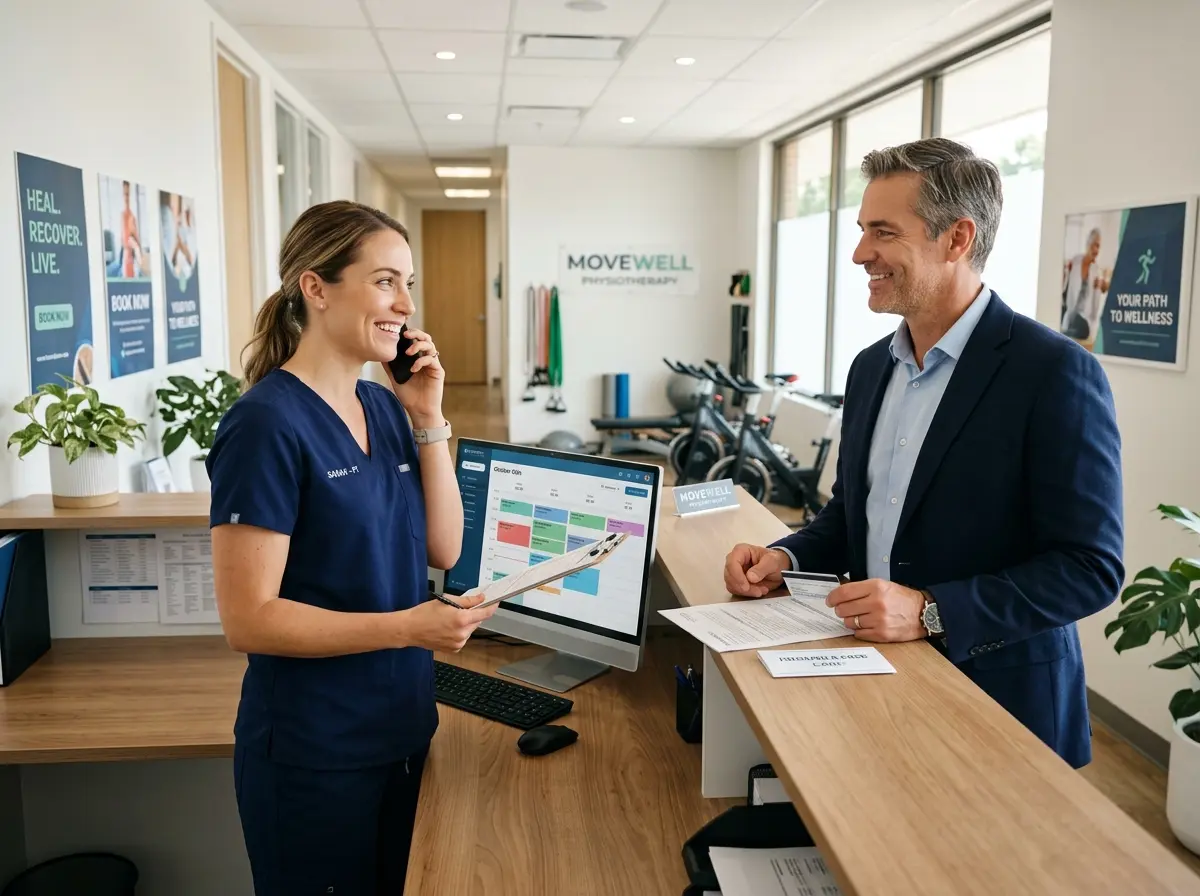
Patient experience doesn't begin in the exam room. It begins the moment a prospective patient decides to reach out. A smooth, professional intake process — whether by phone, web form, or in person — communicates that your practice is organized, respectful of their time, and worth trusting with their health. A chaotic or impersonal intake process communicates... the opposite.
This is where Stella, the AI robot employee and phone receptionist, can genuinely change the game for medical practices. Stella answers phone calls 24/7, walks callers through conversational intake forms, collects patient information, and logs everything into her built-in CRM — complete with AI-generated contact profiles, custom fields, and tags. If someone calls at 9 PM to inquire about a free consultation, Stella handles the entire interaction professionally, without a single human staff member needing to step away from their evening. For practices with a physical location, Stella also stands at the front as a kiosk, greeting walk-ins and guiding them through the same seamless intake process in person. No hold music. No dropped calls. No missed opportunities.
Nurturing Consultation Leads Into Long-Term Patients
Booking the free consultation is a victory, but it's not the finish line. The real work — and the real revenue — comes from converting that initial interaction into an ongoing patient relationship. That requires a deliberate nurturing strategy built into your practice's workflow.
Follow Up Like You Mean It
Statistics consistently show that a significant portion of booked consultations — some estimates suggest as many as 30% or more — result in no-shows when there's no follow-up communication. A simple confirmation message, a reminder the day before, and a brief follow-up after the consultation can dramatically reduce drop-off and signal to patients that your practice is attentive and engaged.
Your follow-up doesn't need to be elaborate. A personalized text or email referencing the patient's specific concern ("We're looking forward to speaking with you about your knee pain on Thursday") is more effective than a generic "You have an appointment" notification. Personalization communicates care — which, in a medical context, is exactly what patients are buying.
Create a Clear Post-Consultation Pathway
Every free consultation should end with a clear, low-pressure next step. Whether that's scheduling a full assessment, receiving a personalized treatment recommendation, or simply receiving a follow-up resource tailored to their concern, patients should leave the interaction knowing exactly what comes next. Ambiguity kills momentum.
Train your consultants — whether physicians, nurses, or patient coordinators — to close every free consultation with a specific offer or action. "Based on what we discussed, I'd recommend we schedule a comprehensive evaluation. I can have our coordinator reach out with available times by end of day tomorrow." That's clear. That's confident. And it works.
Measure What Matters
A free consultation program that isn't tracked is just a charity. Monitor your conversion rates — how many consultations become paying patients, how many no-shows occur, which acquisition channels are driving the most valuable leads, and what your average revenue per converted consultation looks like. Even basic tracking will reveal patterns that allow you to optimize the offer, the intake process, and the follow-up sequence over time.
If your free consultation offer is being promoted across multiple channels — social media, Google ads, a referral program, your website — make sure you can attribute which channels are performing. Doubling down on what works is the simplest growth strategy in existence, and yet remarkably few practices take the time to do it.
Quick Reminder About Stella
Stella is an AI robot employee and phone receptionist built for businesses of all types — including medical practices looking to deliver a consistently professional patient experience. She answers calls 24/7, manages intake, handles FAQs, and greets patients in person at her kiosk, all for just $99/month with no upfront hardware costs. If your front desk is the bottleneck between a great free consultation offer and a fully booked calendar, Stella is worth a very serious look.
Your Next Steps: Turning This Into Action
The free consultation model is not a new idea — but most practices implement it poorly, promote it inconsistently, and fail to operationalize it in a way that scales. The good news is that fixing those gaps doesn't require a massive overhaul. It requires clarity, consistency, and the right tools in the right places.
Start here:
- Define your free consultation offer clearly — format, duration, scope, and target audience — and write one compelling sentence that describes it.
- Audit your intake process — call your own office right now and pretend to be a patient. What happens? Was it good? Be honest.
- Update your digital presence — make sure the free consultation offer is prominently visible on your website, Google profile, and social channels.
- Build a follow-up sequence — at minimum, a confirmation, a reminder, and a post-consultation touchpoint. Automate where possible.
- Set up basic tracking — even a simple spreadsheet is better than flying blind.
Medical practices that grow sustainably aren't necessarily the ones with the best clinical outcomes alone — they're the ones that make it easy to become a patient and feel good to remain one. A well-executed free consultation strategy is one of the most cost-effective ways to build that kind of practice. The only question left is whether you're going to implement it properly — or leave it as a tab you'll "get back to later."