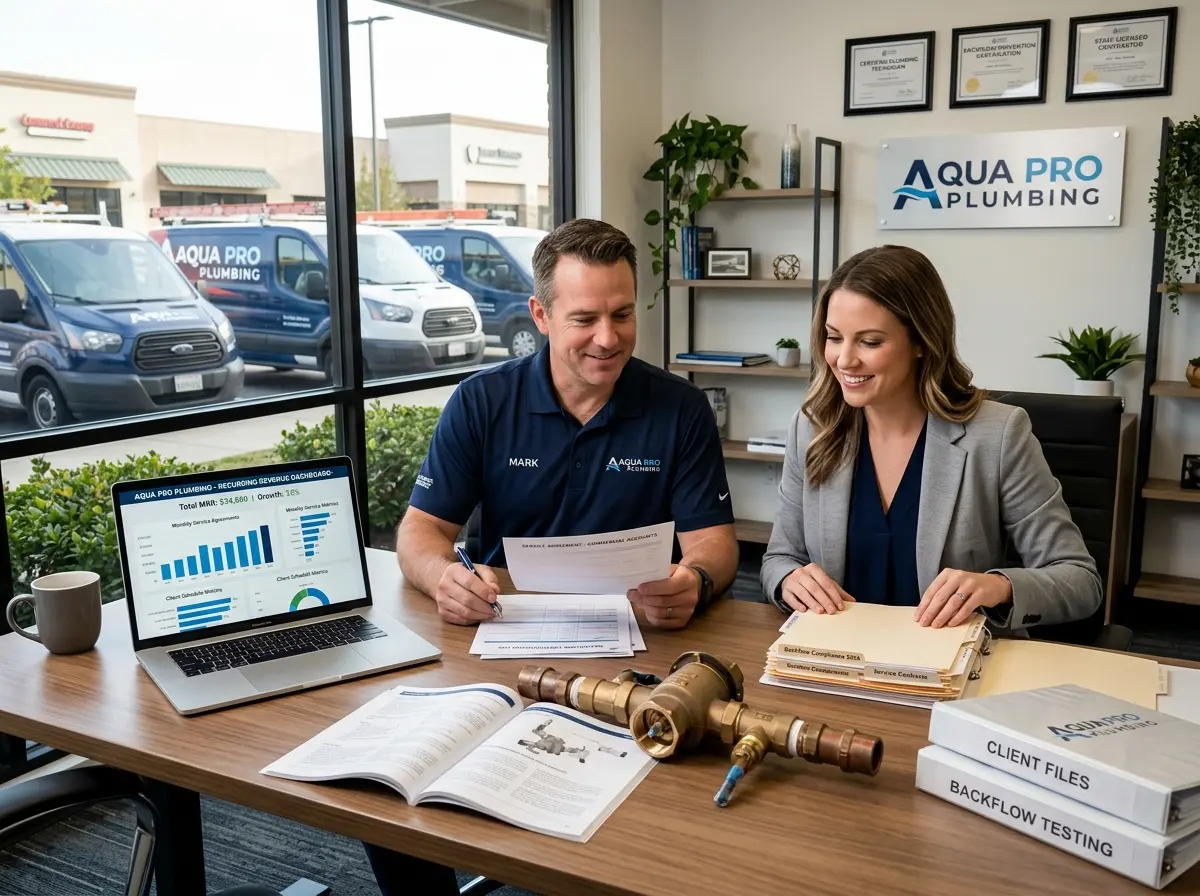
Introduction: Why Your Plumbing Business Needs a Recurring Revenue Stream (And Why Backflow Testing Is a Gift)
Let's be honest — plumbing is a feast-or-famine business. One week you're elbow-deep in a commercial kitchen disaster earning great money, and the next week you're refreshing your email wondering where everyone went. If you've been running your plumbing company on emergency calls and one-off repairs alone, you've been leaving serious money on the table. The kind of money that pays for trucks, techs, and the occasional vacation that doesn't get interrupted by a burst pipe at 2 a.m.
Enter: backflow testing. It's not glamorous. It doesn't have a great PR team. But it is legally required for thousands of commercial, industrial, and residential properties across virtually every municipality in the country — typically on an annual basis. That means every single one of those properties needs a certified backflow tester every year, like clockwork, whether they like it or not. That's not a sales opportunity. That's a mandate. And if you're not the one fulfilling it, someone else is.
Building a structured backflow testing program transforms your plumbing company from a reactive fire-putting-out operation into a predictable, scalable, recurring revenue machine. This guide will walk you through exactly how to do it — and how to run it efficiently so it doesn't consume your life.
Building the Foundation of Your Backflow Testing Program
Get Certified and Get Legal
Before you can charge a single dollar for backflow testing, you need the proper certifications. Most states require backflow testers to hold a certification from an accredited program such as the American Backflow Prevention Association (ABPA) or the American Society of Sanitary Engineering (ASSE). The specific requirements vary by state and municipality, so your first homework assignment is to contact your local water authority and find out exactly what's required in your service area.
The good news? Certification courses are typically a few days long and not prohibitively expensive. You don't need every tech on your crew to be certified — in fact, dedicating one or two employees specifically to backflow testing routes is a highly efficient model. Many plumbing companies find that a single certified tech running a full route can test 10 to 15 devices per day, generating anywhere from $1,500 to $3,000 in daily revenue depending on your market rate.
Identify Your Target Market and Build Your List
Your potential backflow testing clients aren't hard to find — they're literally required by law to have the service done. Your primary targets should include restaurants and food service businesses, apartment complexes, office buildings, irrigation systems, medical facilities, car washes, and any commercial property connected to a municipal water supply with a backflow prevention device installed. Most municipalities maintain public records of registered backflow devices, and your local water authority may even provide lists of properties due for testing.
Start by mapping your existing customer base. Chances are you've already worked on commercial properties that have backflow assemblies. These are warm leads — they already know you, trust you, and you've probably seen their plumbing firsthand. Build a spreadsheet, organize by last-tested date if known, and start there before spending a dollar on cold outreach.
Set Your Pricing and Service Tiers
Pricing for backflow testing varies by region, assembly type, and whether you're including report filing with the municipality. Typical rates range from $75 to $200 per assembly for straightforward residential or light commercial work, with larger or more complex assemblies commanding more. Don't underprice yourself trying to undercut the competition — backflow testing customers rarely choose solely on price, and the annual, recurring nature of the work means even a modest margin compounds beautifully over time.
Consider offering service tiers: a basic test-and-report package, a mid-tier that includes minor repairs and retesting, and a premium tier that includes proactive device inspection, priority scheduling, and automatic annual reminders. Tiered pricing increases average ticket size and makes your top-tier customers feel like VIPs — which, frankly, they should, since they're paying you every year without you having to convince them.
Running Your Program Without Running Yourself Ragged
Automate Your Scheduling and Customer Reminders
The dirty secret of recurring service programs is that the follow-up is where most plumbing companies fail. A customer gets tested in April, life moves on, and by the following March you've both forgotten each other exist. Meanwhile, a competitor swoops in with a postcard and steals your customer. Don't let that happen.
Use a CRM to track every customer's last tested date, device type, location, and municipality filing requirements. Set automated reminders to go out 60 days before their annual testing is due — via email, text, or both. The companies that build truly dominant recurring programs are the ones that make renewal feel automatic and effortless for the customer. They shouldn't have to think about it. You should be reaching out before they even remember it's time.
This is where Stella, the AI robot employee and phone receptionist, can genuinely help your plumbing business. Stella answers every incoming call 24/7 with full knowledge of your services, pricing, and scheduling — so when a customer calls to book their annual backflow test, they're not leaving a voicemail at 7 p.m. and waiting until the next morning. She can collect customer information through conversational intake forms, feed it directly into her built-in CRM, and make sure your team has everything they need before the first tech hits the road. For a business managing dozens or hundreds of recurring accounts, that kind of hands-free customer intake is worth its weight in gold — or at least in copper pipe.
Marketing Your Backflow Testing Program and Keeping Clients for Life
How to Actually Get Your First Clients
Cold outreach doesn't have to be painful. A well-crafted letter or postcard mailed to commercial property owners in your area — one that clearly explains what backflow testing is, why it's legally required, and how easy you make the process — converts surprisingly well, precisely because many property owners are genuinely confused about their obligations. Position yourself as the expert who takes the compliance headache off their plate. That's a compelling pitch that doesn't require a hard sell.
Pair direct mail with a simple Google Business Profile strategy. Make sure "backflow testing" appears clearly in your services, in your business description, and ideally in a few customer reviews. Local search traffic for backflow testing is low competition in many markets because most plumbers either aren't certified or haven't bothered to market the service. That's your opening. Take it.
Building Loyalty and Reducing Churn
Retention is the whole game with recurring revenue. The math is simple: a customer who tests one device annually at $125 is worth $1,250 over a decade. A commercial property owner with five devices is worth $6,250 over that same period — before you factor in repairs, replacements, or referrals. Treat them accordingly.
Small gestures go a long way: a thank-you text after service, a heads-up if you noticed something during the test that might need attention next year, or a holiday card that isn't trying to sell them anything. These touchpoints cost almost nothing and dramatically reduce the likelihood that a competitor's postcard will pry your customer away. In a service relationship that's essentially transactional by nature, a little genuine human warmth is a significant competitive advantage.
You should also make it ridiculously easy for clients to refer you. A simple referral program — "Send us a new commercial client and we'll take $25 off your next test" — can turn your existing base into a sales force. Commercial property managers talk to each other. A recommendation from a peer is worth ten cold postcards.
Scaling Beyond One Tech
Once your program has enough volume to justify a second certified technician, the economics get even more interesting. Two techs running parallel routes can test 20 to 30 devices per day, and the administrative overhead doesn't double — it barely moves. Route optimization software (even something as simple as Google Maps timeline planning) ensures your techs aren't backtracking across town and burning time on windshield hours. As you scale, consider investing in backflow test kits that allow faster reads and digital logging, which both speeds up the work and makes your reporting look far more professional when you submit to the municipality on the client's behalf.
Quick Reminder About Stella
Stella is an AI robot employee and phone receptionist that answers calls 24/7, manages customer intake, and promotes your services — all for just $99/month with no upfront hardware costs. If your plumbing business is juggling a growing backflow testing roster alongside regular service calls, Stella makes sure no customer inquiry slips through the cracks, day or night. She's the front-desk employee who never calls in sick and never forgets to ask for the customer's address.
Conclusion: Stop Waiting for the Phone to Ring and Build Something Predictable
The plumbing industry has long operated on the assumption that revenue is reactive — you fix what breaks, you wait for the next call. A well-built backflow testing program dismantles that assumption entirely. It gives you a roster of clients you know you'll hear from every year, revenue you can forecast months in advance, and a reason to stay in contact with commercial accounts who might also need everything else you offer.
Here's your action plan to get started:
- Research your local certification requirements and enroll in a backflow testing course within the next 30 days.
- Audit your existing customer list for commercial properties that likely have backflow assemblies and make those your first calls.
- Set up a CRM (Stella's built-in CRM works beautifully for this) to track annual testing dates, device types, and follow-up reminders from day one.
- Create a simple one-page marketing piece explaining your backflow testing service and mail or email it to commercial property owners in your area.
- Price your tiers, build your schedule template, and commit to systematic outreach 60 days before each client's annual renewal date.
The plumbers who thrive long-term aren't always the ones with the fastest response time or the fanciest trucks. They're the ones who build systems — systems that generate revenue whether or not the phone rings on its own. Backflow testing is one of the cleanest paths to exactly that kind of stability. The opportunity is sitting right there. Go get certified, build your list, and start collecting.