When the Phone Rings and No One Answers, Your Competitor Says "Thank You"
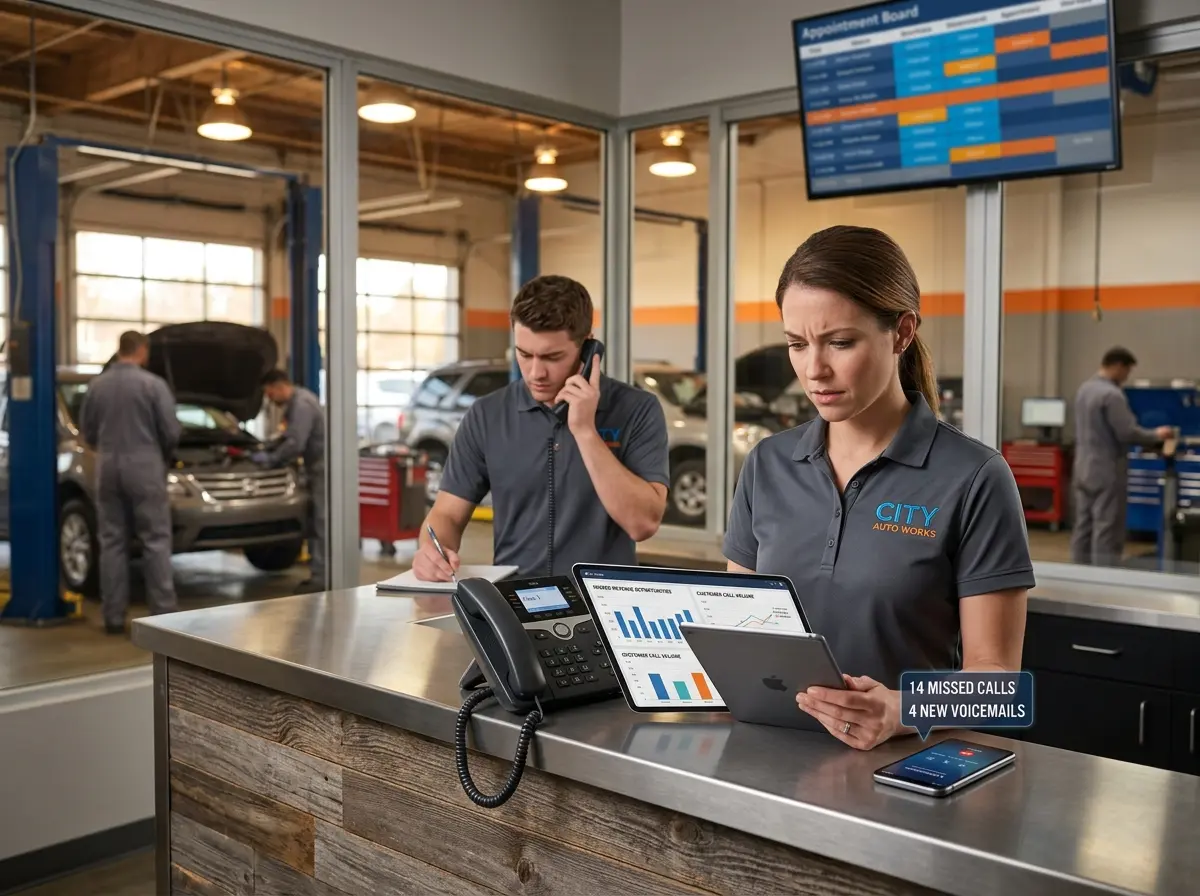
Let's paint a picture you might recognize. It's a busy Tuesday morning at your auto shop. Three cars are in the bays, two technicians are elbow-deep in engine work, and you're trying to sort out a parts order gone wrong. The phone rings. Then rings again. Then — silence. The caller hung up. And just like that, a potential oil change, brake job, or transmission repair walked right out the door before they ever walked in.
If you think that's a rare occurrence, think again. Studies show that 62% of calls to small businesses go unanswered, and of those callers, the vast majority don't leave a voicemail — they simply call the next shop on their list. In the auto repair industry, where trust and first impressions are everything, that missed call isn't just a missed appointment. It's a missed relationship, a missed review, and potentially a missed loyal customer who would have returned for years.
The good news? This is an entirely solvable problem. The better news? You don't need to hire a full-time receptionist to solve it. Let's dig into what's really happening when your shop doesn't pick up, and what you can do about it.
The Real Cost of Missed Calls in the Auto Repair Industry
It's Not Just One Lost Job — It's a Lifetime of Revenue
Auto shop owners often think about missed calls in terms of a single transaction: "We missed a call for an oil change, that's $50 gone." But that's not how customer value actually works. A single customer who brings their vehicle in for routine maintenance three or four times a year, plus the occasional repair, is worth hundreds to thousands of dollars annually. Multiply that by five or ten years of loyalty, and that one unanswered call starts to look a lot more expensive than it did at first glance.
According to the Harvard Business Review, companies that respond to customer inquiries within an hour are seven times more likely to qualify the lead than those that follow up even an hour later. In the auto repair world, "following up later" often means the customer has already booked with someone else and has no reason to call you back.
Your Reputation Is Being Written in Real Time
Here's something auto shop owners don't always consider: the customer experience starts before anyone steps foot in your shop. It starts the moment someone picks up the phone to call you. If that call goes unanswered, their very first impression of your business is one of neglect. They don't know you were juggling three brake jobs. They just know the phone rang and nobody cared enough to pick up.
In an industry where word-of-mouth and online reviews are the lifeblood of new customer acquisition, that first impression matters enormously. One negative review mentioning "couldn't get anyone on the phone" can chip away at the credibility you've spent years building. And no amount of five-star mechanical work fixes a zero-star phone experience.
The Hidden Staff Problem
Even when someone does answer the phone, it's often a technician pulled away from a vehicle, a service advisor trying to manage a waiting customer simultaneously, or — on particularly chaotic days — you yourself. That interruption has a cost too. Studies on workplace productivity suggest it takes an average of 23 minutes to fully regain focus after an interruption. In a shop environment where precision and attention to detail are non-negotiable, that's not a trivial distraction. You're not just losing efficiency; you're introducing risk.
How Smart Auto Shops Are Getting Ahead of the Problem
Let Technology Handle the Routine So Your Team Handles the Complex
The smartest auto shops aren't hiring more front-desk staff to solve their phone problems — they're deploying technology that handles routine inquiries around the clock, so their human team can stay focused on what humans do best: diagnosing problems, building customer relationships, and turning wrenches. This is exactly where Stella, an AI robot employee and phone receptionist, earns her keep.
Stella answers every call — whether it's 8 AM on a Monday or 10 PM on a Saturday — with the same professional, knowledgeable demeanor. She can answer questions about services, hours, pricing, and current promotions without putting anyone on hold or pulling a tech off a job. For shops with a physical location, she also stands at the kiosk inside the shop, greeting walk-ins and proactively engaging customers who are waiting. When a call does need a human — say, a customer requesting a specific advisor or a situation requiring real judgment — Stella forwards it based on whatever conditions you configure. She also captures voicemails with AI-generated summaries and pushes instant notifications to managers, so nothing falls through the cracks. Her built-in CRM stores customer details, interaction history, and AI-generated profiles, while her intake forms collect key information during calls — no clipboard required.
Practical Steps Every Auto Shop Owner Can Take Right Now
Audit Your Current Call Situation Honestly
Before you can fix a problem, you need to understand its true scope. Spend one week tracking every inbound call your shop receives. Note how many were answered, how many went to voicemail, how many voicemails were actually returned, and how many callers simply hung up. Most shop owners are genuinely shocked by what they find. Call tracking software — even simple, inexpensive options — can automate much of this for you and give you hard data instead of gut feelings. Once you see the numbers, the urgency of solving this problem tends to become very real, very fast.
Define What a "Good" Phone Experience Looks Like at Your Shop
Many auto shop owners have never actually defined what a great phone interaction should look and feel like at their business. Should every call be answered within three rings? Should callers always be greeted with your shop name and the agent's name? Should service pricing be discussed upfront or directed to a quote process? Writing down the answers to these questions gives you a standard to hold both your human team and any technology you deploy accountable to. It also ensures consistency — which is, frankly, what customers are really looking for when they call an auto shop they've never visited before.
Make After-Hours Coverage a Priority, Not an Afterthought
Most auto shops operate during standard business hours, which means a significant chunk of customer inquiry calls happen outside those hours — evenings, early mornings, and weekends. These are often the callers with the most urgent needs: a car that broke down, a warning light that came on during the commute home, or someone trying to plan ahead for the week. If your shop goes dark after 5 PM, you're essentially handing those customers to your competitors who have found a way to stay responsive. A 24/7 answering solution — whether AI-powered or a professional answering service — isn't a luxury at this point. It's a competitive necessity.
Quick Reminder About Stella
Stella is an AI robot employee and phone receptionist built for businesses exactly like yours — answering calls 24/7, greeting in-store customers at her kiosk, collecting intake information, and managing everything through a built-in CRM, all for just $99 a month with no upfront hardware costs. She's ready to work the moment you set her up, she never calls in sick, and she won't quietly update her resume while covering your front desk.
Stop Letting Your Phone Ring Into the Void
The unanswered call crisis in the auto repair industry isn't a mystery — it's a predictable, measurable, and very fixable problem. The shops that thrive in the next five years will be the ones that recognize a ringing phone as a business opportunity and treat it accordingly, not as a nuisance to be dealt with when someone gets around to it.
Here's what you can do starting this week:
- Run your call audit. Get the real numbers on how many calls your shop is missing and when they're happening most frequently.
- Define your phone standards. Write down what a great customer call experience looks like at your shop and share it with your team.
- Close the after-hours gap. Identify a solution — whether technology-based or human — that ensures no caller ever reaches dead air when your shop is closed.
- Explore AI-powered options. Tools like Stella can handle the routine so your team handles the exceptional, without blowing your monthly budget.
The bottom line is simple: every call your shop answers is a chance to earn a customer for life. Every call you miss is a chance you've handed to the shop down the street. The phone is already ringing. The only question is whether someone — or something — is there to pick it up.