So, You're Just Winging the Color Consultation?
Let's set the scene: a client sits down in your chair, says "I want something different," and you — armed with years of experience and a healthy sense of optimism — dive in. No structured consultation, no chemical history, no strand test. Just vibes. And then, somewhere between the developer and the toner, things go sideways. Sound familiar? If it does, you're not alone — but you are leaving money, safety, and client trust on the table every single appointment.
A structured chemical service consultation isn't just a formality. It's the professional backbone of every successful color service, and skipping it is roughly equivalent to a doctor skipping your medical history before surgery. Sure, it might be fine. But "might be fine" is a terrible business strategy. Whether you're running a boutique blowout bar or a full-service salon with twelve stylists, building a standardized consultation process into every chemical appointment protects your clients, your staff, your reputation, and your bottom line. Let's talk about how to actually do that.
The Real Risks of Skipping a Proper Chemical Consultation
It's easy to treat consultations as a checkbox — something you technically do while your client is still removing her coat and telling you about her sister's wedding. But a rushed, unstructured consultation is almost worse than no consultation at all, because it gives you the illusion of due diligence without any of the actual protection.
Chemical Incompatibility Is Not a Myth
If there's one thing that can turn a happy client into a liability, it's chemical incompatibility. Clients who have used box dye, keratin treatments, henna, or certain bond builders may react unpredictably to professional color systems. According to industry data, a significant portion of color service complications — including breakage, uneven lift, and scalp reactions — can be traced directly back to undisclosed or unknown prior chemical history. A structured consultation that specifically asks about recent treatments, home product use, and previous reactions isn't being overly cautious. It's being a professional.
Allergies and Sensitivities: The Legal and Ethical Side
PPD (p-phenylenediamine), one of the most common ingredients in permanent hair color, is also one of the most common causes of allergic contact dermatitis in salon clients. The British Journal of Dermatology has documented increasing sensitization rates, and regulatory bodies in multiple countries now recommend — or outright require — patch testing before color services. Beyond the ethical obligation to your client's safety, there's a very practical legal one: if a client has an adverse reaction and you have no documentation of a consultation or patch test, your salon's liability exposure is significant. A proper intake form and signed consultation record is your paper trail. Protect yourself.
Unmanaged Expectations Are Bad for Business
This one is less about safety and more about sanity — yours and your client's. When clients leave disappointed, they don't always blame their unrealistic Pinterest board. They blame you. A structured consultation that includes a thorough conversation about hair history, current condition, desired result, and realistic outcomes dramatically reduces the likelihood of a client walking out unhappy. It also opens the door to upselling treatments like Olaplex or bond builders, which is never a bad thing for your revenue per visit.
How Technology Can Support Your Consultation Process
Streamlining Intake Before the Client Even Sits Down
One of the most practical things you can do is move part of your chemical consultation intake to before the appointment. Digital intake forms sent via text or email — or collected through a kiosk in your lobby — allow clients to document their chemical history, list any known allergies, and describe their goals before they even arrive. This means your stylists walk into each appointment already informed, which makes the in-chair conversation faster, more focused, and significantly more productive.
This is where Stella, the AI robot employee and phone receptionist, can quietly become one of your salon's most useful team members. Stella can collect client intake information conversationally — whether through her in-store kiosk presence in your lobby or during a phone call when a client books an appointment. She can gather details like recent chemical treatments, desired service outcomes, and allergy history, then store it all in her built-in CRM with custom fields and AI-generated client profiles. Your stylists get the information they need before the appointment begins, and your front desk staff can focus on the things that actually require a human.
Building a Consultation Framework That Actually Works
A good consultation framework doesn't have to be complicated, but it does have to be consistent. Every stylist in your salon should be asking the same core questions in the same structured way, regardless of how busy the day is or how well they know the client. Familiarity is not a substitute for documentation.
The Five Core Areas Every Chemical Consultation Should Cover
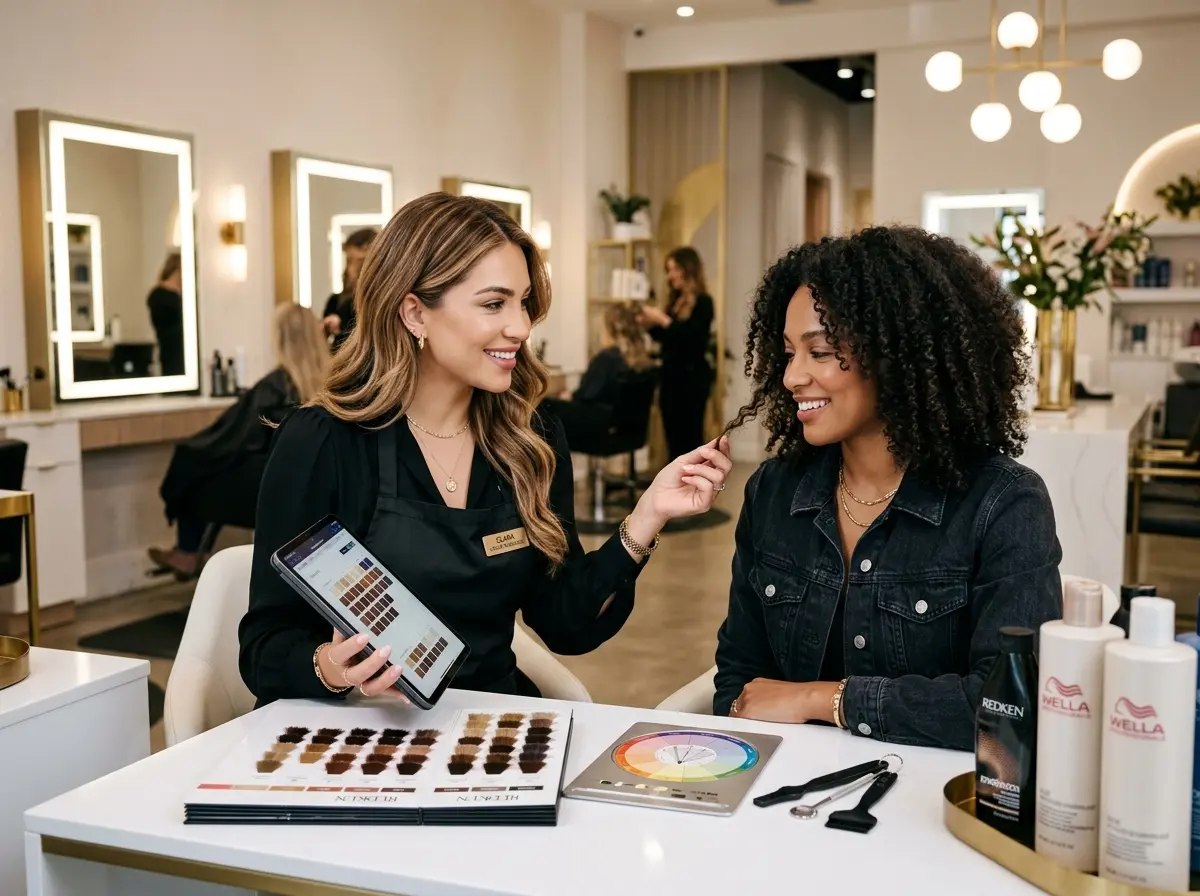
Think of your consultation as having five non-negotiable pillars. First, chemical history — what has been applied to the hair in the last 12 months, including box color, relaxers, keratin, perms, and henna. Second, scalp and skin health — any sensitivities, recent reactions, psoriasis, or open wounds that would contraindicate a chemical service. Third, hair integrity — porosity, elasticity, and current condition, ideally confirmed with a quick physical assessment. Fourth, lifestyle and maintenance expectations — how much time and money the client is realistically willing to invest in upkeep. And fifth, desired outcome — with reference photos, because "warm brunette" means seventeen different things to seventeen different people.
These five areas should be baked into a written form that the client completes and signs. That document becomes part of their permanent client record.
Making Strand Tests and Patch Tests Non-Negotiable
Here's an uncomfortable truth: most salons skip strand tests and patch tests far more often than they should, usually because it feels awkward to ask a returning client to come in two days early, or because the appointment book is already full. But standardizing these tests — and communicating their purpose clearly to clients as a sign of professionalism rather than an inconvenience — changes the dynamic entirely. Clients who understand why you're doing it don't resist it. In fact, many appreciate it. Consider building patch test appointments into your booking flow as a default for new color clients and for anyone returning after a long gap.
Training Your Team to Lead the Consultation, Not Just Complete It
A consultation form is only as good as the conversation around it. Train your stylists to treat the consultation as a client experience moment — a chance to demonstrate expertise, build rapport, and set clear expectations. Role-play difficult conversations, like telling a client their hair isn't healthy enough for the service they want. Give your team scripted language for redirecting unrealistic expectations without making the client feel dismissed. And hold everyone accountable to the same standard by reviewing consultation documentation as part of your regular team check-ins.
Quick Reminder About Stella
Stella is an AI robot employee and phone receptionist built for businesses like yours — she greets clients in your salon lobby, answers calls around the clock, collects intake information, and keeps your CRM organized without adding to anyone's workload. At $99 per month with no upfront hardware costs, she's one of the most practical front-of-house investments a salon owner can make. While your stylists focus on delivering exceptional color services, Stella handles the logistics.
Start Protecting Your Salon — and Your Clients — Today
A structured chemical service consultation is not a nice-to-have. It's a professional standard that protects your clients from harm, protects your business from liability, and dramatically improves the consistency of your service outcomes. The good news is that implementing one doesn't require a complete operational overhaul — it requires clear documentation, consistent training, and the right tools to support your team.
Here's where to start:
- Audit your current consultation process. Are your stylists asking the same questions every time? Is anything being documented and signed? Be honest with yourself.
- Create or update your intake form to cover all five core consultation areas. Make it digital if possible so it's easy to send before appointments and easy to store afterward.
- Build patch test and strand test protocols into your booking process as a standard offering for new clients and returning clients with a significant gap since their last service.
- Train your team on both the form and the conversation — not just what to ask, but how to talk about it with clients in a way that feels professional and reassuring.
- Leverage technology to handle intake before the appointment begins, so your stylists walk in prepared and your consultation time is spent on nuance rather than basics.
Your clients are trusting you with their hair, their scalp, and their self-image. A structured consultation is how you honor that trust — and how you run a salon that clients come back to, refer their friends to, and rave about. That's not just good ethics. That's good business.