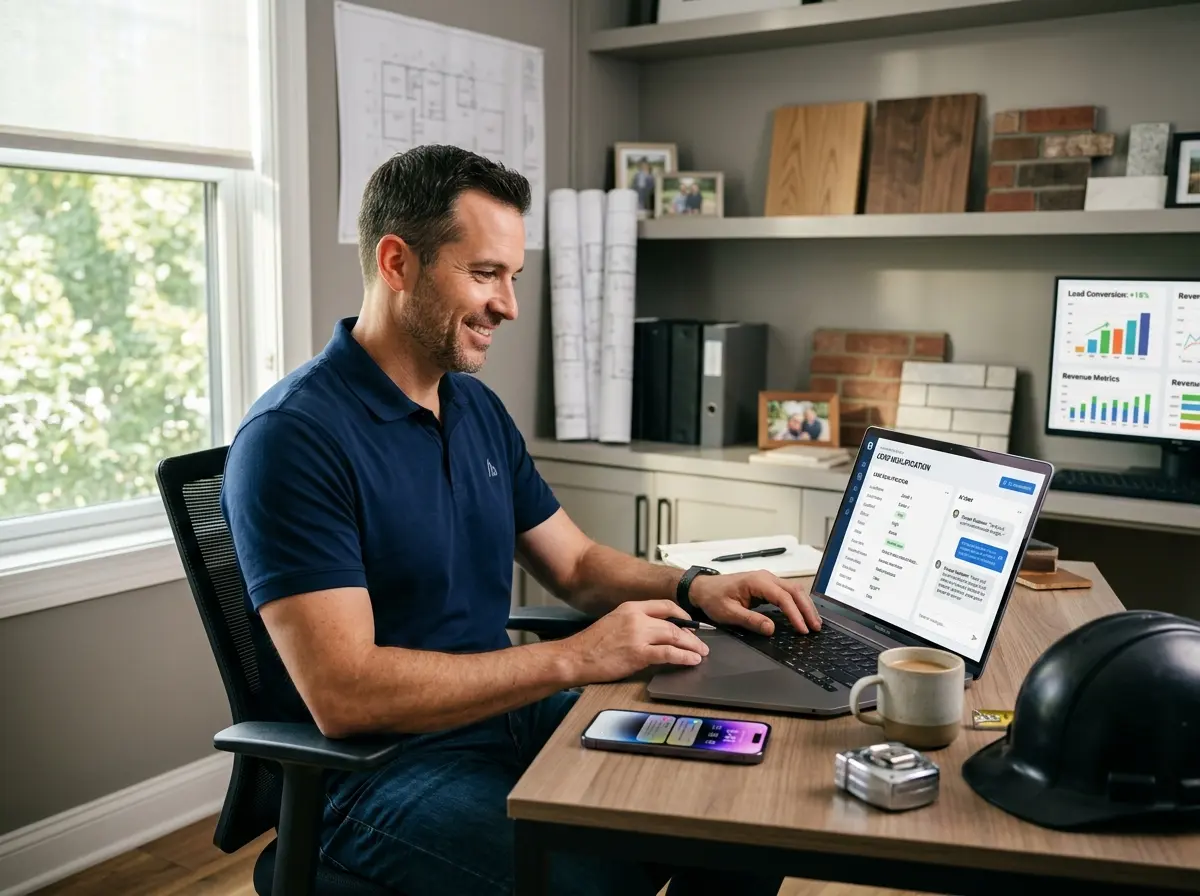
First Impressions Are Everything — Especially Online
Let's be honest: if you're a contractor and your portfolio website looks like it was built in 2009 and hasn't been touched since, you're losing jobs. Not maybe losing jobs. Definitely losing jobs. In a world where homeowners Google everything before they make a single phone call, your website is your first handshake, your elevator pitch, and your closing argument — all rolled into one. And if that handshake is limp, that pitch is confusing, or that argument is buried under stock photos and a phone number that no longer works, you can guess how it ends.
The good news? Building a contractor portfolio website that actually closes deals isn't rocket science. It's not even particularly complicated. It just requires you to think like your client, not like a contractor. Your clients don't care about your equipment. They care about whether you'll show up on time, do quality work, and not leave a disaster in their backyard. Your website needs to say all of that — loudly and clearly — before they ever speak to you.
This guide walks you through exactly how to do that, from the content that builds trust to the technical details that keep you showing up in search results. By the end, you'll have a clear roadmap for turning your portfolio site from a digital business card into an actual lead-closing machine.
Building a Portfolio That Builds Trust
The portfolio is the heart of your website — and it's also where most contractors completely drop the ball. Uploading a dozen grainy before-and-after photos and calling it a day isn't a portfolio; it's a missed opportunity. Your portfolio needs to do more than prove you can swing a hammer. It needs to tell a story that convinces a skeptical homeowner to hand you their house keys and their hard-earned money.
Showcasing Projects the Right Way
Every project you feature should be presented as a mini case study, not just a photo dump. Include the scope of work, the challenge you solved, the materials used, and — critically — the outcome. Did you complete a kitchen remodel two days ahead of schedule? Say that. Did the client's energy bills drop after your insulation work? That's gold. Real results speak louder than any marketing copy you could write.
Photos matter enormously, but quality matters more than quantity. A handful of crisp, well-lit images showing clear before-and-after transformations will outperform fifty muddy smartphone shots every single time. If budget allows, hiring a photographer for your two or three best projects is one of the highest-ROI investments you can make. According to the National Association of Realtors, listings with professional photos receive 61% more views — and the same psychology applies to contractor portfolios.
Getting and Displaying Reviews That Actually Convert
Testimonials are table stakes at this point. Every contractor website has them. What separates the converting sites from the ignored ones is specificity. A review that says "Great work, highly recommend!" does almost nothing. A review that says "Marcus and his crew replaced our entire roof in three days, kept our driveway spotless, and fixed a framing issue we didn't even know existed — all on budget" is the kind of social proof that makes someone pick up the phone.
Actively solicit detailed reviews from satisfied clients on Google, Houzz, and Yelp. Then feature the best ones prominently on your site — not buried on a dedicated "Reviews" page that nobody visits, but woven into your homepage, your project pages, and your service pages. Video testimonials, if you can get them, are even better. A real client talking on camera about how you transformed their bathroom is worth more than ten written reviews.
Defining Your Niche Without Shrinking Your Business
Here's something counterintuitive: the more specific your website is about what you do best, the more leads you'll attract. Generalist contractor sites that list every possible service from "painting" to "full custom builds" tend to signal nothing in particular. Specialists — or at least contractors who present themselves as specialists in one or two high-value areas — earn more trust and command higher rates.
You don't have to turn away general work. But leading with your strongest service category (kitchen remodels, deck construction, commercial tenant improvements, etc.) gives potential clients a reason to believe you're the right person for their specific job. It also helps enormously with SEO, which we'll get to shortly.
Never Miss a Lead Again
Here's a frustrating reality for contractors: you can build the most beautiful portfolio website in your market, rank on the first page of Google, and still lose jobs — because you missed the call. Contractors are busy. You're on a job site, you're in a truck, you're under a sink. You're not sitting by the phone. But your potential clients don't care about any of that. They'll just call the next contractor on their list.
How Stella Can Help Contractors Stay Responsive 24/7
This is where Stella, the AI robot employee and phone receptionist, becomes genuinely useful for contractors. Stella answers your calls 24/7, handles common questions about your services, pricing, availability, and service area, and collects lead information through conversational intake forms — even when you're three stories up on a roof and your phone is in your truck. She can forward urgent calls to you or your team based on whatever conditions you set, and she takes voicemails with AI-generated summaries and instant push notifications so you never walk off a job site wondering what you missed.
For contractors who work solo or run lean crews, Stella functions like having a professional receptionist on staff without the salary, the benefits, or the drama. At $99/month with no upfront hardware costs, it's an easy way to make sure your website's hard work — all those great photos, reviews, and SEO — doesn't go to waste because a hot lead went to voicemail and never called back.
The Technical Side You Can't Afford to Ignore
A beautiful portfolio is worthless if nobody finds it. And even if they find it, it's worthless if it loads slowly, looks broken on a phone, or makes it impossible to figure out how to contact you. The technical fundamentals of your website aren't glamorous, but they're the difference between a site that generates leads and one that just exists.
Local SEO: Getting Found by the Right People
For contractors, local SEO is everything. You're not trying to rank nationally — you're trying to rank when someone in your city types "deck builder near me" or "kitchen remodel contractor in [your city]." The fundamentals here are well-established: claim and fully optimize your Google Business Profile, build location-specific pages on your website, use your city and service area naturally throughout your content, and earn backlinks from local directories, suppliers, and trade associations.
Keywords matter, but don't stuff them awkwardly into your copy. Write naturally for humans first, and structure your content so that search engines understand your geographic focus and your service specialties. Blog posts and project write-ups that mention your location, the neighborhood, or even local landmarks can help you pick up long-tail search traffic that your competitors are completely ignoring.
Mobile Performance and Contact Friction
More than 60% of web searches happen on mobile devices, and the percentage is even higher for local service searches like contractor lookups. If your site isn't mobile-optimized — meaning it loads fast, looks clean on a small screen, and makes it dead simple to call or contact you — you're actively turning away business. Your phone number should be clickable. Your contact form should be short. Your portfolio photos should load quickly without requiring a fiber internet connection.
Page speed is also a direct ranking factor in Google's algorithm. Use tools like Google PageSpeed Insights or GTmetrix to audit your site. Compress your images, eliminate unnecessary plugins, and consider using a content delivery network (CDN) if your site is image-heavy. These are small tweaks that have an outsized impact on both your rankings and your user experience.
A Clear, Compelling Call to Action
Every page on your website should have one obvious next step: call you, fill out a quote request form, or book a consultation. Too many contractor websites leave visitors wandering around with no clear direction, which means they wander right off your site and onto your competitor's. Don't make people hunt for your phone number. Don't hide your contact form on a sub-page. Put your primary call to action above the fold on your homepage, repeat it at the bottom of every project page, and make the language action-oriented — "Get Your Free Estimate" beats "Contact Us" every single time.
A Quick Reminder About Stella
Stella is an AI robot employee and phone receptionist that answers calls 24/7, promotes your services, collects lead information, and ensures no potential client ever hits a dead end when they try to reach you. For contractors who are always on the move, she's the professional front office presence that keeps working even when you can't pick up the phone. At just $99/month, she's one of the easiest ways to make sure the leads your new website generates actually turn into booked jobs.
Your Next Steps: Turn Your Website Into a Deal-Closing Machine
Building a contractor portfolio website that closes deals isn't a one-afternoon project — but it's also not as overwhelming as it might seem when you break it down. Start with what you have. Pull together your five best projects, write a short case study for each one, take or source better photos, and ask your happiest clients for detailed, specific reviews. That alone will put you ahead of most of your competition.
From there, tighten up your technical fundamentals. Make sure your site loads fast, looks great on mobile, and is properly optimized for local search. Claim your Google Business Profile if you haven't already, and spend an hour making sure it's complete and accurate. Then take a hard look at your contact experience — is it frictionless? Is your phone number front and center? Is there a clear call to action on every page?
Finally, make sure your website's leads don't fall through the cracks. A missed call is a missed job. Whether that means adjusting your availability, hiring staff, or letting an AI receptionist handle the overflow, the follow-through matters just as much as the first impression. Your website can do a lot of heavy lifting — but only if the whole system behind it is set up to convert.
Put in the work now, and your portfolio site stops being an obligation you update once a year and starts being the best salesperson you've ever had. One who works nights, weekends, and holidays without complaining once.