Your Portfolio Is Either Closing Deals or Losing Them — There Is No Middle Ground
Let's be honest: most contractor portfolio websites are doing one of two things. Either they're quietly converting curious visitors into paying clients at all hours of the night, or they're sitting there like a digital business card that nobody asked for — collecting dust and occasionally confusing people with a photo gallery that hasn't been updated since 2019. If you're a contractor in any trade — general contracting, landscaping, remodeling, electrical, plumbing, you name it — your website is often the very first impression a potential client gets of your work. And first impressions, as it turns out, still matter enormously.
Here's the uncomfortable truth: a bad portfolio doesn't just fail to close deals — it actively drives clients away. Studies consistently show that users form an opinion about a website within 50 milliseconds, and roughly 75% of consumers judge a business's credibility based on its website design. That's before they've read a single word about your services or seen a single photo of your best project. So if your site looks like it was built on a Sunday afternoon between football games, your visitors already have doubts before they get to the good stuff.
The good news? You don't need to be a web designer or spend a fortune on a custom build to create a portfolio that actually performs. You need strategy, the right content, and a clear understanding of what makes a potential client say "yes, I want to hire this person." Let's break it down.
The Foundation: What Your Portfolio Absolutely Must Have
Before you start obsessing over fonts and color schemes, let's talk about the substance of your portfolio — the core elements that separate a website that converts from one that merely exists.
A Project Gallery That Does the Heavy Lifting
Your project photos are your sales team, your testimonials, and your resume all rolled into one. But not just any photos will do. Blurry, poorly lit, or oddly cropped images of your work can actually make exceptional craftsmanship look mediocre. Invest in good photography — or at minimum, learn how to take decent photos with your smartphone using natural light and a clean background.
More importantly, show before-and-after sequences whenever possible. A bathroom remodel looks impressive on its own, but a side-by-side showing the cracked tile nightmare you walked into and the spa-like transformation you delivered? That's the kind of visual storytelling that makes a homeowner think, "I need this person to fix my kitchen immediately." Organize your gallery by project type so visitors can quickly find work relevant to their own needs, and include brief captions explaining the scope, timeline, and any unique challenges you solved.
Case Studies: Turn Projects Into Stories
Most contractors list projects. Smart contractors tell stories about them. A case study doesn't need to be a 2,000-word essay — even a few well-written paragraphs can be remarkably powerful. Describe the client's problem, your proposed solution, how you executed it, and the outcome. Include real details: the square footage, the timeline, the materials used, the budget range (if the client permits). Specificity builds credibility in ways that vague claims like "quality craftsmanship" simply cannot.
For example, instead of captioning a photo "Master Bathroom Renovation," consider: "Complete gut renovation of a 120 sq ft master bath in a 1960s home. We worked around outdated plumbing, reinforced the subfloor, and delivered a fully tiled, custom-vanity finish two days ahead of schedule." Suddenly, you're not just a contractor — you're a problem solver with a track record. That's who people want to hire.
Social Proof That Actually Sounds Human
Testimonials are non-negotiable, but they need to be credible and specific. "Great work, would recommend!" tells a potential client almost nothing useful. What you want are reviews that mention the project type, the experience of working with you, and the outcome. Reach out to past clients and ask them to share something specific — most people are happy to help if you make it easy for them.
Better yet, embed your Google reviews directly on your site. Not only does this add authenticity (these are verified, public reviews that anyone can check), but it also signals to visitors that you're confident enough in your reputation to put it front and center. Video testimonials, if you can get them, are even more powerful. A 30-second clip of a happy homeowner talking about your work is worth more than a page full of text quotes.
The Operational Edge: Staying Responsive While You're on the Job Site
Here's a problem that doesn't get talked about enough in conversations about contractor marketing: you can have the most stunning portfolio website in your industry, but if potential clients can't reach you — or worse, reach you and get no response — you're leaving money on the table. Contractors are notoriously difficult to get on the phone, mostly because they're busy doing the actual work. That's understandable. But from a client's perspective, an unanswered call often means moving on to the next contractor on the list.
How AI Can Keep You From Losing Leads While You're Working
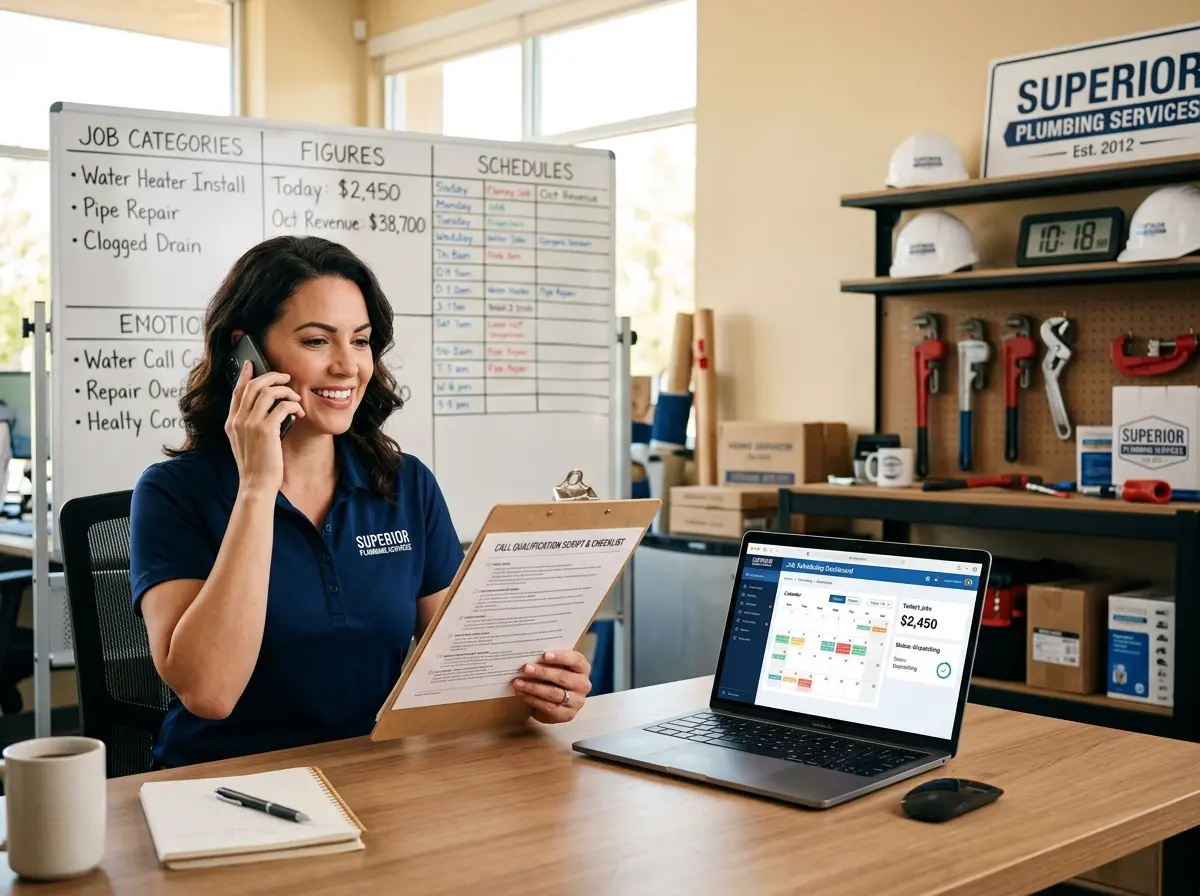
This is exactly where Stella, the AI robot employee and phone receptionist, can make a meaningful difference for contractors and other service-based businesses. While you're on a roof or knee-deep in a renovation, Stella answers your incoming calls 24/7, handles questions about your services and availability, and collects lead information through conversational intake forms — so you come home to organized, qualified leads instead of a pile of missed calls. She can also forward calls to you or your team when it matters, and generate AI-powered voicemail summaries with push notifications so nothing slips through the cracks. For contractors who want to look and operate more professionally without hiring a full-time receptionist, it's a practical and affordable solution at just $99/month.
Design and Structure: Making Your Portfolio Easy to Trust
Once you have compelling content, you need a website structure that guides visitors toward contacting you — not one that makes them work for it.
Navigation, Speed, and Mobile Friendliness
Over 60% of web traffic now comes from mobile devices. If your portfolio looks great on a desktop but falls apart on a phone, you're effectively turning away the majority of your visitors before they even see your work. Use a responsive design template, test your site on multiple devices, and make sure your contact information and call-to-action buttons are prominently visible on mobile screens without zooming or horizontal scrolling.
Page load speed matters too. A site that takes more than three seconds to load loses roughly half its visitors. Compress your images before uploading them — high-resolution photos can be stunningly large files — and keep your site structure clean and simple. You're a contractor, not a tech startup. Your website doesn't need animations, pop-ups, and embedded video backgrounds. It needs to load fast, look sharp, and make it easy for someone to see your work and call you.
Clear Calls to Action at Every Logical Step
Every page of your portfolio should have a clear next step for the visitor. Whether it's "Request a Free Estimate," "View Our Recent Projects," or "Call Us Today," these calls to action should be impossible to miss. Don't bury your phone number in the footer or make visitors navigate three levels deep to find your contact form. Put your primary contact method in the header of every page, repeat it mid-page, and make it available again at the bottom. The goal is to eliminate friction between "I like what I see" and "let me get in touch."
SEO Basics That Actually Help Contractors
You don't need to become an SEO expert, but a few fundamentals can dramatically increase how many people find your portfolio in the first place. Make sure every page has a clear title and description that includes your trade, your location, and the services you offer. For example, "Custom Kitchen Remodeling in Austin, TX | Johnson Contracting" is far more searchable than "Projects." Create individual service pages for your major offerings — roofing, additions, remodeling, etc. — and make sure your Google Business Profile is complete, accurate, and connected to your website. Local SEO is where most contractors compete, and most of the competition isn't doing these basic steps.
Quick Reminder About Stella
Stella is an AI robot employee and phone receptionist built for businesses of all sizes — including contractors and service providers. She answers calls around the clock, promotes your services, collects lead information, and keeps things running professionally while you focus on the actual work. At $99/month with no upfront hardware costs, she's one of the more practical investments a busy contractor can make in their business infrastructure.
Turn Your Portfolio Into a 24/7 Sales Machine
Building a contractor portfolio that actually closes deals isn't about having the fanciest website on the block. It's about making a credible, compelling case that you're the right person for the job — and then making it as easy as possible for a potential client to reach out and hire you. That means investing in good project photography, writing honest and specific case studies, collecting strong testimonials, designing for mobile users, and keeping your contact information front and center.
Here's your action plan to get started:
- Audit your existing site — Load it on your phone right now. Is it fast? Is it easy to navigate? Is your phone number visible immediately? Fix what's broken before adding anything new.
- Gather your best 8–10 projects — Find the before-and-after photos, write a two-paragraph case study for each, and build out a proper gallery organized by project type.
- Ask five past clients for a specific testimonial — Make it easy by suggesting they mention the project type, what they appreciated about the process, and the end result.
- Add clear calls to action to every page, and make sure your contact form or booking request actually works and notifies you immediately.
- Claim and optimize your Google Business Profile so local clients searching for your trade can actually find you.
Your portfolio website should be working as hard as you do. With the right content and structure in place, it can be generating leads, building trust, and closing deals — even while you're on a job site, unavailable to answer the phone. Speaking of which, that's a problem worth solving too. But one thing at a time.