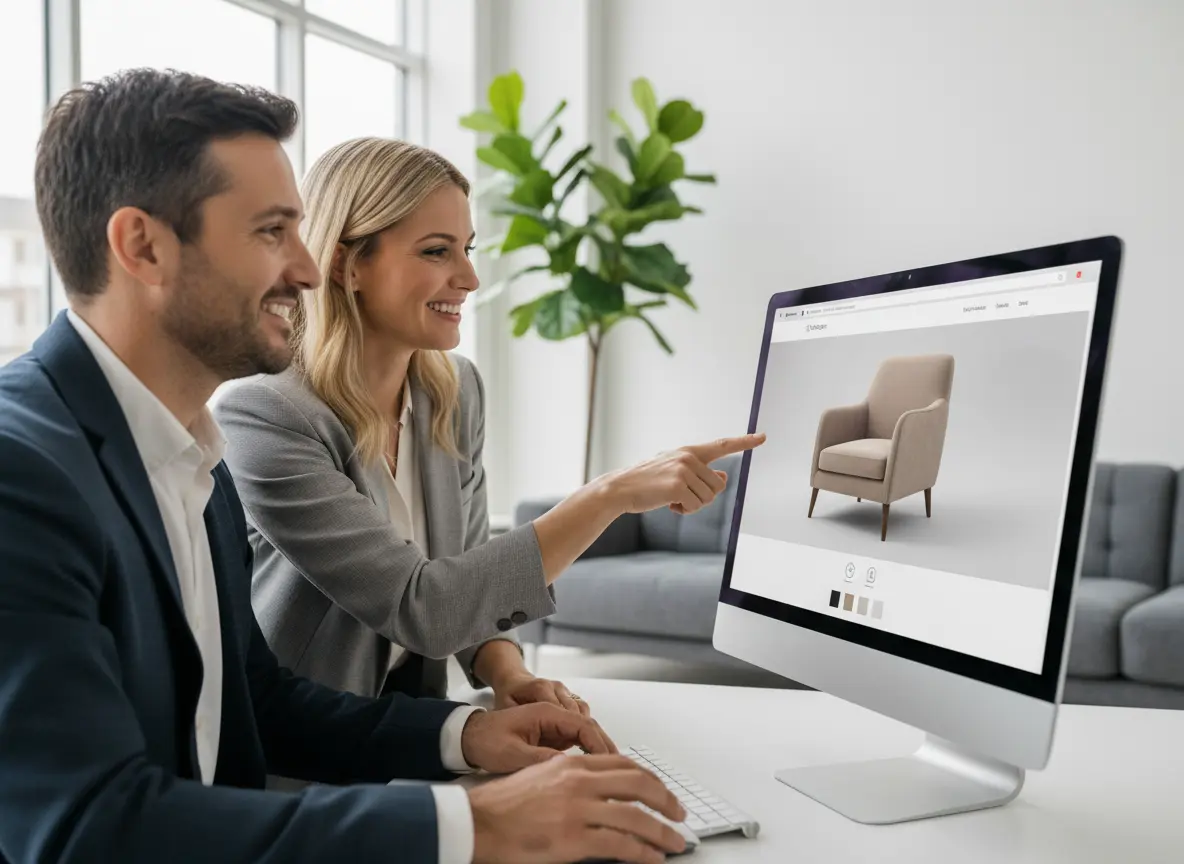
Let's Be Honest: Your Website Photos Are Lying to Your Customers
There, we said it. That gorgeous, professionally shot photo of your "Azure Dream" sectional looks stunning on your website. The lighting is perfect. The angle is just right. It’s nestled in a digital room so beautifully staged it would make an interior designer weep with joy. But here’s the cold, hard, slightly-too-large-for-the-doorway truth: in the real world, that Azure Dream might be more of a "Beige Nightmare" for your customer's living room.
Every furniture store owner knows the sinking feeling of a return. The product comes back, often with a vague note about it "not fitting the space" or the color being "not quite right." The problem isn't your furniture; it's the flat, two-dimensional world it's trapped in online. Photos can't convey scale, depth, or how a piece truly interacts with a room. They force customers to guess, to hold up their phone to their wall and squint, to gamble. And sometimes, that gamble doesn't pay off, costing you time, money, and a little piece of your soul. It’s time to stop letting a 2D medium sell a 3D product.
Why Your Furniture Store Needs to Stop Living in 2D
Moving beyond static images isn't just a "nice-to-have" tech upgrade; it's a fundamental shift in how you connect with and sell to modern customers. It’s about building confidence, reducing friction, and, frankly, making your competitors' websites look like they were designed in 1999. By embracing 3D models, you’re not just showing a product—you’re delivering an experience.
Bridge the "Imagination Gap" and Slash Your Return Rates
The biggest hurdle in online furniture sales is the "imagination gap." You ask your customers to look at a picture and mentally project a 300-pound sofa into their home. That’s a lot to ask. 3D models, especially when paired with Augmented Reality (AR), completely demolish this gap. With a tap on their phone, a shopper can place a virtual version of your dining table in their actual dining room. They can walk around it, see how it fits with their chairs, and check if there's enough room to get to the refrigerator without sucking in their gut.
The result? Confidence. A lot of it. When a customer knows for a fact that a piece will fit and look great, their hesitation evaporates. This isn't just a theory. Studies have shown that products with 3D/AR content can see a 40% reduction in return rates. Imagine what cutting your returns by nearly half would do for your bottom line. Suddenly, investing in 3D seems less like an expense and more like a cheat code.
Showcase Every Angle, Every Texture, Every Flawless Detail
You painstakingly sourced that armchair with the perfect hand-stitched leather and the elegant oak legs. A few JPEGs can't possibly do it justice. A 3D model can. It allows customers to become digital detectives. They can spin the model 360 degrees, zoom in on the fabric's weave, appreciate the grain of the wood, and see the quality of the craftsmanship from every conceivable angle. Because nobody enjoys a surprise upholstery texture.
This level of detail does more than just inform; it builds trust and justifies your price point. When a customer can virtually inspect a product with the same scrutiny they would in your showroom, the perceived value skyrockets. You're no longer just selling a "brown chair"; you're selling a masterpiece of comfort and design, and you're giving them the tools to prove it to themselves.
Stand Out from the "Scroll and Forget" Competition
Take a quick peek at your local competitors' websites. What do you see? Probably a sea of sameness: grid-based layouts, static images, and maybe a clunky photo gallery. It’s functional, but it’s utterly forgettable. Implementing 3D and AR is your chance to be the purple cow in a field of brown ones. It’s an immediate, powerful differentiator that tells shoppers you’re a forward-thinking, customer-centric brand.
An interactive experience makes your website "sticky." Customers stay longer, engage more deeply with your products, and are far more likely to remember you when it's time to buy. It’s a "wow" factor that gets people talking and transforms a simple shopping trip into a memorable event. You’re not just another furniture store; you’re the furniture store that lets you put a sofa in your living room with your phone.
From Showroom to Living Room: Driving In-Store Traffic
While a killer online experience is crucial, let's not forget the heart and soul of your business: your physical showroom. The goal isn't just to sell online; it's to create a seamless journey that often starts on a screen and ends with a handshake on your sales floor.
Using Your Online "Wow" to Get Feet Through the Door
Think of your website's 3D and AR features as the ultimate "pre-shopping" tool. A customer virtually places that perfect oak coffee table in their home. They've confirmed it fits, they love the look, and they're already emotionally invested. What's their next logical step? They want to come in to feel the wood's finish, confirm the quality, and make the purchase with the help of a real person. Your website did the heavy lifting of getting them 90% of the way to a sale.
Now, the last thing you want is for that high-tech, personalized online experience to crash into a generic, impersonal in-store one. This is where you connect the dots. When that excited customer walks in, you need to continue the "wow." This is a perfect job for Stella. Imagine our friendly robot assistant greeting them at the door, asking if they're here to see a specific piece they viewed online. She can then effortlessly direct them to the exact location of the coffee table, mention the matching end tables, and alert a human staff member that a highly qualified lead has just arrived. Stella ensures the momentum from your website isn't lost, bridging the digital and physical worlds into one cohesive, impressive customer journey.
Getting Started with 3D Without Selling a Kidney
Alright, you're convinced. You're ready to enter the third dimension. But the thought of "3D modeling" and "photogrammetry" might be giving you flashbacks to high school geometry class. Relax. This is far more accessible (and affordable) than you might think. You don't need a Hollywood budget or a degree from MIT.
The Tech Isn't as Scary (or Expensive) as You Think
You essentially have two paths for creating 3D models of your furniture, and neither requires a second mortgage.
- The DIY Approach: Believe it or not, your smartphone is a powerful 3D scanner. Apps like Polycam or Scandy Pro use a process called photogrammetry to stitch together dozens of photos into a 3D model. There's a learning curve, and it's best for simpler objects, but it's an incredibly low-cost way to dip your toes in the water. Model one of your best-selling chairs and see what happens.
- Hiring a Professional: For high-quality, consistent results, hiring a 3D artist or agency is the way to go. Platforms like Upwork, Fiverr, or specialized product modeling services have thousands of talented artists. You provide them with photos of your product from all angles, and they deliver a polished, web-ready 3D file. The cost per model can be surprisingly reasonable, especially when you consider the ROI from a single saved return.
The key is to start small. You don't need to digitize your entire inventory by next Tuesday. Pick five of your bestsellers and make them your 3D pilot program.
Integrating 3D Models Into Your Website (The Non-Nerd's Guide)
"Okay, I have this weird .GLB file... now what?" Good news. The people who build e-commerce platforms have already figured this out for you. If you're on a major platform, implementation is often shockingly simple.
- Shopify: Shopify has been a leader in this space. They natively support 3D models and AR on product pages. It's often as easy as uploading the 3D model file just like you would a new product image. Seriously.
- BigCommerce, WooCommerce, etc.: Most other major platforms have apps, plugins, or extensions in their marketplaces specifically for 3D and AR viewers. A quick search for "3D viewer" will usually point you in the right direction.
The user experience should be seamless. A simple, clear button on your product page that says "View in 3D" or "See it in Your Room" is all you need to launch the magic.
Measuring Success: Because This Isn't Just a Cool Gimmick
This is an investment, and every good investment needs to be measured. How do you know if your foray into 3D is actually working? Track the right numbers:
- Conversion Rate: Compare the conversion rate for products that have 3D models versus those that don't. This is your most direct measure of impact.
- Time on Page: Are people spending more time interacting with your 3D-enabled product pages? More engagement typically leads to more sales.
- Return Rate: This is the big one. After a few months, compare the return rate for your 3D-enabled products to their historical rate. This is where the money is saved.
- Customer Feedback: Don't underestimate anecdotal evidence. Listen to what your customers are saying. If they mention how helpful the AR feature was, you know you're on the right track.
A Quick Reminder About Stella
While you're revolutionizing your online showroom, don't let your physical one fall behind. Stella, our tireless in-store robot assistant, is the perfect partner to your new digital strategy. She ensures the high-tech, personalized experience your customers love online continues the moment they walk through your doors.
Conclusion: Stop Showing, Start Experiencing
The line between e-commerce and in-store retail is blurring, and the businesses that will thrive are those that build a bridge between the two. For furniture stores, that bridge is built with 3D models and Augmented Reality. It's about giving customers the confidence to click "buy" and the excitement to visit your store.
Your action plan is simple. Don't try to boil the ocean. Pick one product this week—your most popular armchair, that stunning new lamp, whatever. Go the DIY route or find a freelancer and get it modeled. Add it to your website. And then watch. Watch the engagement, watch the sales, and watch the returns (not) come in.
The future of furniture retail is immersive, interactive, and three-dimensional. It's time to step out of the flat world. Your customers—and your bottom line—are waiting.