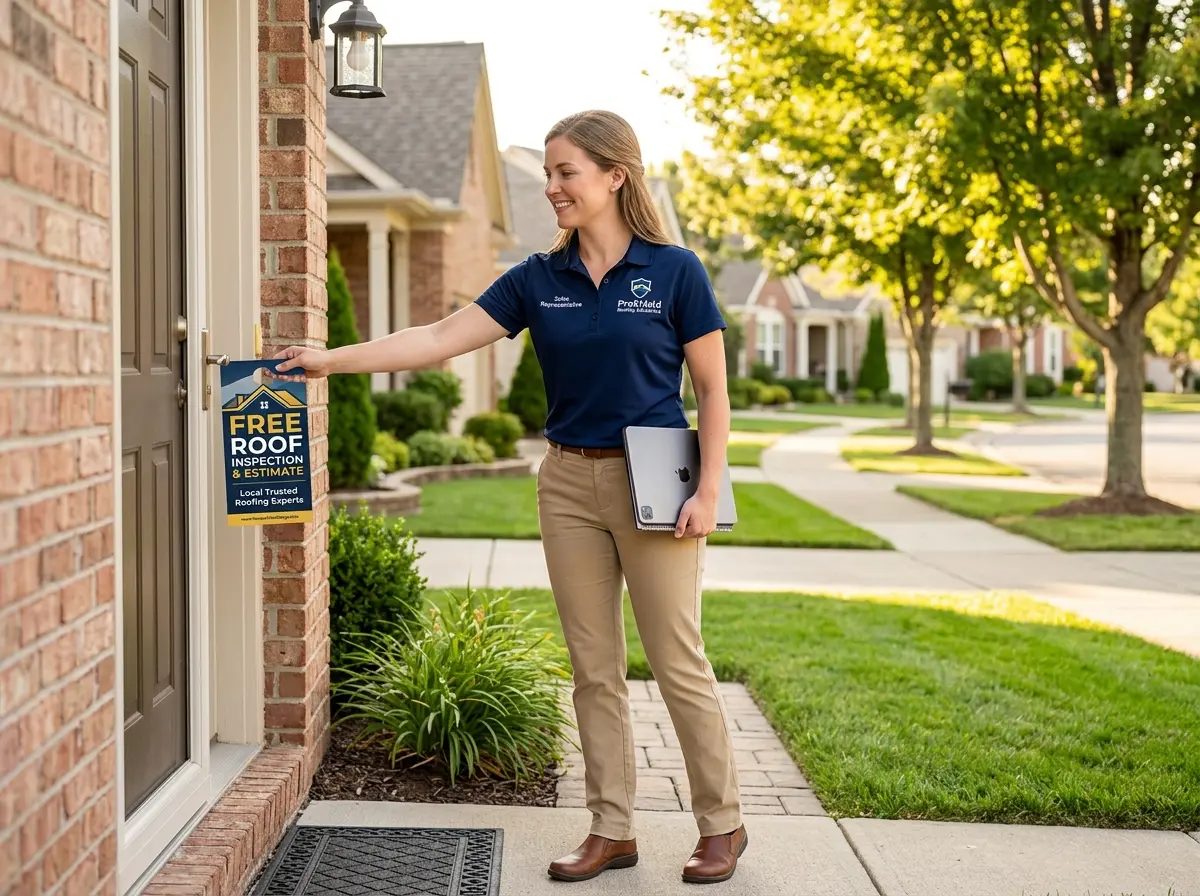
Why Most Door-Hanger Campaigns End Up as Landfill (And How to Fix Yours)
Let's be honest: most door-hanger campaigns are designed, printed, and distributed with great enthusiasm — and then absolutely nothing happens. The phone doesn't ring. The website doesn't spike. The owner stares at a stack of receipts from the print shop and wonders what went wrong. Sound familiar?
Here's the thing: door-hanger campaigns work — but only when they're executed with strategy rather than hope. For roofing companies specifically, door hangers remain one of the highest-ROI local marketing tools available. You're targeting a hyper-local audience, hitting homeowners right at their front door, and giving them something physical to hold onto. According to the Data & Marketing Association, direct mail (including door hangers) achieves response rates of up to 9% — far higher than most digital channels. The problem isn't the medium. It's the message, the targeting, and the follow-through.
This guide is going to walk you through exactly how to build a door-hanger campaign that actually generates roofing leads — not just recycling bin content. We're talking design, distribution strategy, follow-up systems, and how to make sure your business is ready to handle the leads once they start rolling in.
Building a Door-Hanger That Actually Gets Read
Before a single hanger hits a single doorknob, you need to get the fundamentals right. A poorly designed door hanger with a weak offer is just expensive confetti.
Design Principles That Stop the Scroll (Er, the Walk)
Think of your door hanger as a billboard that a homeowner holds in their hand. You have approximately three seconds to make an impression before it gets tossed. Your design should lead with a bold, benefit-driven headline — not your company name. "Storm Damage? Get a Free Roof Inspection Today" is infinitely more compelling than "Smith & Sons Roofing Co. — Quality You Can Count On." Save the brand reinforcement for the back. The front needs to earn attention.
Keep the color palette clean, use high-contrast text, and include a single dominant image — a before/after photo of a roof replacement works exceptionally well for roofing companies. Avoid cluttering the design with too much information. If they need to squint to read it, they won't.
Crafting an Offer That Creates Urgency
A door hanger without a compelling offer is just a piece of cardboard. Your offer needs to do two things: reduce risk and create urgency. Free inspections are the gold standard for roofing — they lower the barrier to entry and get your crew on the property. Pair that with a time-sensitive element: "Free inspection valid through [end of month]" or "Schedule this week and receive a complimentary gutter cleaning."
Also consider including a QR code that links to a dedicated landing page — not your homepage. A landing page built specifically for that campaign lets you track conversions accurately and give the homeowner a seamless next step. Make it easy to say yes, and most importantly, easy to take action without picking up the phone (because some people simply won't call).
What to Include — and What to Leave Out
Every door hanger should have a clear headline, a specific offer, your phone number in large text, a QR code, your website, and one or two trust signals (years in business, licenses, a review rating). That's it. Do not include a full menu of services, your company history, or three paragraphs of fine print. The goal isn't to close the sale on the door hanger — it's to get the homeowner to take one action. One. Keep it focused.
Smart Distribution: Who Gets the Hanger and When
Targeting the Right Neighborhoods
Random distribution is how roofing companies waste money. Strategic distribution is how they build pipelines. The most effective approach is storm-chasing distribution — deploying your team immediately after a hail or wind event in affected ZIP codes. Homeowners who just watched a storm roll through are already thinking about their roofs. You're not creating a need; you're meeting one in real time.
Outside of storm events, focus on neighborhoods with older housing stock (homes built 15–25+ years ago are statistically due for roof attention), areas where you've recently completed jobs (social proof is powerful — "We just replaced your neighbor's roof" is a fantastic door-hanger headline), and zip codes with higher average home values where homeowners are more likely to invest in quality work.
Timing and Team Logistics
Distribution timing matters more than most roofing companies realize. Weekday mornings tend to work well because homeowners are more likely to notice the hanger when they leave for work or return home. Avoid weekends if you can — door hangers left over a weekend get lumped in with general clutter and lose their immediacy.
As for your distribution team, train them on consistency. A hanger hung neatly on a doorknob looks professional. A hanger shoved in a mailbox is both illegal and sloppy (yes, stuffing mailboxes is a federal no-no — door handles only). Track which addresses were covered using simple route-mapping tools like Google Maps or dedicated canvassing apps so you don't double-cover areas or miss key streets.
Making Sure Your Business Is Ready to Catch the Leads
Here's where a lot of roofing companies drop the ball spectacularly. They run a great campaign, generate genuine interest, and then — nothing. A homeowner calls during lunch, nobody answers. They try again in the evening, same story. They move on to the next roofing company whose number was also on a door hanger. The campaign "didn't work" because the follow-up infrastructure wasn't there.
How Stella Can Fill the Gap
This is where Stella becomes genuinely useful for roofing companies running active lead-generation campaigns. Stella is an AI phone receptionist that answers every call, 24/7, with the same knowledge and professionalism as your best office staff — without the salary, the sick days, or the tendency to let calls go to voicemail at 6:45 PM. When a homeowner calls after seeing your door hanger, Stella answers, talks them through your services and current offer, and collects their contact information through a conversational intake process — feeding that data directly into her built-in CRM so your team can follow up with a complete picture of the lead.
For roofing companies managing multiple crews, active campaigns, and high call volumes post-storm, this kind of always-on coverage isn't a luxury — it's a competitive advantage. Stella runs on a $99/month subscription with no upfront hardware costs, which means your campaign ROI doesn't get eaten alive by overhead.
Tracking Results and Improving with Every Campaign
If you're not measuring it, you're not managing it. Door-hanger campaigns are no different from any other marketing channel — you need data to know what's working.
Setting Up Trackable Entry Points
The easiest way to attribute leads to your door-hanger campaign is to use campaign-specific tracking. This means a dedicated phone number (call tracking services like CallRail are inexpensive and easy to set up), a unique QR code linking to a campaign-specific landing page, and a promo code that reps can reference when a lead calls in or submits a form. These three elements together give you a clear picture of how many responses your campaign generated, which neighborhoods performed best, and what your cost-per-lead looks like.
Testing and Iterating Like a Marketer
Don't run the same door hanger forever. Test different headlines, offers, and designs across different distribution zones. Run version A in one neighborhood and version B in another, keep everything else equal, and compare response rates after 30 days. Over time, you'll develop a template that consistently outperforms — and that becomes your control version for future campaigns.
Also pay close attention to your close rate, not just your lead rate. If you're generating calls but not booking inspections, the problem may be your phone follow-up process rather than the door hanger itself. Reviewing call recordings (another feature many call tracking services offer) can be eye-opening.
Knowing When to Scale
Once you've found a door-hanger formula that generates a predictable cost-per-lead, it's time to scale intelligently. Expand your distribution radius, increase print runs for high-performing designs, and start building a regular canvassing schedule rather than treating campaigns as one-off events. The roofing companies that dominate their local markets aren't necessarily the best roofers — they're often just the most consistent marketers. Consistency compounds over time.
Quick Reminder About Stella
Stella is an AI robot employee and phone receptionist built for businesses exactly like yours — handling inbound calls around the clock, collecting lead information through smart intake forms, and keeping everything organized in a built-in CRM. Whether you're in the middle of a busy storm season or running a proactive spring campaign, she makes sure no lead goes unanswered and no opportunity falls through the cracks.
Turn Your Next Campaign Into a Lead Machine
A great door-hanger campaign isn't complicated, but it does require intentionality at every stage. Start with a design that grabs attention and a single irresistible offer. Distribute strategically — storm events, older neighborhoods, and areas where you've recently done work. Make sure your business is actually ready to receive and respond to the leads you generate. Track everything with dedicated numbers and QR codes. And iterate relentlessly based on data.
Here's your action plan to get started:
- Audit your current door-hanger design — does the headline lead with a benefit? Is the offer specific and time-sensitive?
- Set up a tracking number and campaign landing page before your next print run.
- Map your next distribution zone based on storm history, home age data, or recent completed jobs.
- Ensure your phone coverage is airtight — every call that comes in as a result of your campaign needs to be answered, day or night.
- Review your results at 30 days and adjust your design, offer, or targeting for the next round.
The homeowners in your market need roofing services. Your competitors are marketing to them. The only question is whether your door-hanger campaign is professional enough, strategic enough, and followed up on well enough to win the business. Now you have no excuse for it not to be.