The Gym Bag Is in the Cloud Now
Not too long ago, if you wanted to work with a personal trainer, you had to show up somewhere — a gym, a studio, a garage with motivational posters and questionable flooring. The trainer would hand you a clipboard with a health history form, you'd forget to fill in half of it, and scheduling your next session involved a text thread that looked like two people planning a heist.
Times have changed. Personal trainers are now building entirely remote client bases — coaching people across time zones, running group programs online, and scaling their businesses well beyond what a single physical location could ever support. But here's the dirty little secret: the logistics haven't always kept up with the ambition. Scheduling chaos, intake forms stuffed into email threads, missed calls from hot leads — these aren't just annoyances. They're revenue walking out the (virtual) door.
This post is about how one personal trainer decided to stop duct-taping her business together and built something that actually runs. If you're a fitness professional — or honestly, any solo service provider — trying to scale without losing your mind, read on.
The Problem With Growing a Remote Fitness Business the Old Way
Your Calendar Is Not a Business System
Ask any personal trainer how they managed their schedule in the early days and you'll hear some variation of the same story: a shared Google Calendar, a Notes app full of client goals, and approximately fourteen unread DMs from people asking "are you still doing the 6am slot?" The answer, by the way, was always yes, because they were always working.
Manual scheduling is fine when you have five clients. It becomes a part-time job when you have fifteen, and a genuine crisis when you hit thirty. Every back-and-forth message to confirm a session is time you're not spending coaching, creating content, or doing literally anything else that moves your business forward. According to a study by Doodle, professionals waste an average of 4.8 hours per week on scheduling-related tasks. For a solopreneur, that's almost a full working day every week — gone.
Intake Forms Should Not Live in Your DMs
Client intake is genuinely important in the fitness world. Health history, injury disclosures, goals, fitness levels, lifestyle factors — this information shapes programming, manages liability, and helps trainers actually do their jobs well. And yet, countless trainers are collecting this information through casual conversation, scattered emails, or forms they built in Google Docs three years ago and never updated.
Beyond the professionalism issue — and yes, there is a professionalism issue — disorganized intake creates real operational problems. Information gets lost. Clients forget what they told you. You're re-asking the same questions on session one that should have been answered before the first call was ever booked. It's inefficient, and it signals to the client that the business behind the training might be a little... improvised.
The Missed Call Problem No One Talks About
Here's a fun scenario: a potential client finds your website at 9pm on a Tuesday, gets excited, and calls the number on your contact page. You're with a client. Or asleep. Or both, if it's been that kind of week. They don't leave a voicemail. You never know they called. They book with someone else by Wednesday morning.
This happens constantly, and most solo fitness professionals have no idea how much revenue it represents. Studies suggest that up to 85% of callers who don't reach someone on the first attempt will not call back. That's not a statistic you can afford to ignore when every new client represents hundreds or thousands of dollars in recurring revenue.
How Stella Fits Into a Remote Fitness Business
Answering the Phone When You're Busy Actually Training People
This is where Stella, the AI robot employee and phone receptionist, becomes genuinely useful for fitness professionals. Stella answers phone calls 24/7, handles questions about your services, pricing, and availability, and can collect client information through conversational intake directly over the phone — before you've ever spoken to the person. No missed calls. No voicemail graveyards. No leads lost to competitors because you were in the middle of a HIIT session.
For trainers with a physical presence — a studio, a gym space, a wellness center — Stella also operates as an in-store kiosk, greeting walk-ins and engaging prospective clients proactively. But for the fully remote trainer, her phone and web intake capabilities are the real stars of the show. She manages contacts through a built-in CRM with custom fields and AI-generated profiles, so every lead that comes in is organized, tagged, and ready for follow-up — without you lifting a finger.
Meet the Trainer Who Actually Did This
Stella's Story (Not the Robot — the Human)
Let's call her Jordan. Jordan had been personal training for six years, mostly in-person at a commercial gym, when the pandemic essentially forced her hand. She went remote, picked up a few online clients, and realized something surprising: she actually preferred it. No commute, no gym politics, no one hogging the cable machine during her client's workout.
But as her online client roster grew from 10 to 25 to nearly 50, the cracks started showing. She was spending two hours every Sunday just organizing her schedule for the week. New client intake was a patchwork of email forms and Zoom calls. And she was routinely missing calls from prospective clients because she trained people from 6am to noon with almost no breaks.
The Systems She Put In Place
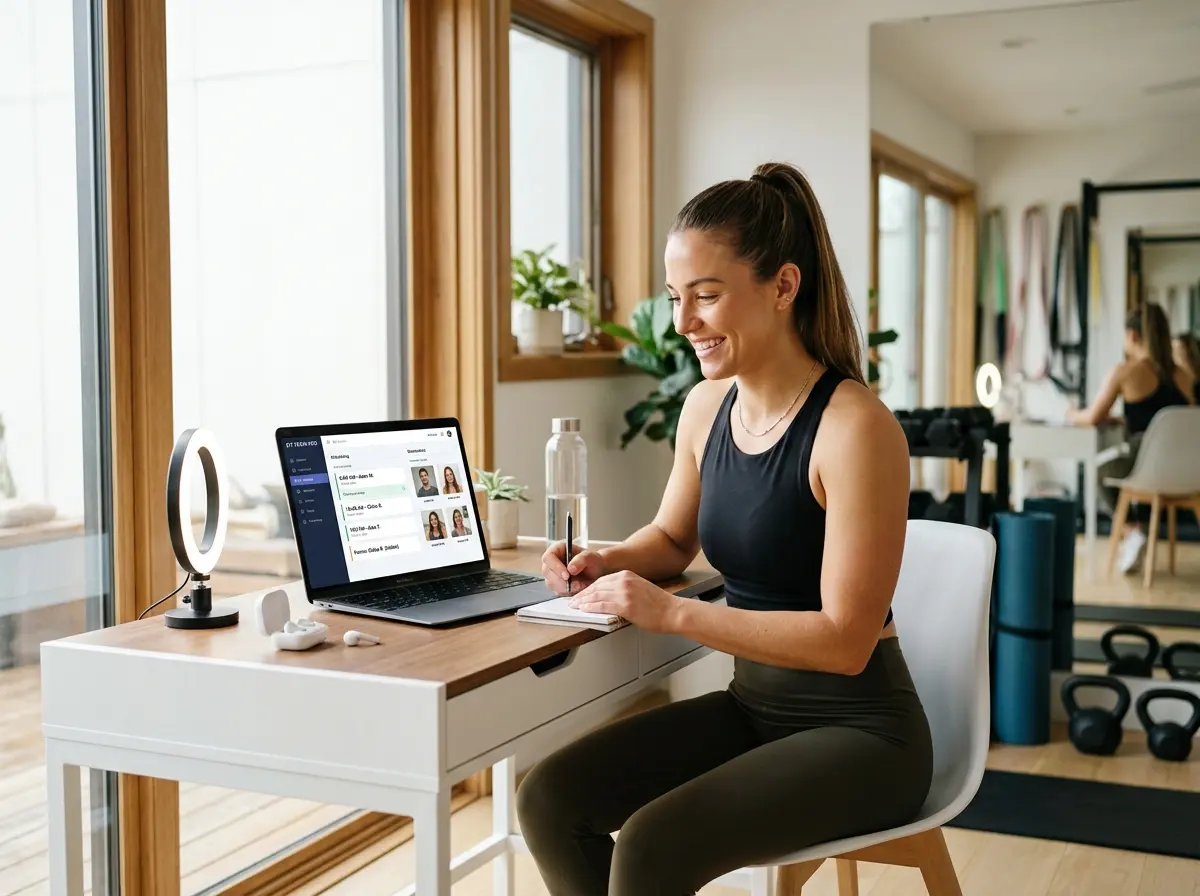
Jordan's transformation wasn't one dramatic overhaul — it was a series of deliberate upgrades. First, she implemented automated scheduling software that let clients book, reschedule, and cancel on their own, with built-in buffers and automatic confirmation emails. This alone reclaimed roughly five hours per week.
Second, she built a proper digital intake flow. New clients complete a health history questionnaire, sign a liability waiver, and submit their goals before their first session is ever booked — all automated, all organized. Session one became immediately more productive because she already knew who she was training.
Third, she addressed the missed call problem. With an AI phone receptionist handling inbound calls, Jordan stopped losing leads to voicemail. Prospective clients could call any time, get real answers about her programs and pricing, and even begin the intake process — all without Jordan being available in that moment. Her conversion rate on new inquiries improved noticeably within the first month.
The Results Worth Talking About
Within six months of systematizing her operations, Jordan had grown her client base to 60 active remote clients — a number that would have been logistically impossible with her old approach. More importantly, her weekly administrative time dropped from roughly 10 hours to under 3. She launched a group coaching program, started a newsletter, and took her first actual vacation in four years. The business ran while she was on a beach. That's the goal.
Building Your Own Remote-Ready Business Infrastructure
Start With Scheduling — It's the Easiest Win
If you haven't implemented automated scheduling yet, stop reading this and go do it. Tools like Calendly, Acuity, or similar platforms allow clients to self-book based on your real availability, send automatic reminders, and handle rescheduling without a single message from you. Set your working hours, add buffer time between sessions, and let the software do what software is supposed to do. This is the fastest, highest-ROI operational change any service-based solopreneur can make.
Build an Intake Process You're Proud Of
Your intake process is a client's first real experience with how you run your business. Make it count. Use a proper form tool — Typeform, JotForm, or an intake feature built into your scheduling or CRM software — and collect everything you need upfront. For fitness professionals this means health history, injury notes, current fitness levels, goals, schedule preferences, and any relevant lifestyle factors. Automate the delivery so it fires immediately after booking, and make sure responses feed directly into your client records. No copy-pasting. No email archaeology.
Treat Your Phone Like a Business Asset
This one gets overlooked by online-first entrepreneurs who assume everyone communicates by text or email. They don't. Many potential clients — especially older demographics or those who found you through word of mouth — will call first. If no one answers, they move on. Even if you're not ready to invest in a full receptionist solution, at minimum set up a professional voicemail, check it daily, and return calls promptly. If you want to do it properly, consider an AI receptionist that can handle calls intelligently and never misses an inquiry regardless of when it comes in.
Quick Reminder About Stella
Stella is an AI robot employee and phone receptionist built for businesses of all sizes — including solopreneurs and fully remote service providers. She answers calls 24/7, handles client intake conversationally, manages contacts through a built-in CRM, and even greets customers in person as a physical kiosk for businesses with a storefront. At $99/month with no upfront hardware costs, she's the kind of team member that actually shows up every single day without complaint.
Your Next Steps Start Today
Building a remote client base as a personal trainer — or any service professional — isn't just about having great skills. It's about having systems that make your expertise accessible, your onboarding seamless, and your availability reliable. Jordan's story isn't extraordinary. It's repeatable. What made it work wasn't luck or a viral moment — it was eliminating the friction that was quietly costing her clients and time every single week.
Here's a practical action plan to get started:
- Audit your current scheduling process. How many messages does it take to book a new client? If it's more than one, you have a problem worth solving.
- Build or upgrade your intake form. Make it thorough, professional, and fully automated. It should fire the moment a client books, without any action on your part.
- Address your phone situation honestly. Are you missing calls? Are prospective clients hitting voicemail during your busiest hours? If yes, fix it — whether through better systems, an answering service, or an AI receptionist.
- Consolidate your client records. If your client information lives across text threads, emails, and memory, invest in a CRM — even a basic one — and centralize everything.
You built a fitness business because you're good at helping people get results. The administrative chaos was never supposed to be part of the deal. Get the systems right, and you'll spend a lot more time doing the work you actually love — and a lot less time losing leads to voicemail at 9pm on a Tuesday.