Your Dermatology Front Desk Is Overwhelmed — And Your Patients Know It
Picture this: A patient calls your dermatology practice at 8:03 AM to ask whether their insurance covers a mole removal. Your front desk staff — who just clocked in, hasn't had coffee yet, and already has three people waiting at the check-in window — puts them on hold. The patient waits four minutes, gives up, and books with a competitor down the street. Lovely.
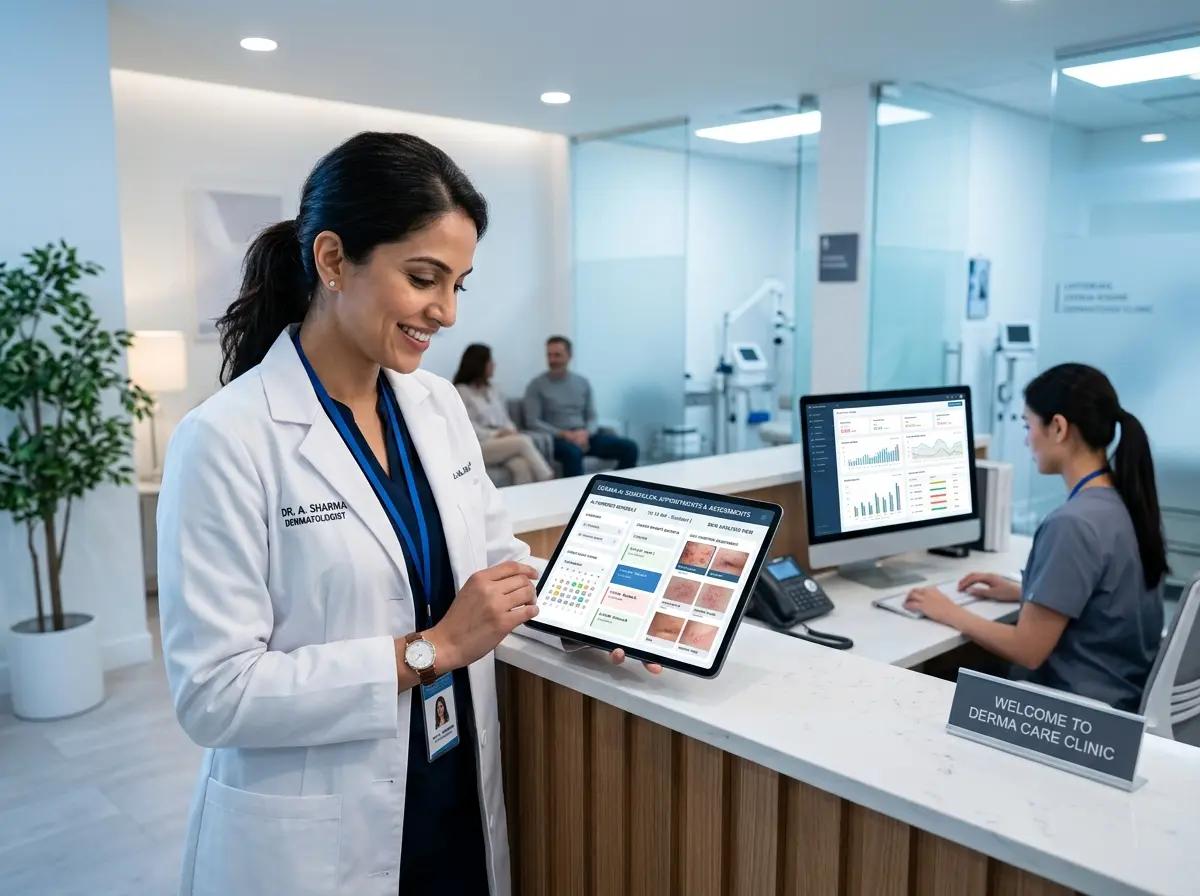
This isn't a rare tragedy. It's Tuesday. And Wednesday. And pretty much every other day in a busy dermatology practice. The front desk is the beating heart of your operation, but it's also the most chronically overloaded part of it. Between triage questions, insurance verification, appointment requests, and the occasional person who just wants to know if you carry a specific sunscreen, your staff is stretched thin — and patient satisfaction quietly suffers for it.
Enter AI. Dermatology practices across the country are discovering that artificial intelligence isn't just for reading pathology slides or analyzing skin lesion images. It's also remarkably good at handling the unglamorous-but-critical work of patient triage and scheduling — the kind of work that bogs down your team before the first patient even walks through the door.
How AI Is Transforming Patient Triage in Dermatology
Symptom-Based Triage: Getting the Right Patient to the Right Appointment
Not every skin concern is created equal. A teenager with a new pimple does not need the same urgency as a 55-year-old with a rapidly changing lesion that could be melanoma. Triage — the process of determining how quickly a patient needs to be seen and by whom — is one of the most clinically important functions in your practice. It's also one that traditionally requires a trained human being, a lot of questions, and a fair amount of time.
AI-powered triage tools are changing that equation. By walking patients through structured, conversational intake questionnaires, AI systems can gather symptom information, duration, patient history, and urgency indicators — then categorize the concern and recommend an appropriate appointment type. A patient describing a lesion that has changed color and shape in the past month gets flagged for a prompt in-person evaluation. A patient asking about a persistent dry patch gets routed to a routine appointment or, where appropriate, a telehealth consultation.
Studies have shown that AI-assisted triage in dermatology can reduce the time to appropriate care for high-priority patients while simultaneously preventing unnecessary urgent visits for low-acuity concerns. That's better outcomes for patients and better resource utilization for your practice — a genuine win-win, which, in healthcare administration, is rarer than you'd think.
Reducing No-Shows with Smarter Scheduling Logic
No-shows are the silent revenue killer of dermatology practices. Industry estimates suggest that no-show rates in dermatology hover between 10% and 30%, depending on the practice and patient population. At $200–$400 per missed appointment slot, that adds up to a staggering amount of money your practice is simply leaving on the table — or rather, watching walk out the door and not come back.
AI scheduling systems can help by doing something your front desk staff technically could do but never has time for: proactively identifying high-risk appointments and triggering follow-up. These systems analyze patterns like appointment type, patient history, time of day, and lead time to predict which bookings are most likely to result in a no-show. They then automatically send reminders, confirm attendance through conversational messaging, and offer easy rescheduling options — before the appointment slot is lost forever.
The result? Practices using AI-assisted scheduling and reminder systems have reported no-show reductions of up to 30%. That's not a rounding error. That's a meaningful change to your monthly revenue and your providers' daily experience.
After-Hours Intake: Capturing Patients Who Don't Call at 9 AM
Here's an uncomfortable truth: many of your potential patients are Googling dermatologists at 11 PM, not 11 AM. They're lying in bed wondering if that spot on their arm is something to worry about, and if your practice can't capture that moment — with some kind of responsive intake mechanism — they'll end up booking with whichever practice actually answers the call, sends the confirmation, and makes them feel like they matter.
AI-powered intake tools, whether deployed via phone, web, or in-person kiosks, allow patients to describe their concerns, provide basic information, and get into your scheduling queue at any hour of the day. No human required. No one grudgingly answering the phone at 7 PM. Just a smooth, professional experience that makes your practice look like it has its act together — even when your staff is at home watching television, which they absolutely deserve to be doing.
Where Tools Like Stella Fit Into Your Practice
AI Reception That Works Around the Clock
For dermatology practices looking to operationalize the concepts above without building a custom AI platform from scratch, Stella offers a practical starting point. Stella is an AI robot employee and phone receptionist that answers calls 24/7, handles patient intake through conversational forms, manages a built-in CRM with custom fields and AI-generated contact profiles, and can route calls to human staff based on configurable conditions — so your team only gets pulled in when a situation genuinely requires them.
For practices with a physical location, Stella also operates as a human-sized in-store kiosk, greeting patients as they arrive, answering questions about services and procedures, and collecting information before they even reach the front desk. That means less friction, shorter check-in times, and a front desk team that can focus on tasks that actually require a human brain. At $99/month with no upfront hardware costs, it's the kind of tool that makes the ROI conversation very short.
Implementation: Making AI Work in a Clinical Environment
Start with a Workflow Audit Before You Buy Anything
The single biggest mistake practices make when adopting AI tools is skipping the boring-but-essential step of mapping their current workflows first. Before you evaluate any platform, spend time documenting exactly what your front desk team does from the moment the phone rings to the moment a patient is seated in an exam room. Where are the delays? Where are the errors? Where do staff feel most overwhelmed?
This audit doesn't need to be a formal consulting engagement. It can be as simple as asking your front desk coordinator to keep a tally of call types for one week. You may discover that 40% of your incoming calls are appointment confirmations or rescheduling requests — a category AI can handle completely autonomously. Or you may find that triage questions from anxious patients are consuming disproportionate amounts of time. Either way, knowing your actual problem is the prerequisite to finding the right solution.
Compliance Considerations Are Real, But Manageable
Yes, you're a medical practice, and yes, HIPAA exists. AI vendors in the healthcare space are well aware of this, and reputable platforms build their systems accordingly — with proper data handling protocols, Business Associate Agreements, and appropriate security standards. That said, the compliance burden is real, and you should approach it seriously.
When evaluating AI tools for triage and scheduling, ask vendors directly about their HIPAA compliance posture, how patient data is stored and transmitted, and whether they can provide a BAA. Any vendor unwilling or unable to answer these questions clearly should be immediately disqualified, regardless of how impressive their demo looks. Protecting patient data isn't optional, and "we're working on it" is not an acceptable answer from a healthcare vendor.
Train Your Team to Work With AI, Not Against It
Staff resistance is a real implementation risk that practice managers consistently underestimate. When your front desk team hears "AI receptionist," some of them will hear "your job is going away." It's worth addressing this directly and early. AI tools in this context are not replacements for your staff — they're filters that absorb the repetitive, low-value interactions so your team can focus on higher-value work: building patient relationships, handling complex situations, supporting clinical staff, and doing the things that actually require empathy and judgment.
Involve your team in the implementation process. Ask for their input on what's working and what isn't. Give them visibility into how the AI is performing. When staff feel like collaborators rather than casualties, adoption goes dramatically better — and your practice gets the full benefit of the technology you've invested in.
A Quick Note on Stella
Stella is an AI robot employee and phone receptionist built for businesses of all types, including medical practices. She answers calls 24/7, collects patient intake information through conversational forms, manages contacts through a built-in CRM, and keeps your front desk from becoming a bottleneck — all for $99/month with no complicated setup or upfront hardware costs. She's basically the staff member who never calls in sick and never puts anyone on hold for four minutes.
The Bottom Line: AI in Dermatology Is No Longer Optional
The dermatology practices that are winning right now — the ones with shorter wait times, higher patient satisfaction scores, and front desk teams that don't look like they're holding on by a thread — are the ones that have stopped treating AI as a futuristic curiosity and started treating it as operational infrastructure.
Here's what you can do this week to start moving in the right direction:
- Audit your call volume and call types. Understand what your front desk is actually fielding before you decide what to automate.
- Identify your highest-friction touchpoints. Is it after-hours inquiries? No-show rates? Triage calls that require clinical judgment? Each problem may have a different solution.
- Evaluate AI tools with compliance as a non-negotiable filter. HIPAA compliance isn't a feature — it's a baseline requirement.
- Pilot before you commit. Most reputable AI platforms offer trial periods. Use them. Measure the actual impact on your team's workload and your patients' experience.
- Bring your staff along for the ride. Implementation succeeds or fails based on adoption. Treat your team as partners in the process.
The technology is here. The ROI is documented. The only thing standing between your dermatology practice and a significantly less chaotic front desk operation is the decision to get started. Your 8:03 AM callers — and your staff — will thank you.