Your Phone Is Ringing. Nobody's Answering. Your Competition Is.
Let's set the scene: A potential client is scrolling Instagram at 9:47 PM, sees your gorgeous before-and-after results, and decides tonight is the night she finally books that HydraFacial she's been putting off. She finds your number, calls you — and gets a voicemail from 2019 that still references your old address. Click. Gone. Probably booked with the spa down the street before her phone even hits the nightstand.
Here's the uncomfortable truth: most med spas don't lose clients because of bad services. They lose them because of bad phone habits. And the worst part? These habits feel completely normal, even reasonable, from the inside. You're busy. Your staff is juggling five things. The phone rings at a weird time. Totally understandable. Totally expensive.
If your med spa is doing everything right — the treatments, the ambiance, the marketing — but revenue still feels stuck, your phone habits might be the silent culprit. Let's talk about the five offenders most likely draining your bookings, and what you can actually do about them.
The Phone Habits Quietly Costing You Clients
1. Letting Calls Go to Voicemail During Business Hours
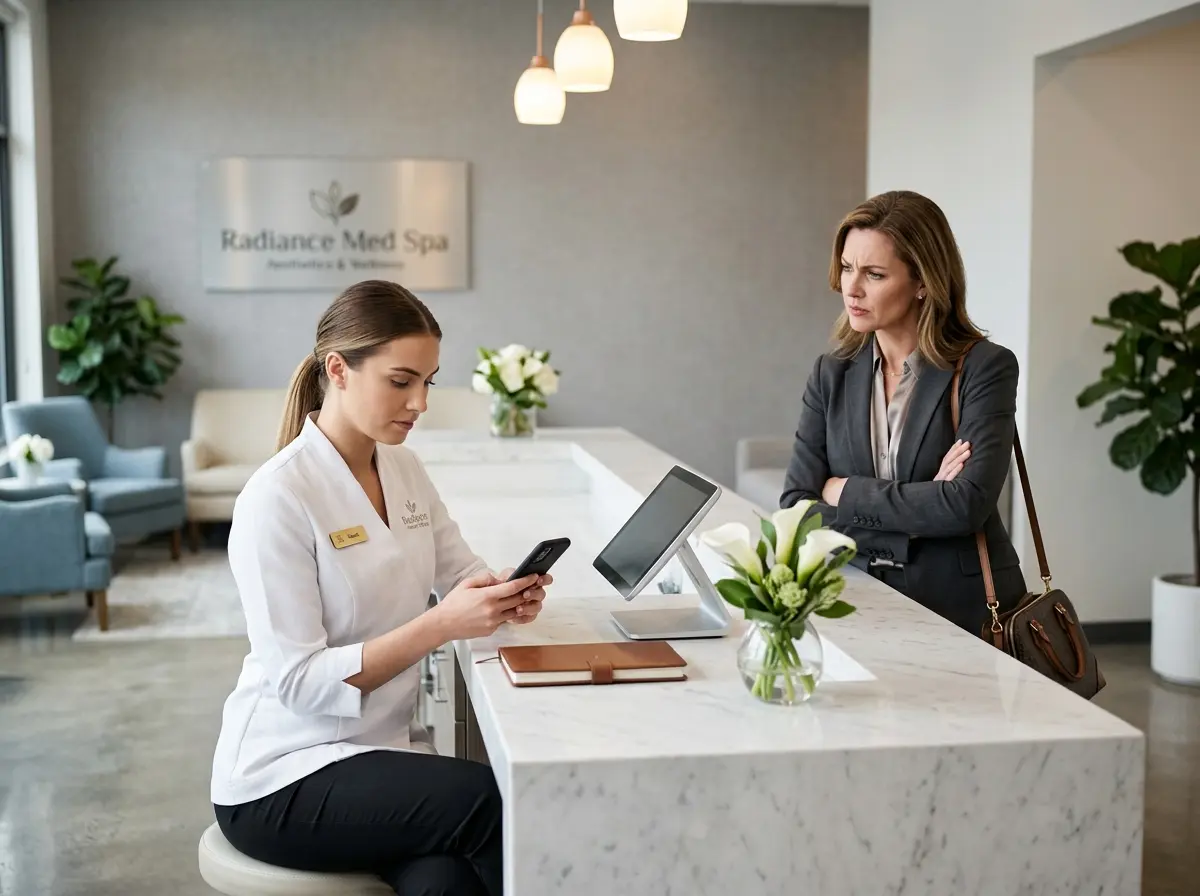
This one stings because it's so common. Your front desk is helping someone at the counter, your aesthetician just wrapped a treatment, and the phone rings. Nobody gets to it in time. Voicemail picks up. No big deal, right?
Wrong. Research from Lead Connect found that 78% of customers buy from the first business that responds to them. In a service industry like med spas — where the barrier to switching providers is essentially zero — that window is brutally short. A client who calls and reaches voicemail during business hours doesn't think, "Oh, they must be busy, I'll wait." They think, "Maybe this place isn't as put-together as their website suggests," and they move on.
Even if they leave a message, you're now racing the clock to call back before they've already booked elsewhere. That's a race you'll lose more often than you'd like to admit.
2. Calling Back Too Late (or Not at All)
Let's say the voicemail does get left. What happens next? In many med spas, it gets retrieved at the end of the day — or the end of the week, if things got hectic. By then, the lead is cold, the client is booked somewhere else, and you're making an awkward return call to someone who barely remembers why they reached out.
Harvard Business Review found that businesses that respond to leads within an hour are seven times more likely to have a meaningful conversation with a decision-maker than those who wait even 60 minutes. Now imagine the callback happening 24 hours later. The math is not flattering.
Consistency matters enormously here. One dropped call is bad luck. A pattern of delayed callbacks is a reputation problem waiting to happen — especially when clients start leaving reviews mentioning how hard it was to get in touch with you.
3. Inconsistent Information Delivered Over the Phone
Here's a sneaky one. A client calls Monday and asks about your current Botox pricing. Your receptionist, doing her best, gives a number from memory — except your pricing sheet was updated two weeks ago. Client calls back Thursday to book and gets a slightly different number from a different staff member. Now she's confused, you look disorganized, and trust has quietly eroded before she's even sat down in your chair.
In med spas especially, where clients are making decisions about both their money and their appearance, inconsistency on the phone reads as unprofessionalism. It plants seeds of doubt that can prevent bookings entirely, or worse, lead to awkward confrontations at checkout when the price isn't what they were told.
How Better Phone Systems Change the Equation
The Real Cost of the Status Quo
Let's put some rough numbers on this. If your med spa averages $250 per appointment and you're missing just five calls per week that could have become bookings, that's $1,250 in weekly revenue walking out the door — or more precisely, hanging up the phone. Over a year, that's over $65,000 in potential income evaporating into voicemail purgatory. Suddenly a phone problem doesn't sound like a minor operational inconvenience. It sounds like a second location you could have opened.
The good news is that this is one of the most fixable problems in your business. Unlike client retention or marketing attribution, phone coverage has a straightforward solution: make sure someone — or something — always picks up.
Where Stella Comes In
This is exactly the kind of problem that Stella was built to solve. Stella is an AI phone receptionist (and in-person kiosk, for spas with a physical location) that answers every call, 24 hours a day, with accurate, consistent information about your services, pricing, promotions, and policies. She doesn't take lunch breaks, doesn't get flustered when two calls come in at once, and doesn't accidentally quote last quarter's pricing.
Beyond just answering calls, Stella can collect client information through conversational intake forms right over the phone — getting you the details you need before a booking is even confirmed. Her built-in CRM stores every interaction with AI-generated client profiles, custom tags, and notes, so your team always has context before they follow up. If a call needs a human touch, she forwards it based on whatever conditions you configure. If not, she handles it herself and sends your manager a push notification with an AI-generated summary of the conversation. It's the phone coverage your front desk wishes it could provide, running quietly in the background while your staff focuses on clients who are already in the room.
More Habits That Are Subtly Hurting You
4. No After-Hours Coverage Whatsoever
Med spa clients are busy people. Many of them are making decisions about their skincare or body treatments during their own off-hours — evenings, weekends, sometimes late at night when they're finally done with their own workday. If your phone goes completely dark after 5 PM, you're invisible during some of the highest-intent browsing windows of the day.
This doesn't mean your staff needs to be on call around the clock. But it does mean that when someone calls at 8 PM on a Saturday to ask how long recovery from a laser treatment takes, they should get a helpful, accurate answer — not a generic voicemail greeting that tells them your office hours and wishes them a great day. A caller who gets useful information after hours is dramatically more likely to book than one who hits a wall and has to remember to try again Monday morning (they won't).
5. Treating the Phone as a Nuisance Instead of a Revenue Channel
This might be the most insidious habit of all, because it's cultural rather than procedural. When your front desk views phone calls as interruptions — something to get through quickly so they can return to the "real" work — it shows. Calls get rushed. Questions get half-answered. Upsell opportunities get ignored entirely because nobody's thinking about the phone as a place where revenue happens.
But the phone is often a client's first real impression of your spa. The tone, the knowledge, the warmth of that interaction sets expectations for the entire relationship. A client who calls and has a genuinely helpful conversation — where they learn about a current promotion they didn't know about, or get a thoughtful recommendation for which treatment fits their concern — is far more likely to book, show up, and return. The phone isn't a chore. It's one of your most underutilized sales tools.
Train your team to treat every inbound call like a warm lead, not a task to complete. Ask questions. Listen. Recommend. Follow up. The client calling you already cleared the hardest hurdle — they want to be there. Your job on that call is just not to talk them out of it.
Quick Reminder About Stella
Stella is an AI robot employee and phone receptionist built for businesses like yours — available as a physical in-store kiosk that greets and engages walk-in clients, and as a 24/7 AI phone receptionist that handles calls with the same knowledge and professionalism your best staff member would. She runs on a simple $99/month subscription with no upfront hardware costs and is easy to get up and running. For a med spa bleeding revenue through missed calls and inconsistent phone coverage, she's worth a very serious look.
Stop Leaving Money on the Voicemail
Your med spa's phone habits are either quietly building your business or quietly dismantling it — and most owners don't realize which one is happening until they actually audit what's going on. Take an honest look at how calls are being handled right now. How many go unanswered during peak hours? How quickly are voicemails returned? Is the information your team gives over the phone consistent and current? What happens when someone calls at 7 PM on a Tuesday?
The fixes don't have to be dramatic. Start by auditing your callback time — aim for under an hour during business hours. Make sure your pricing and service information is written down and accessible to whoever answers the phone. Create a short script for common questions so clients get consistent answers regardless of who picks up. And seriously consider what after-hours coverage looks like for your practice.
Your treatments are good. Your results speak for themselves. Don't let a ringing phone with nobody on the other end be the reason a client chooses someone else. The revenue is there — it's just waiting for someone to pick up.