Your Website Is Open 24/7 — Is Anyone Actually Answering?
Here's a scenario that might feel painfully familiar: It's 10:47 PM on a Tuesday. A homeowner just discovered a crack in their foundation, a leaky roof, or a kitchen that desperately needs a renovation. They're motivated, they're ready to hire someone, and they land on your contractor website. They poke around, get excited, and then... they fill out a contact form and wait. Or worse, they bounce and hire your competitor who had something — anything — interactive waiting for them.
The hard truth is that nearly 50% of B2C customers expect a response within one hour, and the majority of homeowners research contractors outside of traditional business hours. If your website is essentially a digital brochure with a "we'll get back to you" form, you're leaving serious money on the table every single night.
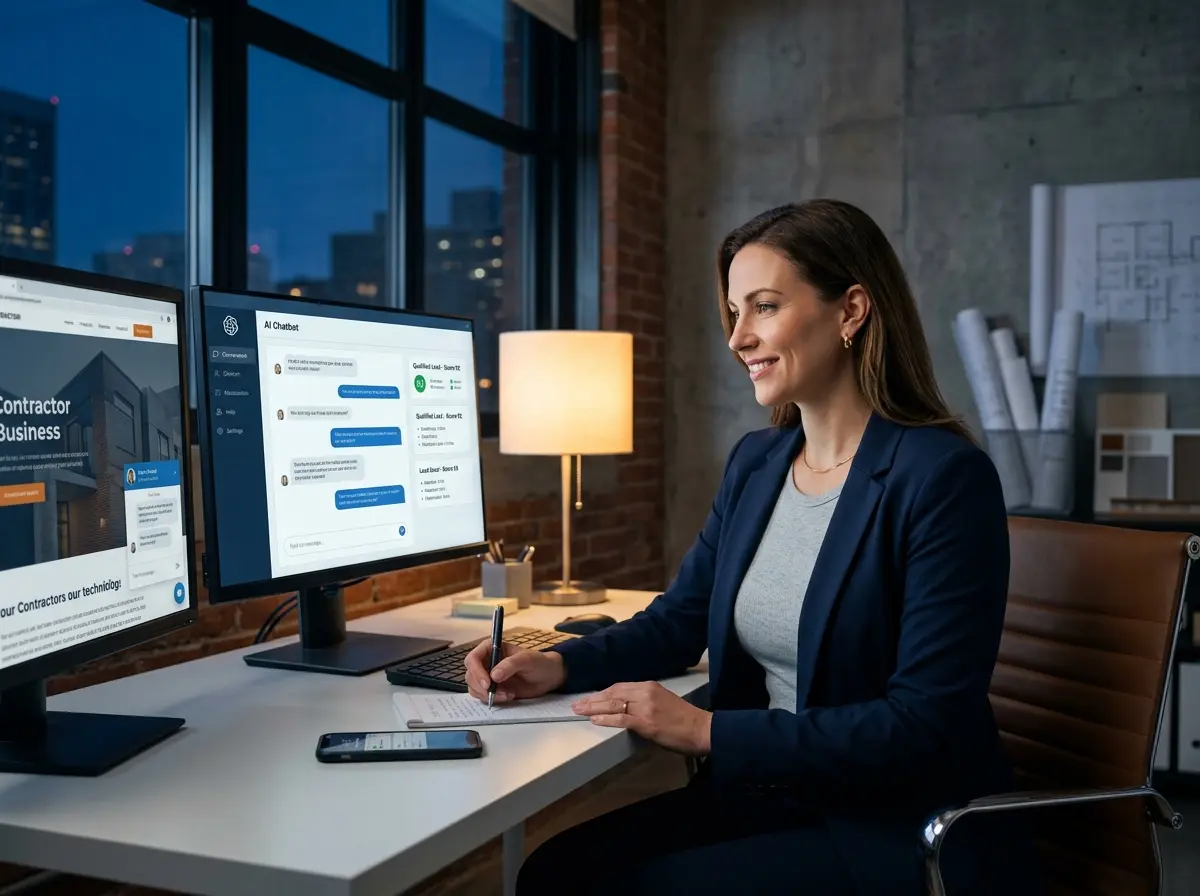
The good news? AI chatbots have become a genuinely powerful tool for contractor websites — not just to answer basic questions, but to actively qualify leads while you're off the clock. Let's talk about how to make that work for you.
Understanding Lead Qualification for Contractors
What Does "Qualifying a Lead" Actually Mean?
Lead qualification is the process of determining whether a prospective customer is worth pursuing — meaning they have the need, the budget, the authority to make a decision, and a realistic timeline. For contractors, this is especially critical because not every inquiry is created equal. A homeowner wanting a full kitchen remodel is a very different conversation than someone who wants a single outlet replaced.
Without a qualification system, your sales team (or you, at 7 AM with a coffee in hand) ends up manually sifting through every inquiry, spending time on dead ends, and sometimes missing the genuinely hot leads buried in the pile. An AI chatbot solves this by doing the sorting for you — automatically, consistently, and without needing a lunch break.
The Key Questions Every Contractor Should Be Asking Leads
A good AI chatbot doesn't just say "Hi! How can I help?" and leave the visitor to wander. It guides the conversation with purpose. For a contractor, the qualifying questions you program into your chatbot should gather the information that helps you prioritize and prepare. Here are the essentials:
- What type of project do you need help with? (roofing, plumbing, electrical, remodeling, etc.)
- What's your approximate timeline? (ASAP, within 3 months, just exploring)
- What's the general scope or size of the project?
- Do you have a budget range in mind?
- What's the best way to reach you, and when?
These five data points alone can transform a vague "someone filled out the form" into a warm, pre-qualified lead with context — so when you do make contact, you're already speaking their language.
Why After-Hours Qualification Is a Competitive Advantage
Most of your competitors have the same hours as you. They're also not answering their phones at 11 PM. The contractor who has an intelligent, conversational presence on their website after hours isn't just being convenient — they're actively capturing leads that everyone else is sleeping through. Studies suggest that contacting a lead within the first five minutes of their inquiry increases conversion rates dramatically compared to waiting even an hour. An AI chatbot doesn't close deals (that's still your job), but it keeps the conversation alive and captures critical information in real time, so your first human touchpoint is warm, informed, and fast.
How AI Tools Like Stella Can Take This Further
From Chatbot to Full AI Receptionist
A website chatbot is a great start, but the most effective contractors are thinking about lead qualification across every touchpoint — not just the website. Stella, an AI robot employee and phone receptionist, extends this capability to your phone lines, operating 24/7 with the same business knowledge she'd use in person. For contractors who get a significant portion of inquiries via phone (and most do), this means no more missed calls going to voicemail oblivion. Stella answers, asks the right questions, collects intake information conversationally, and delivers AI-generated summaries with push notifications so you wake up to qualified leads — not missed opportunities.
What makes Stella particularly useful for lead qualification is her built-in CRM with custom fields, tags, and AI-generated customer profiles. Every conversation — whether it happens on the phone or through a web intake form — feeds directly into a organized contact record. No manual data entry, no sticky notes, no "I think I wrote their number down somewhere."
Setting Up Your Chatbot to Actually Qualify (Not Just Chat)
Design Conversation Flows with Intention
The biggest mistake contractors make when setting up a website chatbot is treating it like a FAQ page with a friendlier interface. A qualifying chatbot needs a structured conversation flow — essentially a decision tree that adapts based on what the visitor tells you. Start with a warm, specific greeting that acknowledges your industry. Something like "Hey there! Looking for a contractor? Tell me a bit about your project and I'll help you figure out next steps." is infinitely better than a generic "Hello, how may I assist you today?"
From there, build branches. If someone says they need roofing work urgently, the chatbot should fast-track them toward a callback request or appointment booking. If someone is in early research mode, it can offer helpful content, gather their contact information, and tag them as a nurture lead. The goal is to match the response to the intent — not just collect an email address and hope for the best.
Integrate Your Chatbot with Your CRM and Calendar
A chatbot that operates in isolation is only half as useful as one that connects to your existing systems. At minimum, your chatbot should be pushing lead data directly into your CRM so that every qualified conversation becomes a contact record without anyone lifting a finger. Even better, consider integrating with your scheduling tool so that high-intent leads can book a consultation directly from the chat window. Removing friction from the booking process is one of the most reliable ways to increase conversion rates, and letting a prospect schedule their own estimate appointment at midnight — without your involvement — is a genuinely beautiful thing.
Follow-Up Automation: Don't Let Leads Go Cold
Lead qualification is only valuable if it leads somewhere. Once your chatbot has captured and categorized a lead, an automated follow-up sequence should kick in. For hot leads (immediate need, defined budget, ready to hire), that might mean an automated SMS or email confirmation that someone from your team will call them first thing in the morning. For warm leads, a drip email sequence over a few weeks can keep you top of mind until they're ready to move forward. The chatbot does the initial work; automation keeps the relationship alive. Together, they make you look remarkably responsive — even when you're sound asleep.
Quick Reminder About Stella
Stella is an AI robot employee and phone receptionist built for businesses of all kinds — including contractors and service providers — who need a reliable, professional presence around the clock. She answers calls, qualifies leads through conversational intake, manages contacts in a built-in CRM, and even handles in-person kiosk interactions for businesses with a physical location. At $99/month with no upfront hardware costs, she's one of the more surprisingly affordable ways to never miss a lead again.
Start Capturing Leads You're Currently Sleeping Through
Here's the bottom line: your website visitors don't keep business hours, and neither should your lead qualification process. An AI chatbot — configured thoughtfully with the right questions, conversation flows, and integrations — can turn your contractor website into a 24/7 lead-generating machine that does the heavy lifting before you ever pick up the phone.
To put this into action, start with these concrete steps:
- Audit your current contact process. How long does it take your team to respond to an inquiry? What information are you missing when you do? That gap is your chatbot's job description.
- Define your qualifying criteria. Write down the five to seven questions whose answers would tell you whether a lead is worth pursuing — these become your conversation flow.
- Choose a chatbot platform that integrates with your CRM and calendar, and commit to building a real conversation flow — not just a contact form with a chat bubble.
- Extend your coverage to phone calls. If a significant portion of your leads call rather than chat, make sure you have an AI solution handling those inquiries after hours too.
- Review and refine regularly. Look at your chatbot conversations monthly. What questions are people asking that you didn't anticipate? What drop-off points exist in the flow? Treat it like a living tool, not a set-it-and-forget-it box you checked.
The contractors winning in this market aren't necessarily the ones with the best crews or the slickest trucks. They're the ones who respond first, communicate clearly, and make it embarrassingly easy for homeowners to say yes. An AI chatbot won't replace your expertise — but it will make sure that expertise gets in front of every lead who comes knocking, whether it's 9 AM or 9 PM.