Introduction: The Number That Tells You Everything (And the One You're Probably Ignoring)
Let's be honest — most practice owners have a general sense of how their patients feel. "People seem happy," you think, as you glance at your three Google reviews and a handwritten thank-you note from 2019. But feelings aren't data, and data is what actually moves the needle on patient retention, referrals, and long-term growth.
Enter the Net Promoter Score (NPS) — one of the simplest, most powerful tools in the customer experience playbook. Originally developed by Fred Reichheld and Bain & Company, NPS has become the gold standard for measuring patient loyalty across healthcare, dental, chiropractic, physical therapy, and virtually every other practice type you can think of. The premise is refreshingly simple: ask your patients one question, get a number, and use that number to make smarter decisions. No PhD in data science required.
In this post, we'll walk you through exactly what NPS is, how to measure it in your practice, and — more importantly — how to actually do something useful with the results. Because a score sitting in a spreadsheet helps nobody.
Understanding Net Promoter Score: The Basics Your Practice Needs to Know
What Is NPS and How Does It Work?
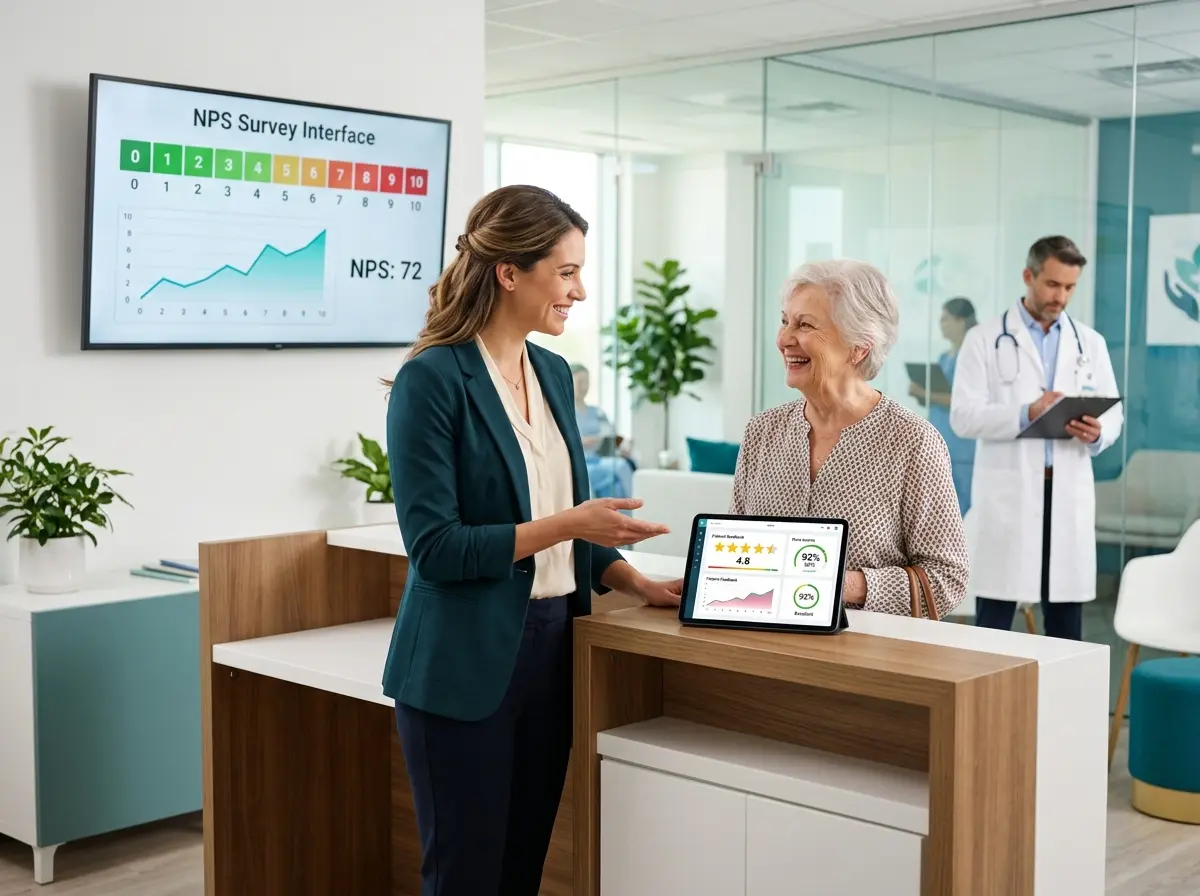
The Net Promoter Score is built around a single survey question: "On a scale of 0 to 10, how likely are you to recommend our practice to a friend or family member?" Based on their response, patients fall into one of three categories:
- Promoters (score 9–10): Your loyal fans. They're actively referring new patients and singing your praises at dinner parties.
- Passives (score 7–8): Satisfied but unenthusiastic. They won't hurt you, but they won't help you much either.
- Detractors (score 0–6): Unhappy patients who could be damaging your reputation — potentially on review sites you haven't checked in months.
Your NPS is calculated by subtracting the percentage of Detractors from the percentage of Promoters. Passives are excluded from the math entirely (because apparently being "fine" doesn't count). The result is a number between -100 and +100. According to industry benchmarks, a score above 50 is considered excellent, and anything above 70 is world-class. For healthcare practices specifically, the average NPS hovers around 58 — so there's plenty of room to stand out.
Why NPS Matters More in Healthcare Than Almost Anywhere Else
In most retail businesses, a dissatisfied customer just buys from a competitor. In healthcare, the stakes are higher. A patient who feels dismissed, confused, or frustrated doesn't just leave — they often delay care, which is bad for them and ultimately bad for your practice's reputation and revenue. Patient experience directly influences clinical outcomes, and multiple studies have shown that patients who trust and feel valued by their provider are significantly more likely to follow treatment plans and return for follow-up care.
Beyond outcomes, word-of-mouth referrals are still the single most powerful marketing channel for most practices. Research from Bain & Company found that increasing customer retention rates by just 5% can increase profits by 25% to 95%. NPS gives you a measurable, trackable way to understand whether your patient relationships are trending in the right direction — before problems become patterns.
How to Collect NPS Data Without Annoying Your Patients
The most common mistake practices make is either never asking for feedback at all, or asking for it in the most friction-heavy way imaginable (a paper form at checkout, anyone?). The good news is that collecting NPS in 2024 is easier than ever. You can embed a single-question survey in a post-visit email or text message, use a dedicated NPS tool like Delighted or SurveyMonkey, or even collect responses through your practice management software if it supports it.
Timing matters. Sending the survey within 24 hours of a visit dramatically increases response rates and ensures the experience is still fresh. Keep the survey short — one required question, one optional follow-up asking why they gave that score. That follow-up is where the real gold is buried. It's the qualitative data that explains the number.
How Modern Tools Like Stella Can Support Your Patient Experience Efforts
First Impressions Are Part of the Score Too
Here's something worth considering: by the time a patient fills out your NPS survey, their experience has already been shaped by a dozen micro-moments — the phone call to schedule their appointment, the greeting when they walked in, how long they sat in the waiting room with nothing to engage them. NPS measures the cumulative experience, which means improving your score requires looking at every touchpoint, not just the clinical encounter itself.
That's where Stella comes in. Stella is an AI robot employee and phone receptionist designed for businesses exactly like yours. For practices with a physical location, she stands in your lobby and greets every patient who walks in — proactively, warmly, and without ever having a bad day. She can answer common questions about services, hours, insurance policies, and promotions, freeing your front-desk staff to focus on higher-value interactions. And for every inbound call — whether it's during business hours or at 11pm on a Sunday — Stella answers with the same professional, knowledgeable presence. She can collect patient intake information through conversational forms, manage contact data through her built-in CRM, and forward calls to staff based on conditions you configure. When patients feel informed and welcomed from the very first interaction, it shows up in your NPS. Consistently.
Turning Your NPS Data Into Actual Improvements
Segment Your Results to Find the Real Story
A single aggregate NPS number is a starting point, not a destination. The real insight comes from segmenting your data — by provider, by appointment type, by day of week, by new patients versus returning patients. You might discover that your NPS among new patients is a disappointing 32 while long-term patients score you at 72. That gap tells you something specific: your onboarding experience needs work. Maybe it's the intake process. Maybe it's the first-visit communication. Maybe the waiting room feels cold and unwelcoming to someone who's never been there before.
Segmentation turns a vague sense of "we could do better" into a targeted action plan. Most NPS platforms make this easy by allowing you to tag responses with custom attributes, or you can do it manually if your volume is small enough. Either way, don't settle for the average when the breakdown is so much more useful.
Close the Loop with Detractors — Before They Write a Review
This is the step that most practices skip, and it is a significant missed opportunity. When a patient gives you a score of 6 or below, that's not a number to quietly file away — that's an invitation to have a conversation. A simple follow-up from a practice manager, acknowledging their feedback and asking what you could do better, can completely transform a Detractor into a loyal patient. People don't necessarily expect perfection; they expect to be heard.
Establish a process where any NPS score below 7 triggers a personal outreach within 48 hours. It doesn't need to be elaborate — a brief, genuine phone call or personalized email is enough. Document the feedback, share it with your team, and track whether specific complaints are recurring. If three different patients in one month mention long wait times in their open-ended responses, that's not a coincidence. That's a workflow problem waiting to be solved.
Activate Your Promoters — They're an Untapped Marketing Asset
Promoters are telling you they love you. The logical next step is to make it easy for them to tell everyone else. After identifying your 9s and 10s, follow up with a warm, specific ask: would they be willing to leave a Google review, share a testimonial, or refer a friend or family member? The key word is easy — include a direct link to your Google listing, keep the ask brief, and express genuine appreciation.
You can also use your Promoters to validate what's working. Review their open-ended responses for patterns. If seven Promoters in a row mention the same provider by name, or consistently praise how organized your scheduling process is, you've identified a genuine competitive advantage worth doubling down on — and worth mentioning in your marketing.
Quick Reminder About Stella
Stella is an AI robot employee and phone receptionist available for just $99/month with no upfront hardware costs. She greets patients at your front door, answers calls around the clock, collects intake information, and manages contacts through a built-in CRM — all without breaks, bad days, or turnover. If you're working to improve the patient experience touchpoints that feed into your NPS, she's worth a look.
Conclusion: One Score, Infinite Improvements
Net Promoter Score isn't magic. It won't fix a broken intake process by itself, and a great score doesn't mean you've earned the right to stop improving. But as a consistent, simple, and surprisingly powerful feedback mechanism, it gives your practice something invaluable: a direct line to how your patients actually feel, expressed in a format you can track, benchmark, and act on over time.
Here's your action plan to get started:
- Choose your NPS tool. Options like Delighted, Medallia, or even a simple Typeform survey will do the job.
- Set up automated post-visit surveys to go out within 24 hours of each appointment.
- Segment your results by provider, patient type, and appointment category to find patterns.
- Create a Detractor follow-up protocol so no unhappy patient goes unacknowledged.
- Activate your Promoters with a simple, direct ask for reviews or referrals.
- Review your full patient journey — including phone interactions and in-office first impressions — to ensure every touchpoint reflects the experience your NPS aspires to deliver.
Your patients are already forming opinions about your practice. NPS just gives you the tools to listen — and the roadmap to make sure those opinions are ones worth sharing.