When Your Phone Won't Stop Ringing (And Your Staff is About to Quit)
If you run a pediatric practice, you already know the drill. It's 9:15 AM on a Monday, three kids are crying in the waiting room, your nurse is trying to update a chart, and the phone is ringing for what feels like the forty-seventh time — and it's only been open for fifteen minutes. The caller wants to know your hours. Your hours. Which are listed on your website, your Google profile, your front door, and probably the inside of their eyelids if they've called before.
Phone volume is one of the most underestimated operational burdens in a pediatric practice. Unlike adult medicine, pediatric patients come with parents — parents who have questions, concerns, follow-ups, and a remarkable ability to call during the exact moment your staff is least available. The result? Missed calls, frustrated families, overwhelmed front desk staff, and a front office culture that slowly transforms from "warm and welcoming" to "please, just let us breathe."
The good news is that this is a solvable problem. And no, the solution isn't hiring a third receptionist you can't afford. Let's talk about how smart communication tools — and a little strategic thinking — can dramatically reduce inbound call volume without reducing the quality of care your families experience.
Understanding Why Your Phones Are Ringing Off the Hook
The Usual Suspects: Repeat and Preventable Calls
Not all phone calls are created equal. In most pediatric practices, a surprisingly large percentage of inbound calls fall into a predictable category: questions that could have been answered without a human picking up the phone. Research from healthcare operations consultants consistently shows that between 30% and 50% of inbound calls to medical offices involve routine inquiries — things like office hours, appointment availability, prescription refill requests, and directions. These aren't emergencies. They're information gaps.
When you start categorizing your call volume, you'll often find a handful of repeat question types dominating your queue. For pediatric practices specifically, common culprits include sick visit availability, vaccine schedules, school and sports physical requirements, after-hours guidance, and insurance accepted. Each of these calls takes two to four minutes to handle. Multiply that by twenty calls a day and you've consumed over an hour of staff time on questions that, frankly, shouldn't require a human at all.
The Hidden Cost of High Call Volume
Beyond the time cost, chronic high call volume creates a cascade of secondary problems that practice managers often don't fully account for. Staff morale takes a hit when employees feel like they're constantly treading water. Quality of in-person patient interactions suffers when a receptionist is mentally managing a ringing phone while trying to check in a family. And missed or mishandled calls translate directly into lost patients — families who couldn't get through and scheduled with another practice instead.
There's also the issue of after-hours calls. Parents don't stop having questions at 5 PM. A child develops a fever at 7:30 in the evening and a parent calls your main line hoping for guidance. If they get a generic voicemail with no actionable information, that's a frustrating experience that quietly erodes trust — even if your clinical care is exceptional.
What "Reducing Call Volume" Actually Means
It's worth being precise here, because the goal isn't to discourage patients from contacting you. The goal is to redirect low-complexity contacts to more efficient channels while preserving human attention for calls that genuinely need it. A parent calling to ask whether you accept their insurance doesn't need to speak with your receptionist — they need an accurate, immediate answer. A parent whose child is having a serious allergic reaction absolutely needs a human. Your communication infrastructure should be smart enough to tell the difference.
How AI Communication Tools Are Changing the Front Office
Automating the Answerable
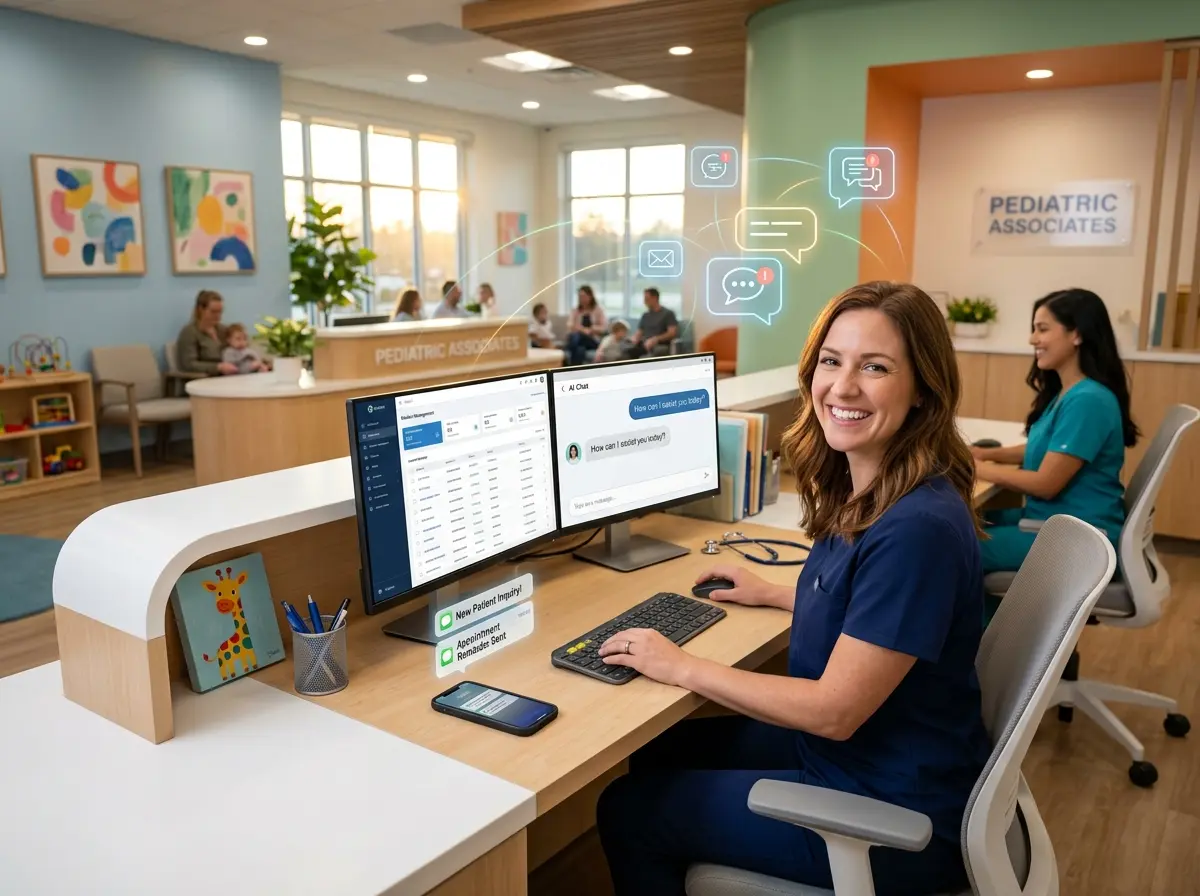
This is exactly where tools like Stella come in. Stella is an AI robot employee and phone receptionist designed to handle the routine communication workload that currently consumes your front desk staff. She answers calls 24/7, responds to common questions about your services, hours, policies, and appointment types, and handles the entire interaction with the kind of friendly, consistent professionalism that doesn't have bad days or get flustered during a busy Monday morning rush.
For a pediatric practice, this means that when a parent calls to ask about your sick visit hours, Stella answers immediately — day or night — with accurate information you've configured. When someone wants to know what insurance plans you accept, she handles it. When a parent needs to leave a detailed message about a prescription refill, Stella takes the voicemail and delivers an AI-generated summary directly to the appropriate staff member with a push notification, so nothing slips through the cracks.
Practices that deploy this kind of intelligent call handling consistently report significant reductions in total inbound call volume handled by human staff — in some cases exceeding 40%. That's not a rounding error. That's an hour or more of reclaimed staff time every single day.
Intake, CRM, and Keeping Patient Information Organized
Stella also includes built-in CRM functionality and conversational intake forms, which is genuinely useful for a practice that's tired of playing information tag. New patient intake, insurance verification prep, and appointment-related questions can all be collected through Stella during a phone interaction — organized automatically into patient contact profiles with custom fields, tags, and AI-generated notes. For a front office team that's currently doing all of this manually, that's a meaningful operational upgrade.
Practical Strategies to Reduce Call Volume Without AI (And With It)
Audit Your Calls Before You Fix Them
The single most underutilized tactic in front office optimization is simply tracking what your calls are actually about. Before implementing any new tool or process, spend two weeks having your staff log the reason for every inbound call. Use broad categories — scheduling, billing, clinical question, general information, refill request, insurance inquiry, and so on. You'll almost certainly be surprised by what you find, and the data will tell you exactly where to focus your energy.
Once you know your top five call reasons, you can build targeted solutions: an FAQ page on your website, automated responses in your patient portal, after-hours messaging that proactively addresses common questions, or an AI call handler configured to address those specific topics fluently. You can't optimize what you haven't measured, and in this case, the measurement is genuinely simple.
Optimize Your Voicemail and After-Hours Messaging
If you're not using an AI-powered call solution, your voicemail greeting is doing more work than you probably realize — and it's likely not doing it well. A generic "we're closed, please leave a message" greeting is a missed opportunity. An after-hours message that tells parents what to do for urgent vs. non-urgent concerns, confirms your hours and patient portal access, and sets clear expectations for callback timelines can deflect a meaningful number of follow-up calls all on its own.
Consider structuring your after-hours message as a brief, decision-tree-style guide: "For emergencies, call 911 or go to your nearest ER. For urgent clinical concerns, please contact our after-hours nurse line at…" Parents who get actionable guidance don't need to call back and ask what to do next.
Empower Parents Through Your Patient Portal
If your practice uses an EHR with a patient portal and your families aren't using it, that's worth investigating. Portal adoption doesn't happen automatically — it requires active encouragement at every appointment, clear instructions, and a portal experience that's actually easier than calling. Practices that successfully shift even a modest portion of routine communication (appointment requests, prescription refills, non-urgent questions) to the portal see measurable reductions in phone volume over time.
The key is removing friction. If logging into your portal requires a parent to remember a username, reset a password, and navigate three menus to send a message, they'll call instead. Audit your portal onboarding experience with fresh eyes and ask honestly: is this easier than picking up the phone?
Quick Reminder About Stella
Stella is an AI robot employee and phone receptionist available for any business at just $99/month — no upfront hardware costs, no complicated setup. She answers calls around the clock, handles routine inquiries, collects patient information through conversational intake forms, and keeps everything organized in a built-in CRM. For practices with a physical location, she's also available as a human-sized in-store kiosk that greets patients and families proactively the moment they walk through the door.
Your Front Desk Deserves Better Than This
Reducing phone volume by 40% isn't magic — it's the result of intentional process design, better communication infrastructure, and tools that handle routine work so your team doesn't have to. For a busy pediatric practice, the stakes are real: staff burnout is expensive, missed calls cost you patients, and every minute your receptionist spends answering "what are your hours?" is a minute not spent on something that actually requires a human being.
Here's where to start:
- Audit your call volume for two weeks and categorize every inbound call by reason.
- Identify your top five repeat question types and build self-service answers for each one.
- Optimize your after-hours messaging to give parents actionable guidance instead of a generic voicemail.
- Evaluate your patient portal adoption and remove friction from the onboarding experience.
- Consider an AI call handling solution like Stella to automate routine call types, capture voicemails intelligently, and give your staff their time back.
Your front office team didn't go into healthcare to spend their days answering the same five questions on repeat. Give them back the capacity to do the work that actually matters — and give your families the responsive, professional experience they deserve, even at 8 PM on a Tuesday when everyone else has gone home.