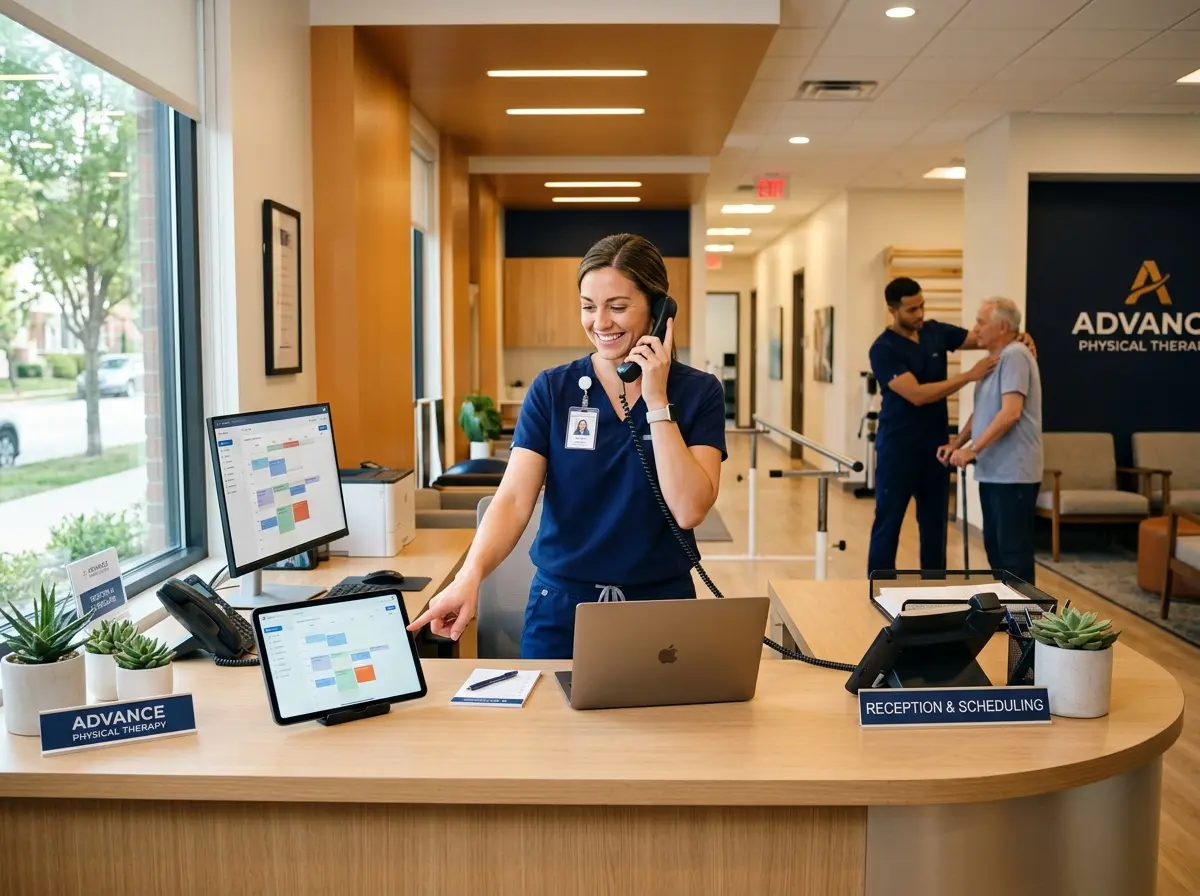
The Phone Call That Could Make or Break Your Practice
Picture this: your front desk phone rings at 2:47 PM on a Tuesday. It's a potential new patient asking, "Do you accept my insurance?" Your receptionist — bless their heart — is simultaneously checking in a patient, answering a scheduling question, and trying to remember where they put the new intake forms. The insurance inquiry gets a rushed, vague answer, and the caller hangs up to "think about it." Spoiler: they don't call back.
If this scenario sounds painfully familiar, you're not alone. Physical therapy practices lose a staggering number of potential patients at this exact moment — the insurance inquiry call. According to industry data, nearly 60% of healthcare prospects who don't get a satisfying first response simply move on to the next provider on their list. That's not a lead problem. That's a conversion problem. And the good news is, it's entirely fixable.
This guide walks you through the practical strategies PT practice owners can use to turn those "do you take my insurance?" calls into confirmed, scheduled appointments — consistently, professionally, and without burning out your front desk staff.
Understanding Why Insurance Inquiries Stall Out
The Information Gap Problem
Most insurance inquiry calls fail not because the patient wasn't interested, but because the conversation hit a wall. The caller asks a specific question — "Do you accept Blue Cross Blue Shield PPO?" — and the front desk either doesn't know offhand, puts them on hold for three minutes, or gives a wishy-washy "it depends" answer that inspires zero confidence. The patient, already a little anxious about starting physical therapy, interprets uncertainty as a red flag and disengages.
The fix here isn't to hire someone with a PhD in insurance billing (though, frankly, that would be nice). It's to equip whoever answers your phones with a clear, confident, scripted response process that acknowledges the complexity of insurance while still moving the conversation forward. Your front desk doesn't need to be a billing expert — they need to sound like they have a plan.
The Momentum Problem
Even when a front desk rep handles the insurance question well, there's a second failure point: the handoff. The caller gets their question answered, and then... nothing. No next step is offered. No appointment is suggested. The conversation ends politely, and both parties hang up with the vague understanding that the patient "might call back to schedule." They won't. At least, not most of them.
Momentum is everything in a sales conversation — and yes, converting a patient inquiry is a sales conversation, even in healthcare. The moment a patient's question is answered is the exact moment to gently pivot toward scheduling. Miss that window, and you're starting from scratch if they call back at all.
The After-Hours Black Hole
Here's the one that practice owners consistently underestimate: a large percentage of insurance inquiry calls happen outside of business hours. Prospective patients research providers during their lunch break, after the kids go to bed, or on a Sunday afternoon. If they call and get voicemail — or worse, no answer — that opportunity evaporates almost instantly. Practices that don't have a solution for after-hours inquiries are essentially leaving a significant slice of new patient acquisition on the table every single week.
Building a Conversion-Focused Intake Process
Scripting the Insurance Inquiry Call
A well-scripted call flow doesn't mean robotic or cold — it means your team is prepared, consistent, and confident. A solid insurance inquiry script should include three phases: acknowledgment, information gathering, and the pivot to scheduling.
Start by acknowledging the question warmly and validating it — insurance is confusing, and patients know it. Then, rather than attempting to answer the coverage question on the spot (which often leads to that dreaded "it depends" moment), collect the patient's insurance information and offer to verify it within a specific, short timeframe: "Let me get your insurance details and I'll have our billing team confirm your benefits within 24 hours — can we go ahead and get you on the schedule while we do that?" This approach answers the spirit of their question, buys you time to verify accurately, and advances the scheduling conversation simultaneously.
Letting Technology Handle What People Shouldn't Have To
This is where smart tools make a real difference. Stella, the AI robot employee and phone receptionist, is built to handle exactly this kind of intake scenario — 24/7, without putting anyone on hold or fumbling through a benefits binder. Stella can answer incoming calls, walk callers through a conversational intake form to collect their name, contact information, insurance carrier, and reason for visit, and store everything directly in her built-in CRM with AI-generated summaries and custom tags. Your billing team wakes up the next morning with a clean list of verified leads to follow up with — not a stack of scribbled sticky notes.
For practices with a physical location, Stella's in-clinic kiosk presence means walk-in inquiries get the same consistent, professional experience as phone callers. Whether someone is calling in after hours or stopping by to ask questions before committing, nothing falls through the cracks.
The Art of the Pivot: Moving from "Maybe" to "Scheduled"
Assumptive Scheduling Done Right
Assumptive scheduling is one of the most effective — and most underused — conversion techniques in healthcare intake. Rather than asking "Would you like to schedule an appointment?", which invites a yes-or-no hesitation moment, you offer a choice between two yeses: "We have availability Thursday at 10 AM or Friday at 2 PM — which works better for you?"
This technique works because it shifts the patient's mental frame from should I schedule? to when should I schedule? It's not pushy or manipulative — it's just thoughtful communication design. Patients who call with an insurance inquiry are already motivated. They have a problem they need help with. Your job is simply to make the next step as easy and obvious as possible, rather than leaving them to navigate it on their own.
Handling Objections Without Losing the Lead
Sometimes the caller genuinely can't commit until they know their out-of-pocket costs. That's fair — healthcare expenses are real, and dismissing cost concerns is a fast way to lose trust. Instead of treating this as a dead end, treat it as a data collection opportunity. Collect their insurance information, offer a specific callback timeline for benefits verification, and in the meantime, secure a conditional appointment slot: "Let me hold a spot for you while we verify — if the costs don't work for you, no problem at all, we can release it. But this way you're not waiting if everything checks out."
This approach respects the patient's concern while keeping them engaged in the process. Most people, when given a low-pressure way to stay involved, will take it.
Following Up Like You Mean It
The follow-up is where most practices completely drop the ball. A patient calls, expresses interest, says they need to check their benefits, and hangs up — and nobody ever calls them back. Implement a simple, structured follow-up protocol: a call or text within 24 hours of the initial inquiry, followed by one more touchpoint 48 hours later if there's no response. Keep it friendly, brief, and patient-focused. "Hi, this is [Name] from [Practice] — I'm just following up on the insurance verification we ran for you. Happy to answer any questions when you have a moment!"
Two touchpoints is usually enough. More than that edges into uncomfortable territory. Less than that — meaning zero — is a conversion rate killer.
Quick Reminder About Stella
Stella is an AI robot employee and phone receptionist that handles calls, greets patients, collects intake information, and manages contacts — all for $99/month with no upfront hardware costs. She works 24/7, never needs a break, and brings the same professional consistency to every single interaction whether it's a phone call at midnight or a walk-in on a busy Monday morning. For physical therapy practices trying to stop leaking new patient leads, she's worth a serious look.
Turn Your Phones into a Scheduling Engine
The insurance inquiry call doesn't have to be a conversion graveyard. With the right scripting, the right tools, and a consistent follow-up process, it becomes one of the most reliable entry points in your new patient pipeline. The patients calling to ask about insurance aren't tire-kickers — they're motivated individuals who have already decided they need physical therapy. They just need a practice that makes it easy to say yes.
Here's where to start:
- Audit your current intake calls. Listen to a week's worth of recorded calls (if you have them) or shadow your front desk for a day. Identify exactly where conversations are stalling out.
- Build or refine your call script. Make sure it includes a clear acknowledgment, an information-gathering step, and a direct pivot to scheduling.
- Solve the after-hours problem. Whether that's an AI phone receptionist, a dedicated after-hours line, or a robust callback protocol, stop letting off-hours inquiries disappear into voicemail purgatory.
- Implement a two-touch follow-up system. Assign ownership, set a timeline, and make it non-negotiable.
Your schedule doesn't fill itself — but with the right systems in place, it gets a whole lot closer to doing exactly that.