When Your Staff Spends More Time on Paperwork Than Patients, Something Has to Change
If you run a med spa, you already know the drill. Your highly trained aestheticians and nurses spend a third of their day doing things that have absolutely nothing to do with lasers, injectables, or skincare — things like answering the same five phone questions on repeat, manually entering client intake forms, and playing phone tag with people who just want to know your weekend hours. It's not exactly the glamorous side of the business they signed up for.
Administrative overhead is one of the biggest silent killers of profitability in the med spa industry. According to industry research, front desk and administrative tasks can consume 40–60% of staff time in service-based businesses, time that could otherwise be spent delivering treatments, building client relationships, or — imagine this — actually growing the business. One med spa owner we spoke with described her front desk situation as "organized chaos with a smile." Charming, but not scalable.
The good news? Automation has gotten remarkably good, remarkably affordable, and remarkably less robotic-sounding than it used to be. Here's how smart med spas are cutting administrative work nearly in half — and what you can implement starting this week.
The Administrative Bottlenecks That Are Quietly Draining Your Med Spa
The Phone Problem Nobody Wants to Talk About
Let's be honest: the phone is both a lifeline and a liability. Every unanswered call is a potential client who just booked with your competitor down the street. But every answered call pulls a staff member away from a client who is already in your chair. It's a lose-lose situation that most med spas just accept as part of doing business.
In a typical med spa, the front desk fields dozens of calls per day. A significant portion of those calls are asking questions with answers that are already on your website — hours, pricing, what to expect during a HydraFacial, whether you offer a first-time client discount. These are not complex, nuanced inquiries requiring a human being with years of experience. They're FAQ calls. And they're eating your staff alive.
The solution isn't to hire another receptionist (though your accountant will thank you for not doing that). The solution is to handle routine inquiries automatically, at scale, without sacrificing the warm and professional tone your brand has worked hard to build.
Intake Forms: The Paper Chase That Never Ends
Client intake is another area where med spas hemorrhage time. Traditional paper forms require someone to hand them out, collect them, review them for completeness, and then manually enter the data somewhere useful. Digital forms help — but only if they're actually connected to your workflow and don't require a client to fill out a 47-field PDF before they've even decided if they like you.
Conversational intake — where a client answers questions naturally, as part of a phone call or kiosk interaction — dramatically increases completion rates and data quality. When people feel like they're having a conversation rather than filing a tax return, they provide better information and they feel better about the experience before they've even walked through your door.
The CRM No One Actually Updates
Here's a universal truth about CRM systems: they are only as useful as the data inside them, and the data inside them is only as good as the people who remembered to enter it after a busy Saturday. Most med spas have a client database that is somewhere between "pretty good" and "complete fiction," depending on how the last few months went.
Automated contact management — where client profiles are built and updated through actual interactions rather than manual data entry — solves this problem at the root. When your system is capturing information as conversations happen, you stop relying on human memory and good intentions, both of which are in short supply during a rush.
How AI Tools Like Stella Are Changing the Front Desk Game
A Receptionist Who Never Calls in Sick
Stella is an AI robot employee and phone receptionist built for exactly this kind of environment. For med spas with a physical location, she's a friendly, human-sized kiosk that stands in your lobby, greets walk-ins, answers questions about your services and current promotions, and collects client information — all without pulling a single staff member away from what they're actually supposed to be doing.
On the phone side, Stella answers calls 24/7 with the same depth of business knowledge she uses in person. She can handle routine inquiries, promote specials, collect intake information through natural conversation, and forward calls to human staff when the situation genuinely warrants it. She also takes voicemails with AI-generated summaries and sends push notifications to managers — so nothing falls through the cracks, even at 10pm on a Sunday.
Her built-in CRM automatically builds and updates client profiles using custom fields, tags, and AI-generated summaries from real interactions. Combined with conversational intake forms that work on the phone, on the web, or at the kiosk, it's a system that actually stays current without requiring someone to remember to update it. For a med spa trying to reduce administrative burden, that combination is genuinely significant.
Building a Leaner Administrative Workflow Without Losing the Personal Touch
Audit Where Your Staff Time Actually Goes
Before you can fix anything, you need an honest picture of where your administrative hours are going. Spend one week tracking how your front desk and clinical staff divide their time. You'll likely find a predictable pattern: a large chunk of time going to phone calls, another chunk to intake and data entry, and a surprising amount to internal communication and scheduling coordination.
Most med spa owners who do this exercise for the first time are genuinely surprised by the results. It's not that the work feels overwhelming — it's that it's so fragmented and routine that nobody thinks to question it. Once you see the actual numbers, the business case for automation becomes very easy to make.
Automate the Repetitive, Humanize the Relational
The goal of administrative automation is not to remove the human element from your med spa — it's to make sure your humans are doing human things. Your experienced aesthetician should be consulting with a nervous first-time Botox client, not explaining your cancellation policy for the fourteenth time this week.
A practical framework for this is simple: identify every recurring administrative task and ask whether it requires genuine human judgment or relationship-building. If the answer is no, it's a candidate for automation. Answering FAQs? Automate it. Collecting basic intake information? Automate it. Sending appointment reminders? Already automated in most booking systems. Following up with a client who had a bad reaction to a treatment? That one's human. Keep it human.
Measure What Changes After You Automate
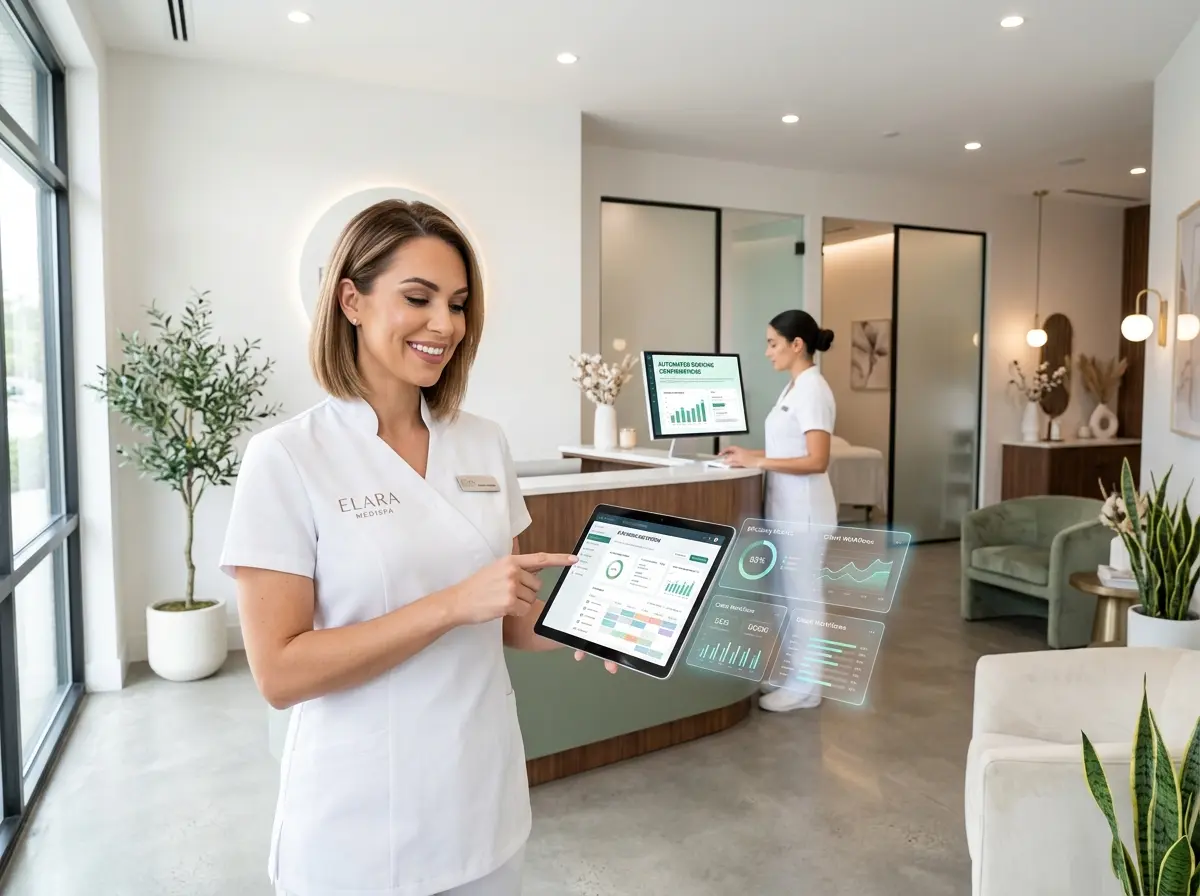
Automation without measurement is just hoping for the best with extra steps. Once you implement any new system, track the metrics that actually matter to your business: staff hours spent on administrative tasks per week, percentage of calls answered versus missed, client intake completion rates, and how up-to-date your client database is. These numbers give you a real baseline and let you quantify the ROI of every tool you bring in.
The med spa that inspired this post tracked these numbers carefully. Over 90 days, they reduced administrative work by 60%, dropped their missed call rate to nearly zero, and — perhaps most tellingly — reported that their front desk staff were noticeably less frazzled by midday. That last one doesn't show up in a spreadsheet, but it absolutely shows up in client experience.
A Quick Reminder About Stella
Stella is an AI robot employee and phone receptionist that works around the clock — greeting in-store visitors, answering calls, collecting intake information, managing client contacts, and promoting your services without ever needing a coffee break or a pep talk. She runs on a straightforward $99/month subscription with no upfront hardware costs and is built to get up and running quickly. For med spas looking to cut administrative overhead without cutting staff morale, she's worth a serious look.
Start Small, Move Fast, and Stop Doing Things the Hard Way
The med spa industry is competitive, margin-sensitive, and increasingly dependent on the client experience to differentiate one business from another. You cannot afford to have your best people buried in administrative busywork when they could be delivering exceptional treatments and building the kind of client loyalty that drives referrals.
Here's what you can do this week to start moving in the right direction:
- Track your time for five business days. Have each staff member log how their hours are divided between administrative tasks and client-facing work. The data will speak for itself.
- Identify your top five recurring phone questions. These are the ones that get asked multiple times per day and require no real judgment to answer. These should be automated first.
- Audit your intake process. Is it conversational and easy? Or is it a barrier clients have to push through? If it's the latter, it's costing you completions and client goodwill.
- Evaluate your CRM honestly. If your client database requires constant manual maintenance to stay accurate, you have a structural problem — not a staffing one.
- Explore AI tools built for your context. The technology exists, it's affordable, and the med spas using it are pulling ahead of the ones still running on clipboards and charm alone.
A 60% reduction in administrative work isn't a fantasy — it's a documented result from a real business that decided to stop accepting inefficiency as a normal cost of operations. Your staff didn't get into the aesthetics industry to answer the phone all day. Give them their time back, and watch what they do with it.