You're Paying for Clicks. Are You Getting Consultations?
Let's set the scene: You've launched a Google Ads campaign for your med spa. The clicks are rolling in, your cost-per-click looks reasonable, and your dashboard is full of satisfying little upward-trending graphs. You feel like a marketing genius. Then you check your actual booked consultations and hear... crickets.
Welcome to one of the most common (and expensive) frustrations in med spa marketing. Google Ads can be an absolute powerhouse for driving new clients — Botox seekers, laser enthusiasts, people who Googled "how to look 10 years younger without anyone knowing" at 11pm — but only if your campaigns are built to convert, not just to collect clicks. There's a meaningful difference between someone clicking your ad out of curiosity and someone actually picking up the phone or booking a consultation. The gap between those two actions is where most ad budgets quietly go to die.
This guide is here to close that gap. Whether you're managing ads yourself or overseeing an agency, these strategies will help your Google Ads campaigns work harder — and smarter — for your med spa.
Building Campaigns That Attract the Right People
The first step to getting more consultations isn't spending more money — it's spending it on the right people. A click from someone who just wants to know "what is CoolSculpting" is not the same as a click from someone searching "CoolSculpting consultation near me." One is a curious browser. The other is a potential client with their wallet already warming up.
Intent-Based Keyword Strategy
High-intent keywords are the backbone of any med spa Google Ads campaign worth its budget. These are search terms that signal a person is ready to act — not just research. Think phrases like "Botox specials [your city]," "lip filler appointment near me," or "best med spa for microneedling [neighborhood]." These convert at dramatically higher rates than broad, informational keywords.
Equally important is your negative keyword list. If your ads are showing up for searches like "DIY chemical peel" or "med spa jobs," you're burning money on people who are never going to book with you. Regularly auditing your search term reports and adding irrelevant queries to your negative keyword list is one of the highest-ROI habits you can build in paid search.
Audience Targeting and Match Types
Broad match keywords might seem appealing because they cast a wide net, but in med spa advertising, they often cast that net into a very wrong pond. Phrase match and exact match give you more control over who sees your ads. Layer in audience targeting — such as in-market audiences for beauty services or remarketing lists of past website visitors — and you'll start reaching people who are genuinely on the path to booking.
Google's Customer Match feature also lets you upload your existing client list so you can target (or exclude) them strategically. Running a campaign to win back lapsed clients? That's a smart use of Customer Match. Running a new client acquisition campaign and accidentally showing ads to people who already booked last week? Less smart.
Location Targeting That Actually Makes Sense
Med spas are local businesses. There's rarely a reason to target an entire state when your clients are mostly driving from a 15-mile radius. Tighten your geographic targeting, use bid adjustments to prioritize zip codes closer to your location, and consider excluding areas where conversion rates are historically low. Hyper-local campaigns consistently outperform broad geographic campaigns in the aesthetics industry — because convenience is a genuine factor when someone is choosing where to get their filler done.
What Happens After the Click — And Why It Matters More Than You Think
Here's a truth that's hard to hear: even a perfectly targeted, beautifully written ad can fail if what comes after the click is a mess. Your landing page, your response time, and your intake process are the silent killers of consultation conversion rates. People searching for med spa services are often comparing multiple options simultaneously. If your competitor answers the phone and you don't, you just lost that lead — even if your ad was better.
Landing Pages Built to Convert
Sending ad traffic to your homepage is a classic mistake. Your homepage is designed for browsing. A landing page is designed for one thing: getting that person to take a specific action. For a med spa, that means a page with a clear headline, a compelling offer (a free consultation, a first-time discount, a quick-response promise), minimal distractions, and a simple form or prominent phone number. A/B test your headlines, your call-to-action buttons, and your form length. Even small changes can produce double-digit lifts in conversion rates.
How Stella Can Help Convert Leads Into Booked Consultations
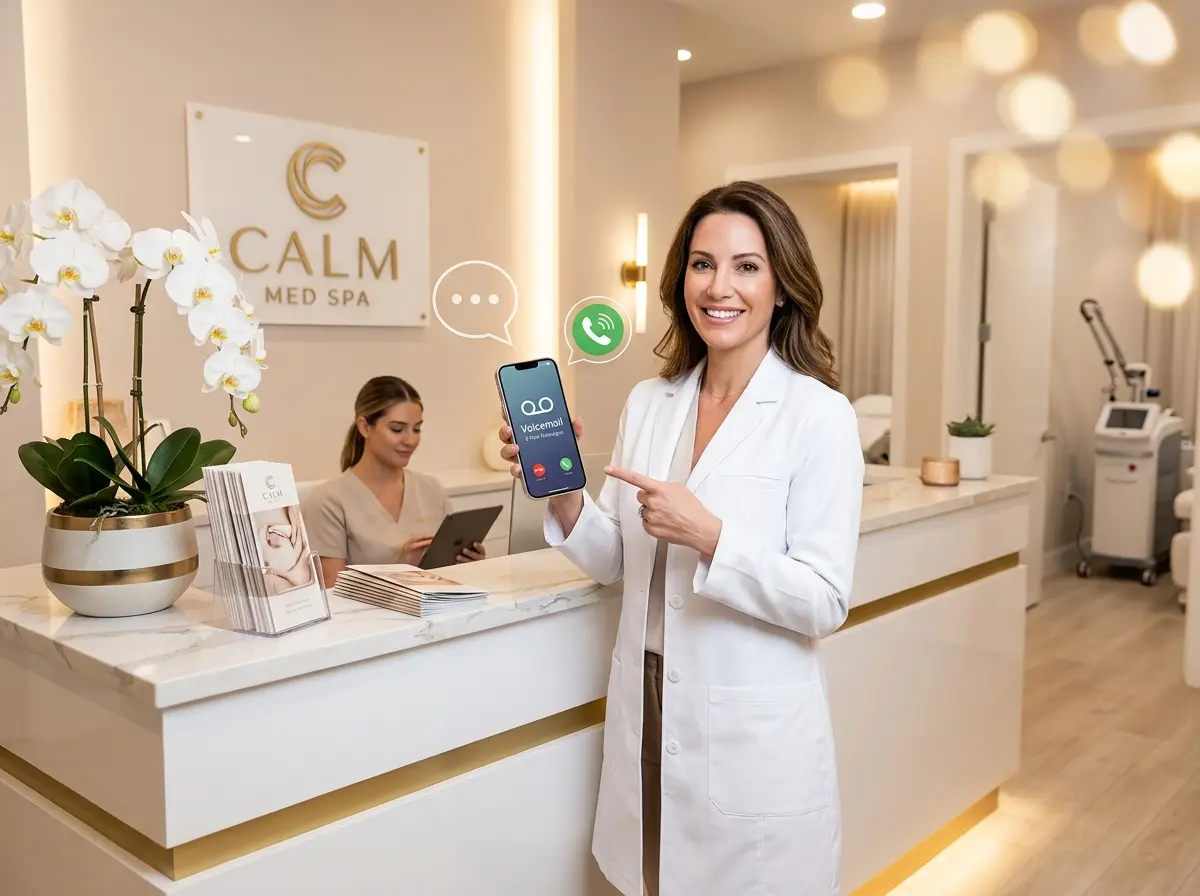
This is where a lot of med spas quietly lose the race. A potential client clicks your ad, gets excited, calls your number — and hits voicemail during a busy treatment hour. That lead is probably gone. Stella, the AI robot employee and phone receptionist, answers every call, 24/7, with the same knowledge your best front desk staff would have. She can answer questions about services, pricing, promotions, and availability — and collect intake information conversationally so your human team starts each consultation already knowing what the client needs.
For med spas with a physical location, Stella also works as an in-store kiosk, greeting walk-ins and engaging them proactively about current specials — turning curious foot traffic into booked appointments. At just $99/month with no upfront hardware costs, she's a practical addition to any practice serious about converting their marketing investment into real revenue.
Writing Ads That Actually Make People Want to Book
Assuming your targeting is dialed in and your landing page is solid, the ad copy itself needs to do some heavy lifting. It needs to speak directly to what your ideal client wants, address the hesitations they might have, and give them a compelling reason to click your ad instead of the seven others on the page.
Lead With Benefits, Not Services
Nobody wakes up and thinks, "I want to purchase a series of IPL photofacial treatments." They wake up and think, "I want to look less tired" or "I want to get rid of these sun spots before my reunion." Your ad copy should speak to the outcome, not the procedure. "Look refreshed and radiant — book your consultation today" will outperform "IPL Photofacial Treatments Available" almost every time. Features inform; benefits persuade.
Use Ad Extensions Like You Mean It
Google's ad extensions are free real estate that most small businesses dramatically underuse. Sitelink extensions let you highlight specific services (Botox, fillers, laser treatments) with individual links. Callout extensions let you add trust signals like "Board-Certified Providers," "Same-Week Appointments," or "Free Consultations." Call extensions put your phone number directly in the ad. Location extensions show your address and distance. Using all relevant extensions increases your ad's visual footprint and gives potential clients more reasons — and more ways — to engage before they even reach your site.
Test, Measure, and Don't Fall in Love With Your First Draft
The best-performing med spa Google Ads campaigns are never "set and forget." They're living, breathing things that get tested and refined over time. Run at least two to three headline variations per ad group. Monitor your click-through rates, conversion rates, and cost-per-conversion — not just impressions and clicks. Track phone calls as conversions (Google's call tracking makes this relatively painless). And if something isn't converting after a statistically meaningful sample, cut it without sentimentality. Your budget will thank you.
A Quick Reminder About Stella
Stella is an AI robot employee and phone receptionist built for businesses like yours. She answers calls around the clock, greets in-store visitors, promotes your services and specials, and collects client information — all without breaks, bad days, or turnover. At $99/month, she's one of the most affordable ways to make sure your marketing dollars don't go to waste when a lead actually tries to reach you.
Put It All Together and Watch Your Consultations Climb
Running Google Ads for a med spa isn't complicated in theory — but it requires attention to every link in the chain. The right keywords attract the right people. The right landing pages give those people a reason to act. Fast, professional follow-up (whether human or AI-powered) ensures that interest doesn't evaporate. And well-written, benefit-focused ads with strong extensions make sure you're earning the click in the first place.
Here's your action plan: Start by auditing your current keyword list for intent and eliminating wasteful spend on irrelevant queries. Build or refine a dedicated landing page for your top service. Activate all relevant ad extensions if you haven't already. Set up call tracking so you actually know which campaigns are driving consultations versus just traffic. And make sure someone — or something — is answering when those calls come in.
The med spas winning at Google Ads aren't necessarily spending more than their competitors. They're just making smarter decisions at every step of the funnel. Now you have the roadmap. The only question left is whether you're going to use it.