From Crickets to Credibility: How One Plumber Changed Everything
Let's paint a picture. You're a homeowner with a burst pipe at 11 PM, frantically Googling "plumber near me." Two companies pop up. One has 200 reviews and a solid 4.8-star rating. The other has 10 reviews and a 3.9. Which one are you calling? Exactly. You didn't even need a second to think about it.
This is the reality that Marcus, owner of a mid-sized residential plumbing company, faced when he realized his Google Business Profile looked like a ghost town. He was doing great work — genuinely excellent work — but his online presence told a completely different story. His competitors, some of whom were frankly not as skilled, were drowning in five-star reviews while he sat quietly at a modest 10. The problem wasn't his plumbing. The problem was that nobody was asking for reviews, and customers — bless their hearts — almost never leave them on their own.
So Marcus did something about it. He built an automated review request campaign, stayed consistent for 12 months, and ended the year with over 200 Google reviews and a transformed local search presence. Here's exactly how he did it, and how you can too — no matter what industry you're in.
Why Most Businesses Are Losing the Review Game (Without Even Knowing It)
The Forgetting Problem Is Real
Research consistently shows that around 72% of customers will leave a review if simply asked — yet the vast majority of businesses never ask at all, or they ask once, awkwardly, in person, and then never follow up. Marcus was guilty of exactly this. His technicians would occasionally mention "hey, feel free to leave us a Google review" at the end of a job, but there was no system, no follow-up, and no consistency. Some customers genuinely intended to leave a review and then got distracted by literally anything else in their lives. A child needed feeding. A show started. The moment passed. Without a structured reminder, that review was gone forever.
Timing Is Everything
Another critical issue is timing. Ask for a review too soon — say, while the technician is still under the sink — and it feels transactional and awkward. Ask too late — three weeks after the job — and the emotional peak of "wow, my plumbing works again!" has completely faded. The sweet spot is typically within 24 to 48 hours of service completion, when the customer still remembers the experience vividly and the goodwill is fresh. Marcus's old approach had no timing strategy whatsoever. His campaign changed that completely.
Volume Beats Perfection
Here's something most business owners don't realize: a 4.6-star rating with 200 reviews is significantly more trustworthy to potential customers than a 5.0-star rating with 8 reviews. Consumers are smart. They know a perfect score with a handful of reviews could mean anything. But 200 reviews with a strong average? That's social proof at scale. The goal of Marcus's campaign wasn't perfection — it was volume, consistency, and authenticity. He wasn't coaching customers on what to say. He was simply making it easy for satisfied customers to do what they already wanted to do.
Building the Automated Review Request Campaign Step by Step
The Workflow That Did the Heavy Lifting
Marcus partnered with a local marketing consultant to set up a simple but powerful automation using his existing job management software and an email/SMS platform. The workflow was straightforward: when a job was marked "complete" in his system, the customer's contact information triggered an automated sequence. Within 24 hours, the customer received a personalized SMS — not a generic blast, but a message that referenced the specific service performed — thanking them and including a direct link to his Google review page. No hunting for the right page. No extra steps. One tap and they were there.
If the customer didn't engage with the SMS within three days, a follow-up email went out. Friendly, not pushy. Something like: "We just wanted to make sure everything is still working perfectly — and if you have a moment, we'd love to hear your thoughts." That two-touch sequence alone accounted for the majority of his new reviews.
How Stella Helped Streamline Customer Data Collection
One challenge Marcus ran into early on was inconsistent customer data. Sometimes a job would be completed, but the contact record was missing an email address or had an outdated phone number — making the automation useless for that customer. This is where Stella, the AI robot employee and phone receptionist, made a meaningful difference for his operation.
When customers called to book a job, Stella handled the intake process conversationally, collecting name, address, phone number, email, and service details through her built-in intake forms — all of which fed directly into her CRM. No more missing emails. No more illegible handwritten notes from whoever answered the phone that day. Every customer record was clean, complete, and ready for the automation to work its magic. For a business that lives and dies by its ability to follow up, that kind of data hygiene is worth its weight in gold.
What Made the Campaign Actually Work Over 12 Months
Consistency Over Intensity
The single most important factor in Marcus's success wasn't the cleverness of his messaging or the particular platform he used. It was consistency. He didn't run the campaign for a month, get excited about the results, and then let it fall apart. The automation ran in the background, quietly doing its job every single day, for an entire year. He averaged roughly 15 to 20 completed jobs per month, and with a conversion rate of around 30% on his review requests, that meant five to seven new reviews coming in regularly. That kind of steady accumulation is what turns 10 reviews into 200 over time — no viral moments required.
Responding to Every Review — Good and Bad
Marcus made one additional commitment that amplified the campaign's effectiveness: he responded to every single review, personally. Not with a copy-paste template, but with a genuine acknowledgment that showed he read what the customer wrote. For positive reviews, he thanked them by name and mentioned something specific. For the occasional negative review — yes, a few came in — he responded calmly, professionally, and with a direct offer to make things right.
This matters more than most people think. Potential customers read the responses just as much as the reviews themselves. A business owner who engages thoughtfully with feedback signals trustworthiness and accountability. And according to Google, businesses that respond to reviews are seen as 1.7 times more trustworthy than those that don't. Marcus turned his review section into a living demonstration of his customer service — and it showed in his conversion rate from profile views to actual calls.
The Results After 12 Months
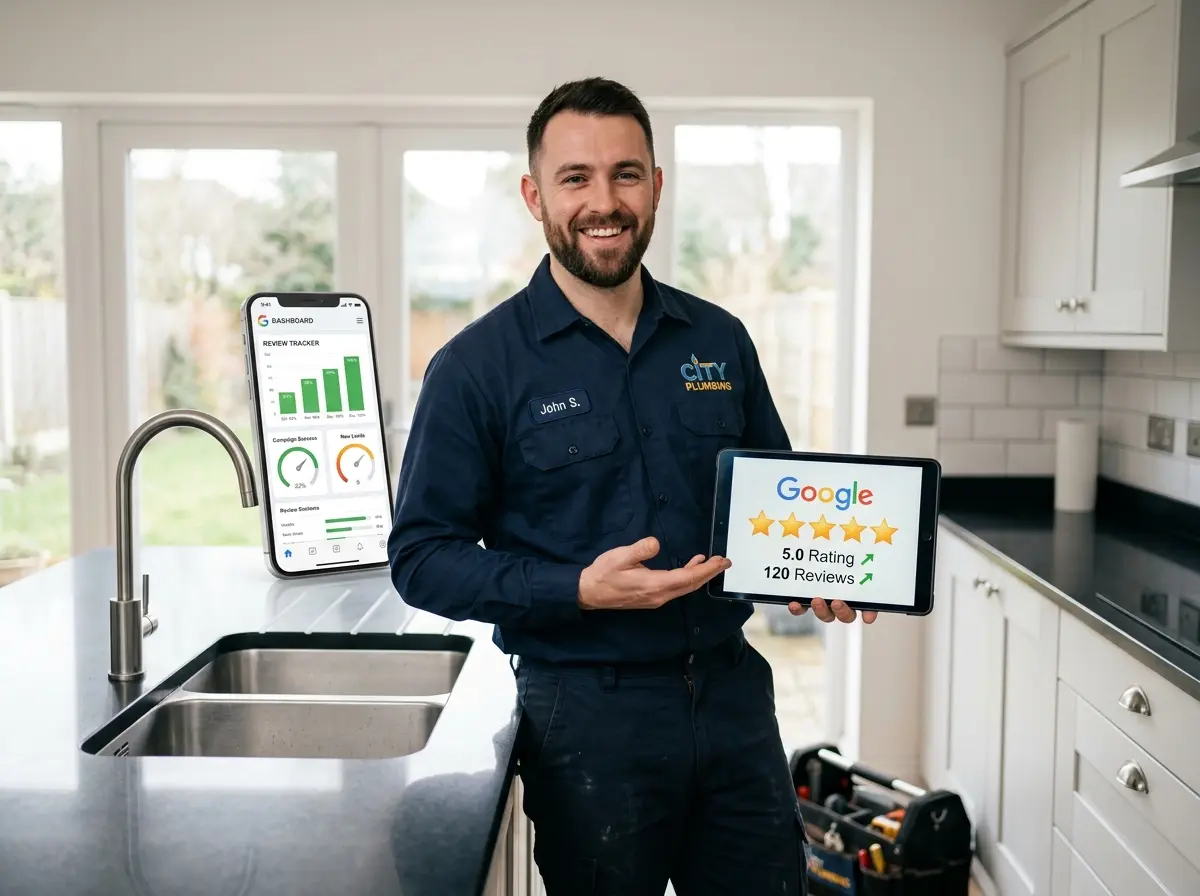
By the end of the year, Marcus had gone from 10 reviews to just over 200. His average rating settled at a very respectable 4.7 stars. His Google Business Profile views increased by over 300%, and inbound calls from new customers — people who found him through local search — nearly doubled. He hadn't changed his prices, hadn't hired additional staff for marketing, and hadn't spent thousands on ads. He'd simply built a system that made it easy for happy customers to tell the world what they already thought. The automation did the asking. He did the work. The reviews took care of the rest.
Quick Reminder About Stella
Stella is an AI robot employee and phone receptionist that greets customers in-store, answers calls 24/7, collects customer information through conversational intake forms, and manages contacts through a built-in CRM — all for just $99/month with no upfront hardware costs. Whether you're a plumber, a salon owner, or a multi-location retailer, she handles the front-end details so your team can focus on delivering the kind of service that earns five-star reviews in the first place.
Your Next Steps Toward 200 Reviews
Marcus's story isn't a fluke — it's a formula. And the good news is that you don't need to be a tech wizard or hire an expensive agency to replicate it. Here's how to get started:
- Audit your current review situation. How many Google reviews do you have right now? What's your average rating? What does a competitor with significantly more reviews look like? Use that as your benchmark and your motivation.
- Clean up your customer data. Before any automation can work, you need reliable contact information for your customers. Implement a process — whether through Stella's intake forms, your booking system, or a manual checklist — to ensure every customer record includes both a phone number and email address.
- Set up a two-touch automated sequence. SMS within 24 to 48 hours of service completion, followed by an email three days later if there's no engagement. Keep the message personal, brief, and include a direct link to your Google review page. Remove every possible obstacle between the customer and the submit button.
- Commit to responding. Block 15 minutes per week to respond to new reviews. It takes almost no time and delivers outsized trust signals to everyone who reads your profile afterward.
- Run it for a full year. Resist the urge to evaluate results after six weeks. Review accumulation is a long game, and the compounding effect of consistency is where the real magic happens.
The plumbers, dentists, auto shops, and salons dominating your local search results aren't necessarily better than you. In many cases, they've simply figured out that asking for reviews, systematically and persistently, is a business strategy — not an afterthought. Marcus figured that out. Now it's your turn.