When Your Salon Closes, Your Competitors Don't
Here's a scenario that plays out thousands of times every night across the beauty industry: A potential client — let's call her Maya — finishes a long day at work, pours herself a glass of wine, and finally has a moment to think about booking that color appointment she's been putting off. It's 9:47 PM. She picks up her phone, calls your salon, and gets... voicemail. So she hangs up, scrolls Instagram for thirty seconds, and books with the salon three blocks away that had an online form. You never even knew Maya existed.
If that stings a little, it should. Because the uncomfortable truth is that a significant chunk of your potential clientele is shopping for services outside of your business hours. According to various consumer behavior studies, nearly 40% of service bookings happen outside of traditional working hours. That's not a rounding error — that's a revenue category.
The good news? You don't need to hire a night-shift receptionist or chain yourself to your phone until midnight. What you need is a smarter intake system — one that works while you sleep, captures lead information conversationally, and hands you a tidy summary in the morning. This post breaks down exactly how busy salons are doing it.
Why After-Hours Leads Are Slipping Through the Cracks
The Voicemail Black Hole
Let's be honest about voicemail: it is a graveyard for good intentions. Clients leave rambling, vague messages. Staff listen to them between appointments. Details get misheard or forgotten. The callback happens hours later — sometimes the next day — and by then the client has moved on. Voicemail made sense in 1987. In today's world, where people expect instant acknowledgment, it's a friction point you simply cannot afford.
The issue isn't just that voicemail is slow. It's that it creates a one-sided experience where the client does all the work — leaving their information, their request, their availability — and then has no idea if anyone received it or when they'll hear back. That uncertainty is where leads go to die.
The "I'll Just Book Online" Myth
Many salon owners respond to the after-hours problem by pointing to their online booking system. And yes, online booking is great — but it only works for clients who are already motivated enough to navigate your website, find the right service, pick a stylist, choose a time, and complete the process. That's a lot of steps for someone who's still on the fence.
What about the person who has a quick question first? What about the client who wants to know if your balayage specialist has any openings before they commit? Those people don't complete your booking form — they call. And when nobody answers, they leave. A text-based intake system bridges this gap by meeting uncertain clients exactly where they are, answering basic questions, and collecting their information in a low-pressure, conversational way.
What "After-Hours Leads" Actually Looks Like
Not every after-hours contact is a ready-to-book client. Some are price shoppers. Some are curious first-timers. Some are existing clients with a quick question about their upcoming appointment. A smart intake system doesn't just collect phone numbers — it collects context. What service are they interested in? Are they a new or returning client? What's their preferred time of day? This information transforms a raw lead into something actionable, so when your team arrives in the morning, they're not starting from zero.
How Stella Fits Into a Salon's After-Hours Strategy
A Phone Receptionist That Never Clocks Out
This is where Stella becomes genuinely useful for salons. When a client calls after hours, Stella answers — not with a robotic phone tree, but with a natural, conversational AI that knows your services, your pricing, your hours, and your current promotions. She can answer common questions, handle intake, and collect the client's name, contact information, service interest, and preferred availability — all through a friendly, text-based or voice-based interaction depending on how you configure her.
For salons with a physical location, Stella also operates as an in-store kiosk during business hours, greeting walk-ins, promoting specials, and answering questions so your stylists can focus on the client in their chair rather than the one lingering at the front desk. Her built-in CRM captures all intake information with AI-generated client profiles, custom tags, and notes — so every lead that comes in after hours is organized and ready for follow-up, not buried in a voicemail queue.
Building a Text-Based Intake System That Actually Works
Design for Conversation, Not Interrogation
The biggest mistake salons make when setting up intake forms — text-based or otherwise — is treating them like a DMV application. Name. Phone. Email. Service. Submit. It's clinical, it's cold, and it communicates nothing about your brand. A conversational intake system, by contrast, feels more like a quick chat. It asks one question at a time, acknowledges responses naturally, and adapts based on what the client says.
For example, instead of a static form field that says "Preferred Service," a conversational intake might say: "Are you thinking about a color service, a cut, or something else entirely? No worries if you're not sure yet — we can help you figure it out." That single line of copy does three things: it gives options, it removes pressure, and it sounds human. That's the difference between a lead who completes the intake and one who abandons it halfway through.
Capture the Right Information Without Overwhelming People
You don't need their life story — you need enough to have a productive follow-up conversation. For most salons, a solid after-hours intake should capture the following:
- Name and preferred contact method (phone or text — don't assume)
- Service interest (even a rough category is helpful)
- New or returning client (this changes your entire follow-up approach)
- Preferred days or times (so your first callback already has options ready)
- Any specific questions or notes (optional, but gold when clients volunteer it)
That's five data points. A well-designed conversational system can collect all five in under two minutes without the client feeling like they're filling out a mortgage application. Keep it tight, keep it friendly, and always confirm that someone will be in touch — and by when. That last part is critical. Clients who know what to expect are far less likely to go book elsewhere while they wait.
Close the Loop Automatically — and Fast
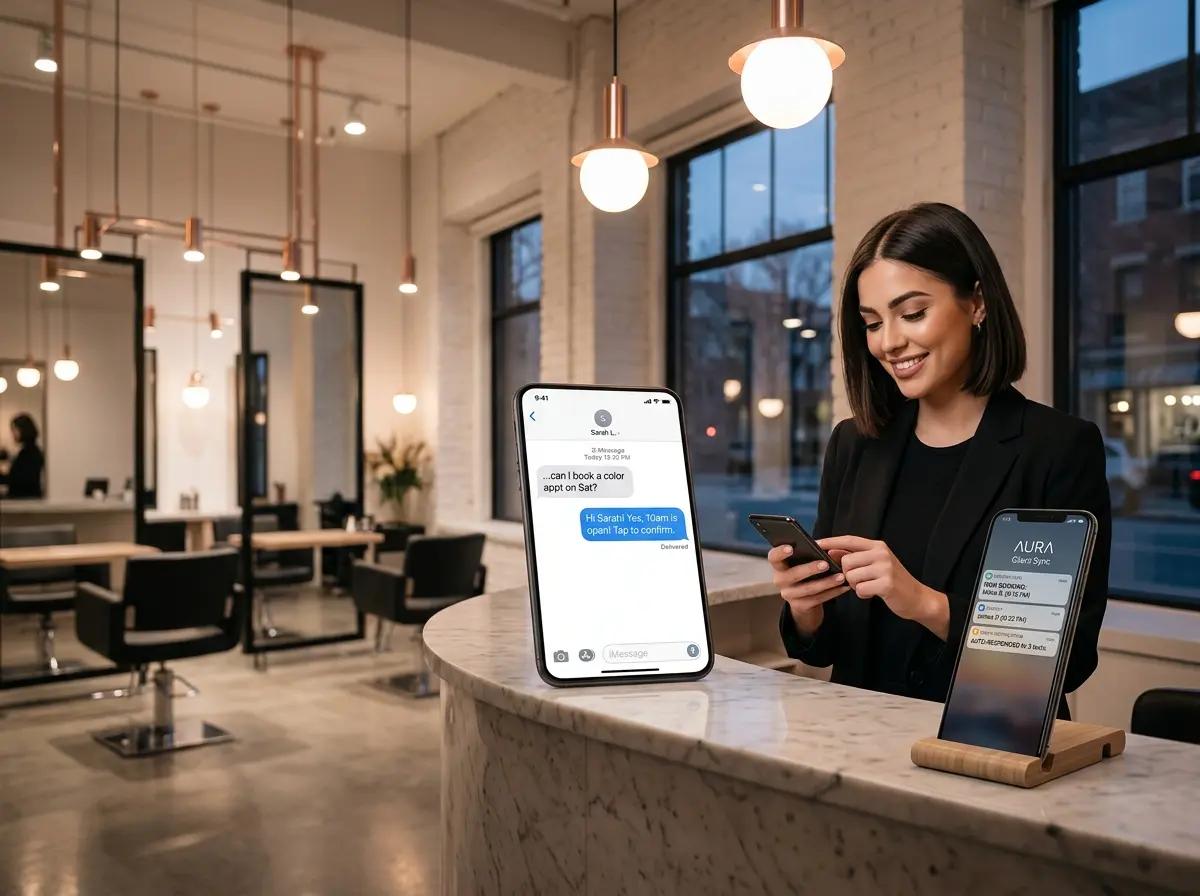
An intake system without a follow-up protocol is just an expensive contact form. The real power of text-based intake is what happens immediately after the client submits their information. At minimum, they should receive an automatic confirmation message that acknowledges their inquiry, sets a realistic expectation for response time, and ideally includes something valuable — a link to your service menu, a current promotion, or a warm note about what to expect when they come in.
On your end, the intake should trigger a push notification to the appropriate staff member so that no lead sits cold for twelve hours. The faster your team follows up — ideally within the first hour of opening — the higher your conversion rate will be. Research consistently shows that response time is one of the strongest predictors of lead conversion in service-based businesses. First impressions don't just happen in person anymore. They happen in your response time.
Quick Reminder About Stella
Stella is an AI robot employee and phone receptionist built for businesses exactly like yours — she answers calls 24/7, runs as an in-store kiosk, and manages intake, lead capture, and client information through a built-in CRM, all for $99/month with no upfront hardware costs. She's the after-hours team member who never calls in sick, never misses a lead, and never needs a coffee break. For salons serious about capturing every possible client inquiry, she's worth a serious look.
Turn After-Hours Inquiries Into Monday Morning Bookings
The salons winning right now aren't necessarily the ones with the best stylists or the prettiest Instagram feeds — they're the ones that make it easy to become a client. That means being reachable when clients are actually thinking about booking, collecting their information in a way that doesn't feel like homework, and following up fast enough that they haven't already committed elsewhere.
Here's where to start if you're building or improving your after-hours intake system:
- Audit your current after-hours experience. Call your own salon at 9 PM and see what happens. You might be surprised — or horrified.
- Map out the five essential intake data points and design your intake flow around collecting those conversationally.
- Set up an automatic confirmation response so clients know their inquiry landed somewhere real.
- Create a morning follow-up protocol so your team knows exactly who to call and in what order when they arrive.
- Explore AI-powered tools that can handle intake, answer common questions, and keep your CRM updated without adding to your team's workload.
Maya is out there right now, glass of wine in hand, trying to book an appointment. The only question is whether she's going to book with you — or with whoever answers first.