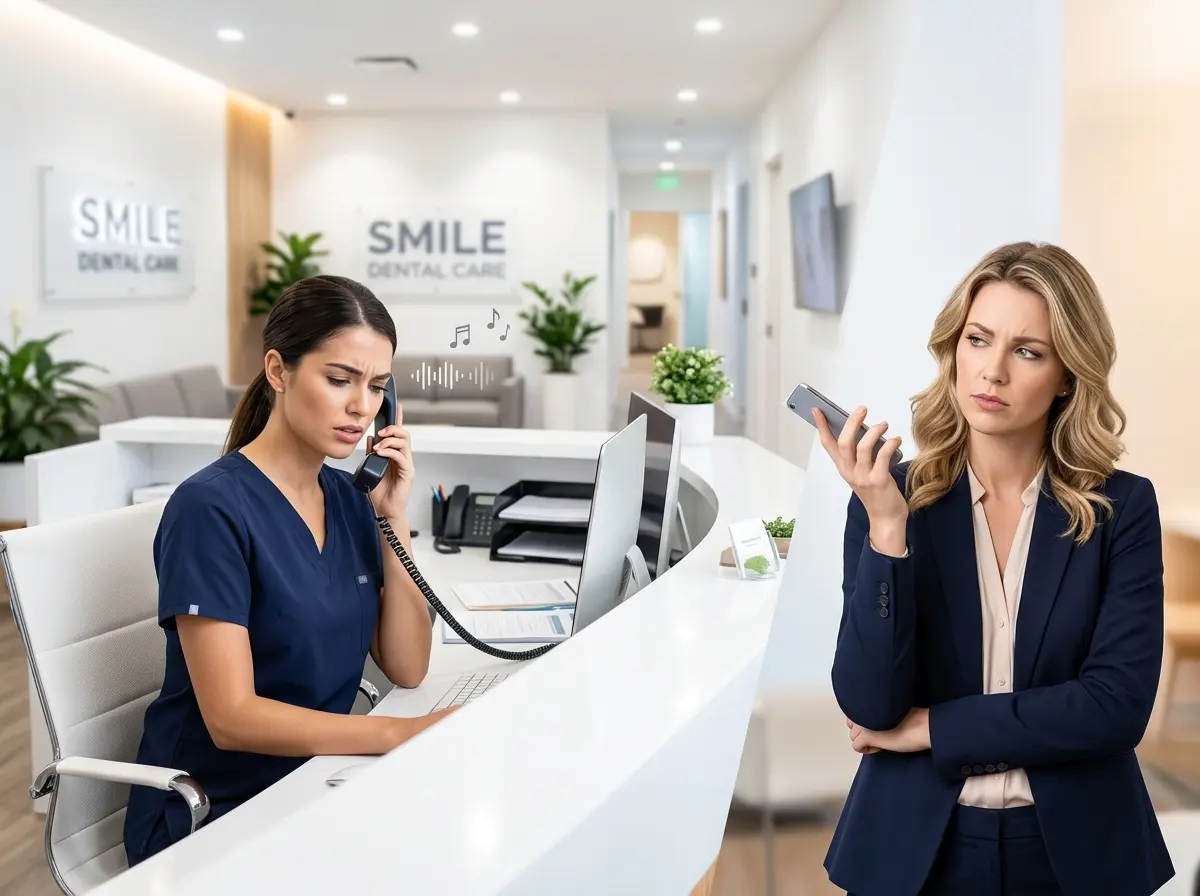
Your Hold Music Is Not the Problem — But It Kind of Is
Picture this: a potential new patient finally gets around to calling your dental practice. They've been putting it off for weeks (it's dentistry, after all — nobody's rushing to the phone). They dial. Someone picks up, says "please hold," and then... Kenny G. Or worse, a radio station with actual commercials for your competitors. Forty-five seconds later, they hang up and book somewhere else.
Now, you might think the hold music is the villain here. It's not — not exactly. The real problem is that your front desk is overwhelmed, callers are being placed on hold in the first place, and the entire phone experience from first ring to booked appointment is leaking new patients like a cracked molar leaks sensitivity. The hold music is just the final indignity.
New patient phone calls are arguably the most valuable calls your practice receives. Research from the dental industry consistently shows that practices miss or mishandle a significant portion of new patient calls — some studies suggest upwards of 25–35% of calls go unanswered or result in no appointment. That's not a small problem. That's a waiting room that never fills up.
The good news? This is entirely fixable. Let's talk about why dental practices lose new patients on the phone and what you can do about it.
The Phone Experience Is a First Impression — Treat It Like One
First Contact Sets the Tone for the Entire Patient Relationship
In dentistry, trust is everything. Patients are letting someone put sharp metal objects in their mouths — they need to feel comfortable before they even walk through the door. That trust-building starts the moment they pick up the phone. A rushed, distracted, or absent receptionist signals chaos. A smooth, warm, informative call signals a practice that has it together.
Think about what a new patient is actually trying to accomplish during that first call. They want to know if you're accepting new patients, whether you take their insurance, what your availability looks like, and whether you seem like a place they won't dread walking into. If any of those questions go unanswered — because they got put on hold, reached voicemail, or spoke to someone clearly juggling three other things — the conversion is at serious risk.
The Hidden Cost of Missed and Mishandled Calls
Here's a number worth sitting with: the lifetime value of a dental patient is typically estimated between $3,000 and $10,000 depending on treatment history and family size. When a new patient call goes unanswered on a Tuesday afternoon because your front desk is checking out two patients and confirming tomorrow's appointments simultaneously, you're not missing a phone call — you're potentially missing thousands of dollars in long-term revenue.
And it's not just the missed calls. It's the rushed calls, the ones where important questions don't get answered because the receptionist is distracted. It's the after-hours calls that go to a generic voicemail with no callback guarantee. It's the calls where the patient asks about a teeth whitening promotion they saw on your website and the front desk has no idea what they're talking about. Every friction point is a reason for a prospective patient to say "maybe I'll try someone else."
What a Great First Call Actually Looks Like
A high-converting new patient call answers key questions confidently, communicates warmth and professionalism, gathers the patient's basic information, and ends with a scheduled appointment — or at minimum, a clear next step. It doesn't require the caller to repeat themselves, wait on hold while someone finds the schedule, or navigate a phone tree that feels like it was designed in 2003. Simple, right? The challenge is delivering that experience consistently across every call, every day, including evenings, weekends, and those chaotic Monday mornings when half your staff is running late.
A Smarter Front Line for Your Dental Practice
How AI Phone Answering Can Plug the Gaps
This is where Stella, the AI robot employee and phone receptionist, becomes genuinely relevant to your practice. Stella answers calls 24/7 with the same knowledge your best front desk staff would have — information about services, insurance policies, hours, new patient promotions, and more. She can collect new patient intake information conversationally over the phone, so by the time a patient walks in, you already have what you need. Her built-in CRM logs and organizes every interaction, creating AI-generated patient profiles with tags, notes, and summaries that your team can actually use.
For practices with a physical location, Stella also operates as an in-office kiosk — greeting patients when they arrive, answering questions about services or current promotions, and reducing the interruption load on your front desk. The combination of consistent phone coverage and in-person engagement means fewer dropped balls and a more polished experience across every touchpoint.
Fixing the Conversion Funnel From Ring to Booked Appointment
Stop Letting After-Hours Calls Die Quietly
Plenty of people call dental practices outside of business hours — evenings after work, Saturday afternoons, that oddly specific 7:12 AM when someone's tooth starts hurting and they panic. If your answer to those calls is a generic voicemail, you're leaving a significant number of new patient opportunities completely unattended. Even if you call back the next morning, the patient has often already found someone else or talked themselves out of going at all.
The fix here is straightforward: make sure your after-hours calls are handled with the same quality as your in-hours calls. That means having a system that can answer intelligently, provide real information, collect the caller's details, and either route urgent calls appropriately or ensure a prompt, informed callback. A voicemail dump is not a system — it's a hope.
Train Your Team on Phone Conversion, Not Just Phone Etiquette
There's a meaningful difference between answering the phone politely and actually converting a caller into a booked patient. Most dental front desk training focuses on the former. Phone conversion training focuses on things like:
- Asking the caller's name early and using it throughout the call
- Transitioning naturally from answering questions to offering an appointment
- Handling insurance uncertainty without losing the caller ("Let me look into that for you — in the meantime, can I grab your preferred days so we can get something tentatively on the calendar?")
- Never ending a call without a clear next step
- Recognizing and gently addressing hesitation rather than just accepting "I'll call back later"
These aren't complicated techniques, but they require intentional training and regular reinforcement. If your front desk team has never had a dedicated phone conversion conversation, that's a quick win waiting to happen.
Audit Your Own Phone Experience
When did you last call your own practice as a mystery shopper? If the answer is never, put it on your calendar for this week. Call during a busy period — late morning is usually peak chaos — and pay attention to every detail. How many rings before someone picks up? Are you placed on hold immediately? Does the person who answers know your current promotions? Do they ask for your name? Do they offer to schedule an appointment, or do they wait for you to ask?
You'll likely discover at least two or three specific friction points you didn't know existed. That's not a criticism of your team — it's a systems problem, and systems problems have solutions. Document what you find and use it to drive your training and technology decisions.
Quick Reminder About Stella
Stella is an AI robot employee who answers phone calls 24/7, handles in-office patient interactions from her kiosk, collects intake information through conversational forms, and keeps everything organized in a built-in CRM — all for $99/month with no hardware costs upfront. She's the front desk reinforcement your practice didn't know it needed, and she never asks to leave early on a Friday.
Your New Patient Pipeline Deserves Better Than Hold Music
The dental practices that are consistently growing their new patient numbers aren't necessarily spending more on advertising. Many of them have simply gotten very good at converting the calls and visits they're already getting. They've treated the phone experience as a core part of their patient acquisition strategy rather than an afterthought managed by whoever happens to be at the front desk.
Here's what you can do right now to start moving in that direction:
- Audit your current call experience by calling your own practice anonymously during peak hours.
- Identify your after-hours gap — find out how many calls you're receiving outside business hours and what's currently happening to them.
- Train your team on phone conversion, not just phone courtesy. Role-play common scenarios, especially the tricky ones like insurance questions and appointment hesitation.
- Consider AI phone support to handle overflow, after-hours calls, and consistent intake collection without adding headcount.
- Track your new patient call conversion rate so you have a baseline to improve against. You can't fix what you don't measure.
Your hold music isn't the problem — but if callers are hearing it, something upstream has already gone wrong. Fix the upstream, and you might be surprised how quickly your schedule starts to fill.