You're Paying for Clicks. Where Are the Patients?
Congratulations — your Google Ads campaign is running, your Meta ads are getting impressions, and your cost-per-click is looking reasonable. There's just one small problem: your schedule isn't filling up. You're generating traffic, burning budget, and somehow still staring at a half-empty appointment calendar. Sound familiar?
Here's the uncomfortable truth that most dental marketing agencies won't tell you upfront: getting a click is easy. Converting that click into a seated patient is an entirely different discipline. Paid advertising gets people to your door — metaphorically speaking — but if what's waiting on the other side of that click is a slow website, a confusing booking process, or a phone that rings into oblivion at 7 PM, you've just paid good money to lose a patient to the practice down the street.
The good news is that the leaks in your conversion funnel are almost always fixable. Let's walk through what's actually going wrong and, more importantly, what to do about it.
The Real Reasons Your Ads Aren't Converting
Your Landing Page Is Doing More Harm Than Good
Most dental practices make the mistake of sending paid ad traffic directly to their homepage. This seems logical — it's your website, after all — but it's one of the most reliable ways to waste ad spend. Your homepage is designed to serve everyone: existing patients, curious neighbors, job applicants, and people who just Googled the wrong thing. A prospective patient who clicked an ad for "affordable teeth whitening in Austin" doesn't want to navigate your full menu to figure out if you even offer that service.
Dedicated landing pages — ones that mirror the exact message of the ad, speak directly to the patient's concern, and have a single, clear call to action — routinely convert 2x to 5x better than generic homepages. That means if your landing page is already converting at 2%, a properly built one could get you to 6–10% without spending an extra dollar on clicks. Your landing page should answer three questions within five seconds: What is this? Is it for me? What do I do next? If it can't do that, your ad budget is essentially subsidizing your competitors.
You're Targeting the Right People at the Wrong Moment
Paid search works best when someone has intent — they're actively looking for a dentist right now. But many dental practices layer in broad audience targeting, interest-based social ads, or remarketing campaigns without adjusting their messaging to match where the person is in their decision-making journey. Someone who visited your website once while researching "how much do veneers cost" is not ready to see an ad that just says "Book Your Appointment Today." They need education, reassurance, and social proof first.
Segment your campaigns by intent level. Use search ads for high-intent queries like "dentist near me accepting new patients" and use social ads to nurture colder audiences with before-and-after results, patient testimonials, and answers to common questions. Treat your ad strategy like a conversation, not a cold sales pitch, and your conversion rates will follow.
Your Offer Isn't Compelling Enough to Act On
People are busy and mildly suspicious of dentists — no offense to the profession, it's just the nature of drills and invoices. If your ad offer is "Schedule a Consultation," you're asking someone to commit time and mental energy to something with no defined value. Compare that to "New Patient Special: Exam, X-Rays & Cleaning for $99" or "Free Smile Assessment — No Obligation." Suddenly there's a clear, low-risk reason to act now rather than closing the tab and forgetting you exist.
Strong offers reduce friction. They give the prospective patient a concrete reason to choose you over the seventeen other dental practices that also showed up in their search results. Audit your current ad offers and ask yourself honestly: would you click on this?
Plugging the Leaks: Where Stella Fits In
The Phone Is Still Your Most Important Conversion Tool — and Most Practices Ignore It
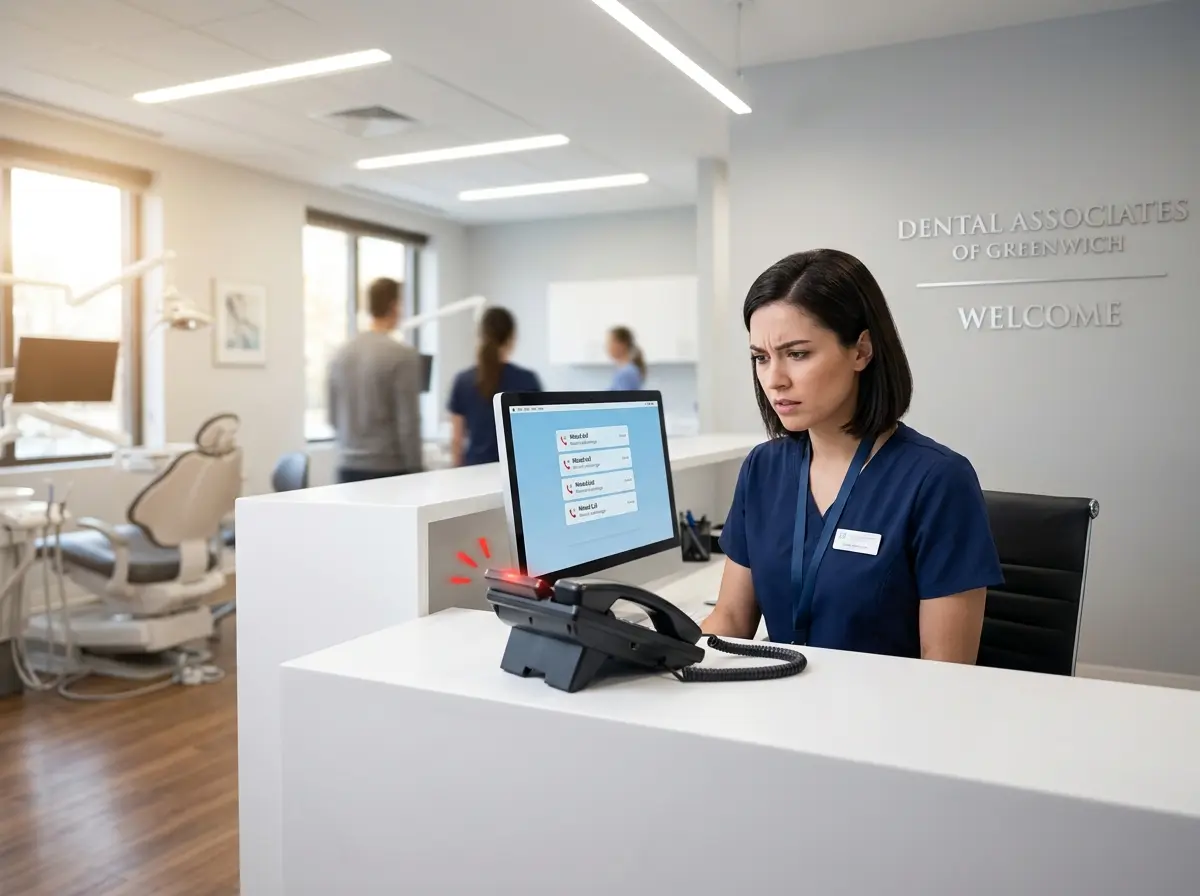
Here's a statistic that should make every dental practice owner put down their coffee: nearly 62% of dental patient calls go unanswered or are placed on hold long enough that the caller hangs up. You spent money on ads, got someone interested enough to pick up the phone, and then… nothing. Or worse, voicemail. In 2024, a prospective patient who hits voicemail at a dental office does not leave a message — they call the next practice on the list.
This is exactly where Stella earns her keep. Stella is an AI phone receptionist that answers calls 24/7 with the same knowledge a trained human receptionist would have — services, pricing, insurance questions, hours, new patient specials, and more. She can collect patient intake information conversationally during the call, forward calls to staff when needed, and ensure that no lead you paid to generate ever disappears into a voicemail black hole. For practices with a physical location, she also operates as a friendly in-store kiosk, greeting walk-ins and answering questions proactively. When your ads are running overnight or on weekends, Stella is still at her post, converting curious callers into booked appointments.
Optimizing the Full Patient Journey, Not Just the Ad
Make Booking Effortless
The moment a prospective patient decides they want to book, any friction you introduce between that decision and a confirmed appointment is a conversion killer. Online booking should be available, obvious, and functional on mobile — because the majority of your ad traffic is coming from smartphones. If your booking system requires creating an account, filling out a three-page form before the first appointment is even confirmed, or navigating a clunky portal that looks like it was designed in 2009, you're losing patients who were genuinely ready to commit.
Reduce the steps. Offer multiple booking options — phone, online form, text — so patients can choose what's comfortable for them. And make sure that whatever option they choose, someone (or something) responds quickly. Speed-to-response is one of the strongest predictors of conversion in healthcare. Studies consistently show that responding to a new patient inquiry within five minutes makes you dramatically more likely to book that patient than if you respond even thirty minutes later.
Use Reviews and Social Proof Strategically in Your Funnel
Your Google reviews are not just for reputation management — they're a conversion asset. A dental practice with 200 reviews and a 4.8-star average is going to convert paid traffic at a meaningfully higher rate than one with 40 reviews and a 3.9. Prospective patients are making fear-driven decisions; they need reassurance that you're safe, gentle, and worth the appointment.
Feature your best reviews directly on your ad landing pages. Use video testimonials in your social ad campaigns. Run a systematic process for requesting reviews from happy patients immediately after their visit — while the positive experience is fresh. This isn't just good marketing, it's closing the trust gap that prevents clicks from becoming patients.
Track What Actually Matters
If your definition of ad success is impressions and click-through rate, you're measuring the wrong things. The metrics that matter for a dental practice are cost per booked appointment and cost per new patient. Set up proper conversion tracking — including phone call tracking — so you know which campaigns, keywords, and ads are actually driving patients through your door versus which ones are just burning budget impressively. Google Analytics, call tracking software, and your practice management system should be talking to each other. If they're not, you're flying blind with someone else's money.
A Quick Reminder About Stella
Stella is an AI robot employee and phone receptionist designed to help businesses like dental practices never miss a lead, a call, or a conversation. She answers phones around the clock, greets in-person visitors, handles intake, and promotes your current offers — all for $99/month with no upfront hardware costs. If your ads are generating interest but your front desk isn't available to capture it, Stella bridges that gap reliably and professionally.
Turn Your Ad Spend into a Patient Pipeline
Paid advertising for dental practices works — but only when the entire system behind the click is built to convert. Getting someone to click your ad is the beginning of the job, not the end of it. Here's where to focus your energy starting today:
- Audit your landing pages. If you're sending traffic to your homepage, build dedicated pages for each campaign. Match the message, simplify the layout, and include a single clear call to action.
- Sharpen your offers. Give prospective patients a specific, low-risk reason to choose you now. New patient specials, free consultations, and defined service bundles outperform vague calls to action every time.
- Fix your phone response. Whether through staff scheduling adjustments, a dedicated after-hours solution, or an AI receptionist, make sure every call gets answered and every lead gets followed up with quickly.
- Build your review engine. More authentic five-star reviews lower your effective cost per acquisition because they increase conversion rates across your entire funnel.
- Track cost per patient, not just cost per click. Set up the measurement infrastructure to know what's actually working, and reallocate budget accordingly.
Paid advertising is a powerful tool for dental practices, but it rewards the practices that treat it as one piece of a complete patient acquisition system — not a magic button. Get the full experience right, and your click-to-patient conversion rate will start telling a very different story than it does today.