You Appreciate Your Clients — Now Prove It (and Get Some Referrals While You're at It)
Here's a truth that no one in the financial advisory world likes to say out loud: your clients have options. Lots of them. Between robo-advisors, big-box brokerages, and that one guy at the country club who swears he "knows a guy," the competition for client loyalty has never been more intense. So what separates the advisors who build generational client relationships from those who get ghosted after a market correction? Often, it comes down to something deceptively simple — making people feel genuinely valued.
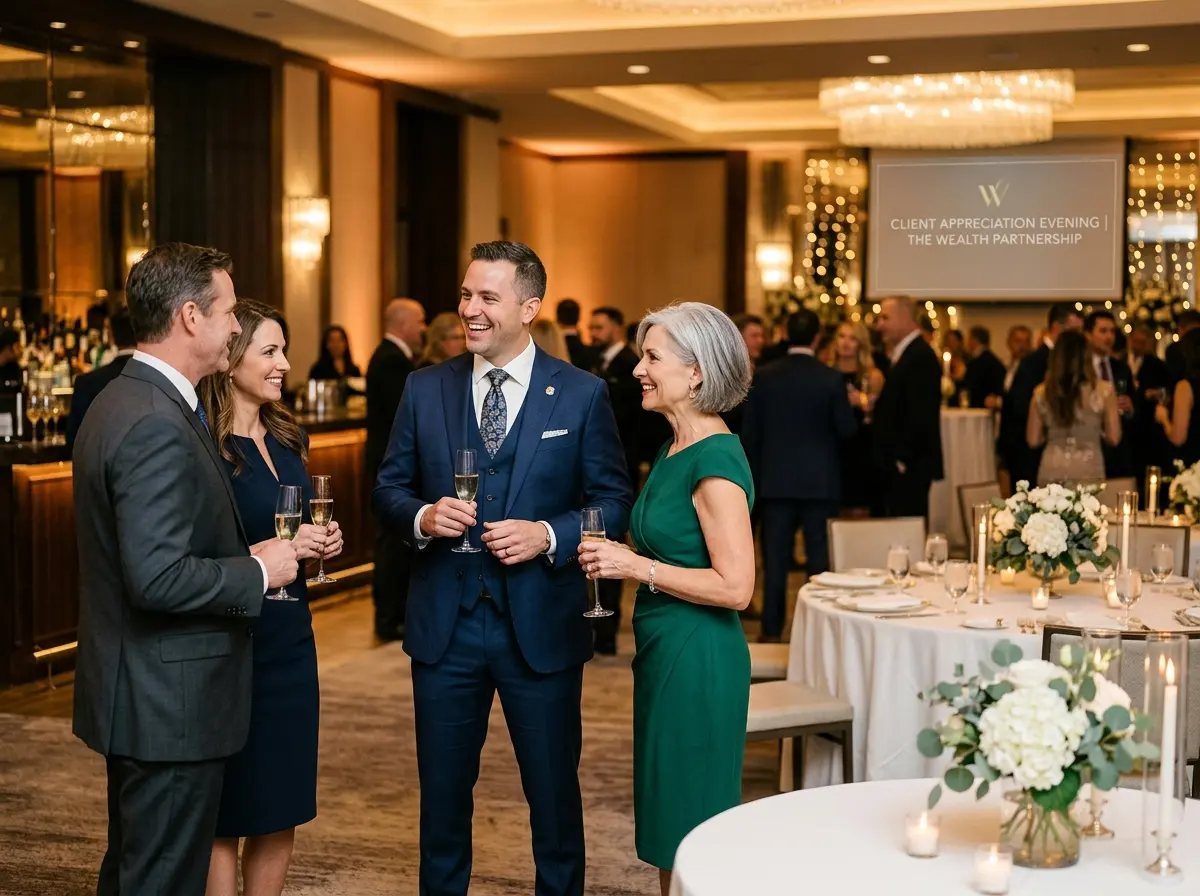
Enter the client appreciation event. Done right, these gatherings are not just a free excuse to eat mini quiches. They are relationship accelerators, referral engines, and brand-building opportunities all wrapped into one elegant evening (or afternoon, or morning — we don't judge). Done wrong, they're an expensive room full of awkward small talk and a cheese platter that cost more than your first car.
This guide will walk you through how to plan and execute client appreciation events that your clients actually enjoy — and that quietly, professionally, and effectively generate the referrals your practice needs to grow.
Planning an Event Worth Attending
The dirty secret of client appreciation events is that most of them are forgettable. A conference room, some boxed lunches, and a slideshow about portfolio diversification is not an event — it's a meeting with better sandwiches. To stand out, you need to be intentional from the very beginning.
Know Your Audience Before You Book the Venue
Your top clients are not a monolith. Some are retired empty-nesters who would love an evening wine tasting. Others are busy professionals who want something short, impactful, and close to downtown. Before you start calling venues, segment your client list by lifestyle, demographics, and relationship tier. A bourbon and cigars evening might be perfect for one segment and completely tone-deaf for another.
Consider hosting two or three smaller, targeted events rather than one big generic gathering. A cooking class for your younger professional clients, a golf outing for your retirees, and an educational lunch-and-learn for your business owner clients will resonate far more deeply than a one-size-fits-all cocktail hour. The goal is for every attendee to leave thinking, "They really get me." That feeling is the foundation of a referral.
Structure the Experience to Encourage Conversation
Referrals don't come from speeches — they come from conversations. Design your event so that clients naturally mingle, interact with your team, and feel comfortable bringing up their finances (or their friends who need financial help). Avoid formats that put everyone in rows staring at a screen. Instead, opt for roundtable dinners, interactive activities, or stations that naturally spark discussion.
Brief, high-value programming works well — a 15-minute market outlook from you, followed by open networking, hits the sweet spot between educational and social. Resist the urge to turn the evening into a sales presentation. Your clients will sense it immediately, and nothing kills a referral mood faster than feeling like you're being pitched at an event that was supposedly "just for them."
Budget Wisely — Generosity Doesn't Require Extravagance
You don't need to rent a rooftop or hire a celebrity chef to make an impression. According to various industry surveys, clients consistently rank personalization and thoughtfulness over sheer spending when evaluating appreciation gestures. A handwritten note at each place setting, a small personalized gift, or remembering a spouse's name goes further than an open bar at a generic hotel ballroom.
Set a per-client budget, stick to it, and invest where it matters most: the experience, the details, and the follow-up. Speaking of which — the follow-up is where most advisors leave referrals on the table, and we'll get to that shortly.
Keeping Your Practice Running Smoothly While You're in Event Mode
Here's something nobody talks about when planning client appreciation events: your practice doesn't pause just because you're schmoozing. Prospects are still calling. Existing clients have questions. Someone wants to schedule a portfolio review. And if your phone goes unanswered while you're busy selecting centerpieces, you may be appreciating your current clients while inadvertently ignoring your future ones.
Let Technology Handle the Front Lines
This is where Stella — an AI robot employee and phone receptionist — becomes genuinely useful for financial advisors. While you and your team are focused on event planning, event execution, or even just the post-event recovery period, Stella answers calls 24/7, handles routine inquiries, collects client information through conversational intake forms, and ensures no lead slips through the cracks. She can forward urgent calls to your staff based on configurable conditions, take detailed voicemails with AI-generated summaries, and push instant notifications to the right people. For advisors with a physical office, she also greets walk-ins proactively — so your front desk experience stays professional even when your human staff is stretched thin during event season.
Turning Guests Into Referral Sources
The event itself is the beginning of the referral process, not the end. Most advisors make the mistake of hoping that a good time automatically translates into introductions. It doesn't — at least not reliably. Referrals require a little more intentional engineering, and the good news is that it's not complicated.
Create Natural Referral Moments During the Event
The best referral conversations happen organically, but you can design the conditions that make them more likely. One proven technique: invite your best clients to bring a guest. Frame it as a friend or family member who might enjoy the experience — not as a prospect — and let the relationship do the work. When their guest has a great time and sees how warmly you treat your clients, the introduction practically makes itself.
You can also place subtle, non-pushy cues throughout the event. A simple card on the table that reads, "Know someone who could use a financial second opinion? We'd love to be introduced," is low-pressure and surprisingly effective. It gives clients permission to think about referrals without making them feel like they're attending a recruitment drive.
The Follow-Up Is Where Referrals Are Actually Born
Within 48 hours of the event, every attendee should receive a personalized thank-you — not a mass email blast with their first name in the subject line, but a genuine acknowledgment of something specific from the evening. "It was great hearing about your daughter's college plans" is worth ten generic "Thanks for coming!" messages.
For your top clients, consider a personal phone call. This is also the natural moment to ask — professionally and warmly — whether they know anyone who might benefit from the same level of attention and care. Most clients are happy to refer; they just need a gentle, specific prompt. Studies have shown that over 80% of satisfied clients are willing to give referrals, but fewer than 30% actually do — almost entirely because no one ever asked them directly.
Track Everything and Refine for Next Time
After each event cycle, debrief with your team. How many attendees brought guests? How many referrals were generated in the 30 days following the event? Which event format produced the most engaged conversations? This data is gold, and yet most advisors treat event planning as an art rather than a science. Build a simple tracking system — even a spreadsheet works — and use it to continuously improve your approach.
Over time, you'll discover which client segments respond best to which formats, what follow-up timing works, and which personal touches move the needle most. The advisors who treat appreciation events as a repeatable, measurable strategy are the ones who see compounding returns from them year after year.
Quick Reminder About Stella
Stella is an AI robot employee and phone receptionist that works around the clock — greeting clients in your office, answering calls 24/7, collecting intake information, managing a built-in CRM, and ensuring your practice always has a professional, responsive front line. At just $99/month with no upfront hardware costs, she's the kind of team member who never calls in sick, never takes a lunch break, and never misses a call during your client appreciation event setup. For financial advisors who want their practice to run smoothly while they focus on relationship-building, she's worth a serious look.
Your Next Steps: From Reading This to Actually Doing It
Client appreciation events are one of the highest-ROI activities a financial advisor can invest in — but only if they're executed with intention. Here's how to move from inspired to implemented:
- Segment your top 20–50 clients by lifestyle and demographics, and identify the right event format for each group.
- Set a date at least 6–8 weeks out and begin venue and vendor planning with a clear per-client budget in mind.
- Build your guest list with referral potential in mind — consider a "bring a friend" format for your most enthusiastic clients.
- Design the follow-up before the event, not after. Know exactly what you'll send, when you'll call, and how you'll ask for introductions.
- Track your results — referrals generated, new appointments booked, and qualitative feedback — so you can improve the next one.
The financial advisors who grow their practices through referrals aren't doing anything magical. They're simply making people feel valued, staying consistently present, and having the confidence to ask for introductions at the right moment. A well-executed client appreciation event is the perfect setting for all three.
Now go plan something worth attending — your future clients are already out there, one introduction away.